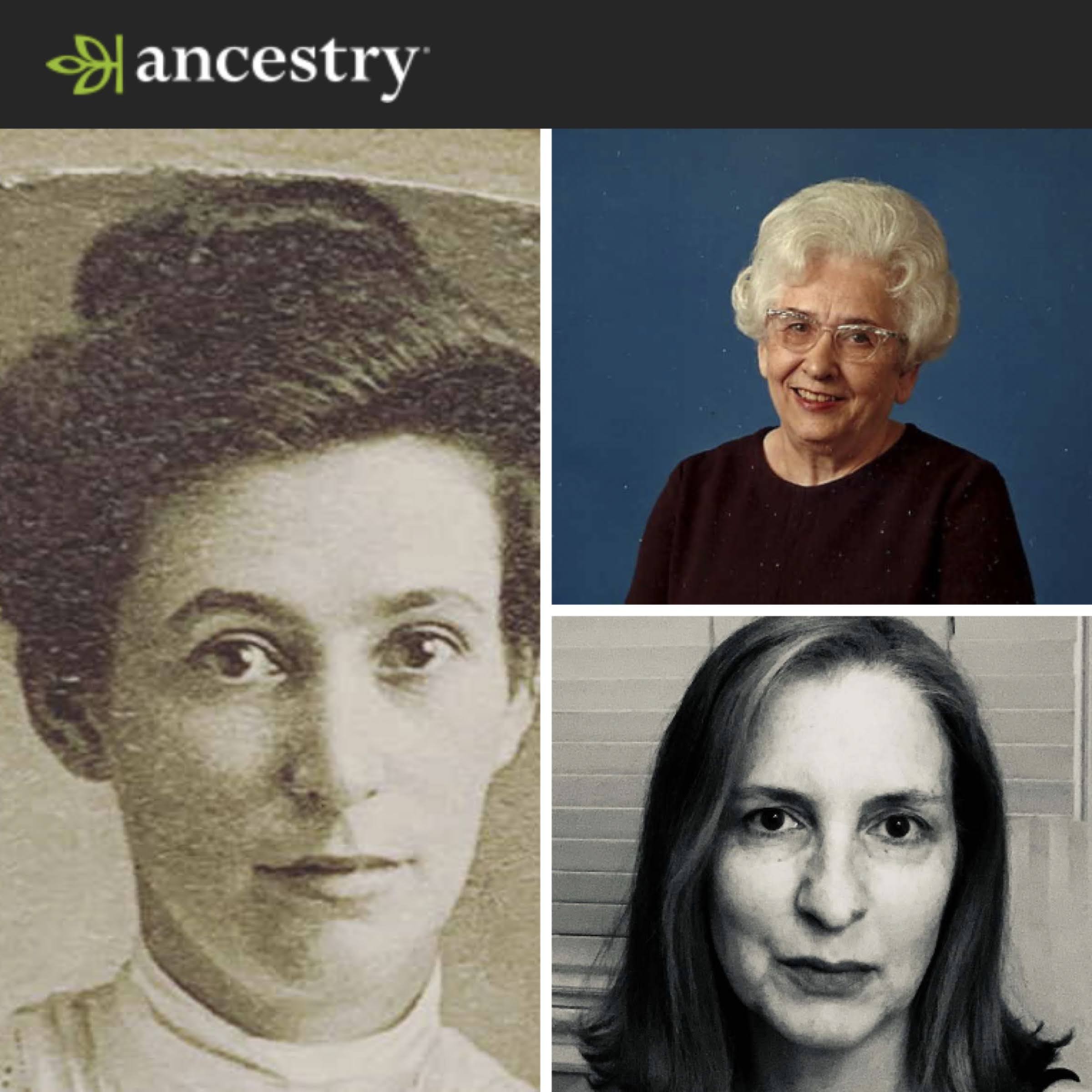
Oh, my Martha Jane. Her story will break your ever-loving heart. She lost her mom when she was five years old. She and her sister were raised by Shakers at Pleasant Hill, KY. Plucked suddenly from that idyllic, utopian children’s life to then carrying the weight of consummate caregiving for a family in crisis.
She was brought to apply all the learning of Shakers care full-time for the family of her eldest sister, Mary Bell Bradshaw Murphy. Martha was thirteen years younger than her sister, who needed help even before her mental breakdown.
Martha Jane broke off a romance after she was scorned by the mother of the man she loved. Martha Jane then married Surber Corman, a young widower with two small children after the recent tragic loss of their mother.
Martha Jane endured burying babies and children from more than one angle. She endured harsh conditions. And, her own tragic end is hard to conceive with the cause of death noted as “2nd & 3rd degree burns over 60% of her body,” according to the KY death certificate.
Traumas and taking on the yoke of someone’s tragedy lives in my DNA. I don’t need 23&Me to tell me that, even if they could. I can think of repeat experiences that fit that depiction.
More on Martha Jane Bradshaw in S1:E 23-E24-E25, coming later.
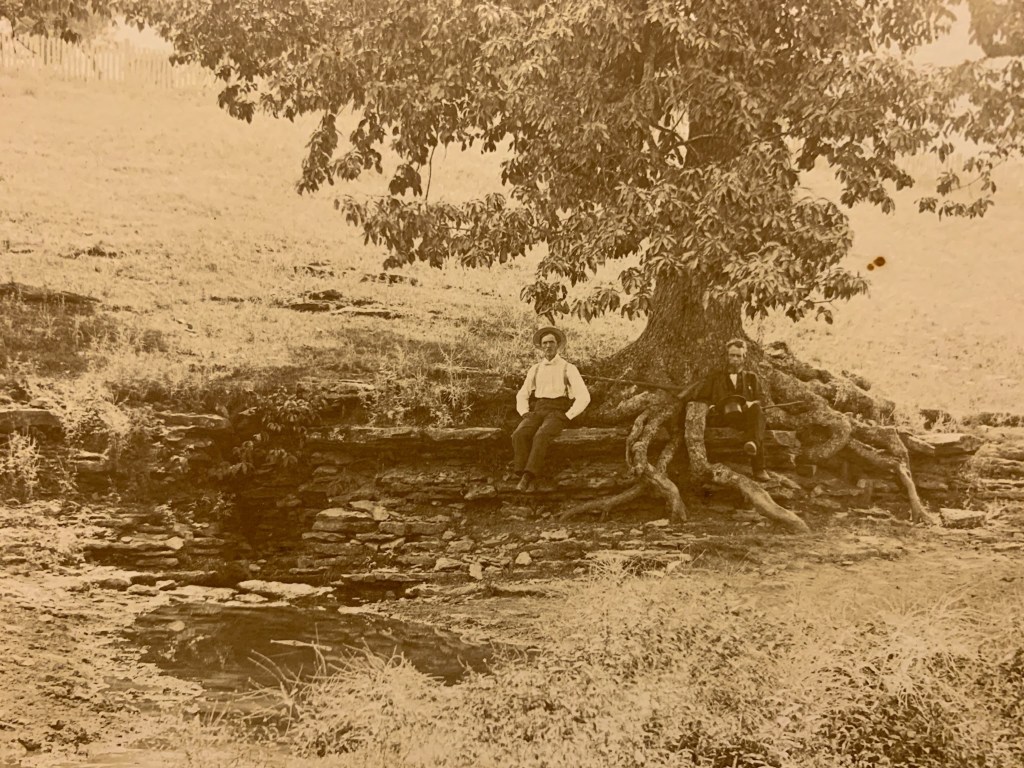
I love this photo. It was taken at the head or spring of Jessamine Creek that I knew somewhat as a child and my father knew as part of his daily life at the old home place. An original of this image is among the family heirloom artifacts I am in the process of documenting, which leads me to wonder if these men are ancestors of mine. The slope of the hillside, stacked layers of limestone formation, trickling water you can almost hear, the majestic shade tree with exposed mature roots like tentacles and brush in the foreground. I easily wax romantic about the richness of the scene. Additionally, this image appears in History of Jessamine County, Kentucky reference found in the Jessamine County Public Library. There are many great resources there.
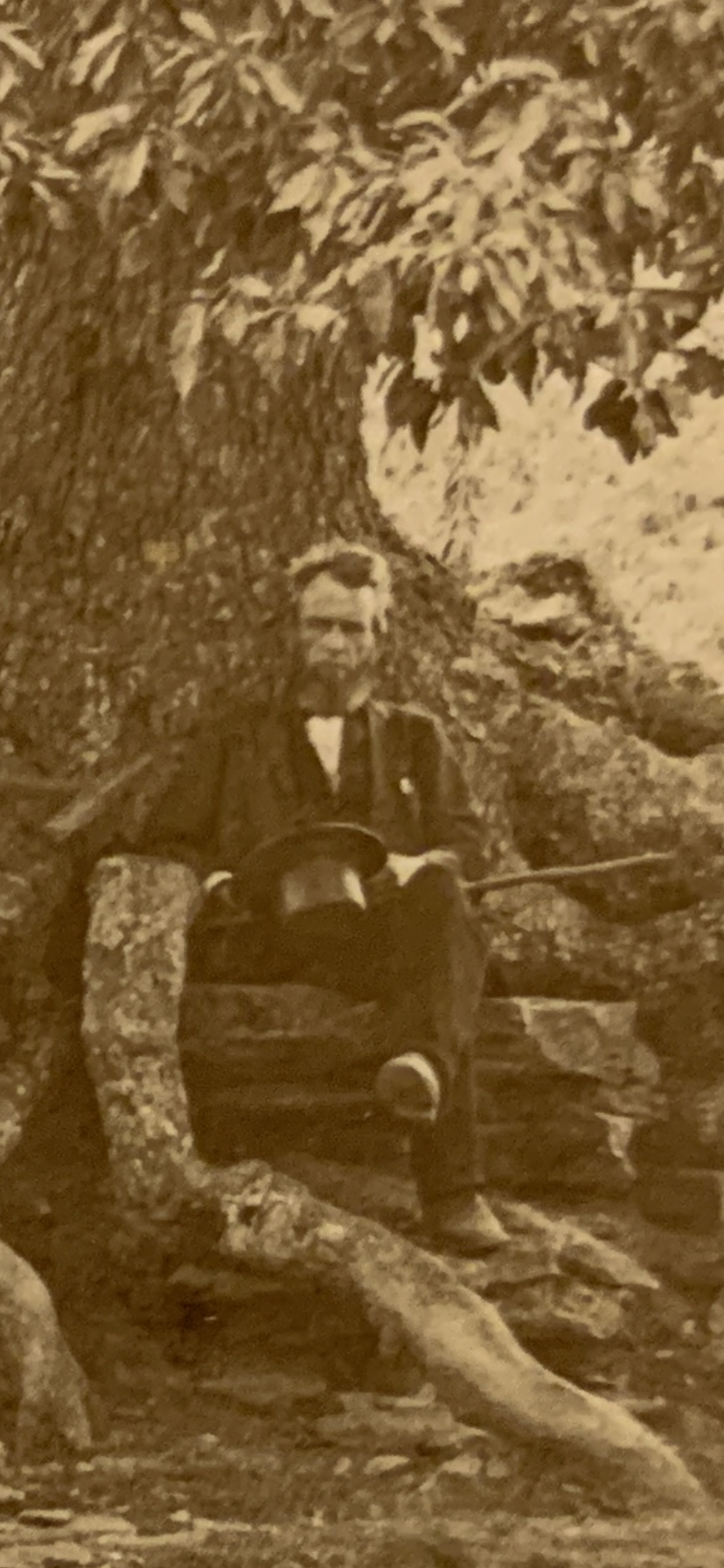
Can anyone help me estimate the date of the image? The original print I have is affixed to a kind of cardboard so I am not risking damage to examine the back for any notes or context. Does the attire of the two men seated amongst the exposed tree roots provide clues? The man in suspenders does not look significantly of any particular time period as white shirt, trousers and suspenders is fairly common men’s attire. To me, the man on the right in his suit and with his hat and cane astride his lap looks reminiscent of Abraham Lincoln but that is not my assertion for it to actually be him. He would need to be squatted well into that spot, if so. There are physical similarities to my ancestor Pleasant Cook but I doubt the alignment of time periods.
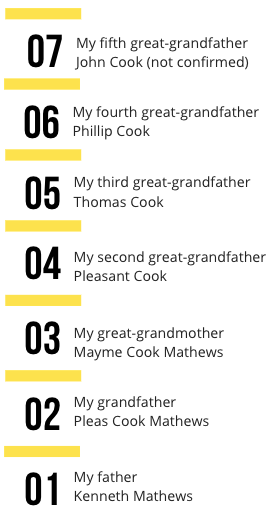
At closer examination of the background milieu, I see the repetition of pattern similar to a fence, a barn and perhaps a farmhouse. I am in the process of determining at what point the land was acquired into our family. A Jessamine County deed recorded in the mid-1800s shows Pleasant Cook (my 2nd great grandfather) purchased 53 acres along Jessamine Creek, among several other sizable property acquisitions. When he died in 1917, the creek property passed to his only daughter, Mayme Cook Mathews, my great grandmother. After her passing, the property was owned by my grandfather, Pleas Cook Mathews.
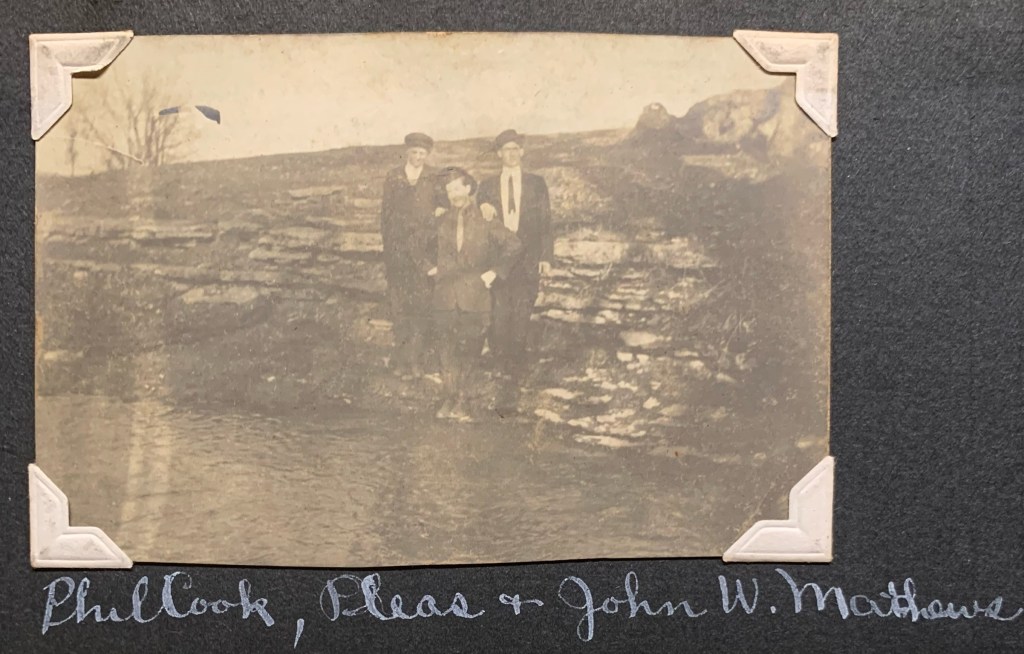
The image below shows my grandfather, his brother and their cousin standing together adjacent to the Jessamine Creek springs. I can estimate this image to be prior to 1917, which is when Pleas left for France in WWI. I wonder if this could have been taken at a special occasion, like a funeral. They are dressed in a way that makes me think it possible.
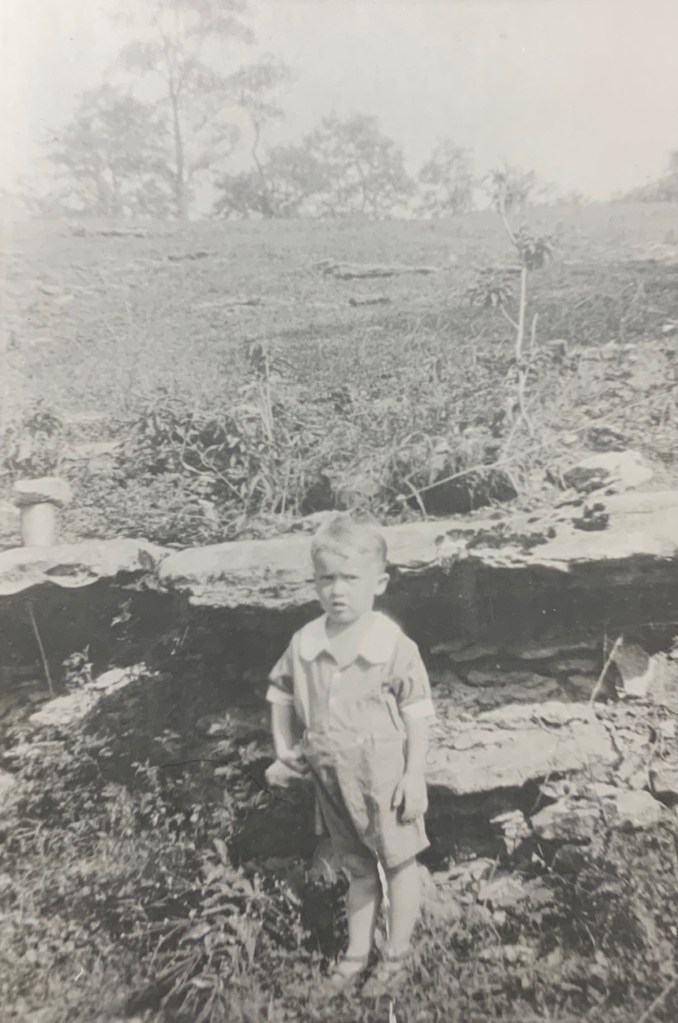
As another in this series, here is young Robert Ira Mathews, my uncle, at the same rocky crag as the other images. This image is circa 1935 based on the other artifacts of the same period. The Jessamine Creek spring was an integral part of my father’s family life growing up on the farm. More of those stories to come…
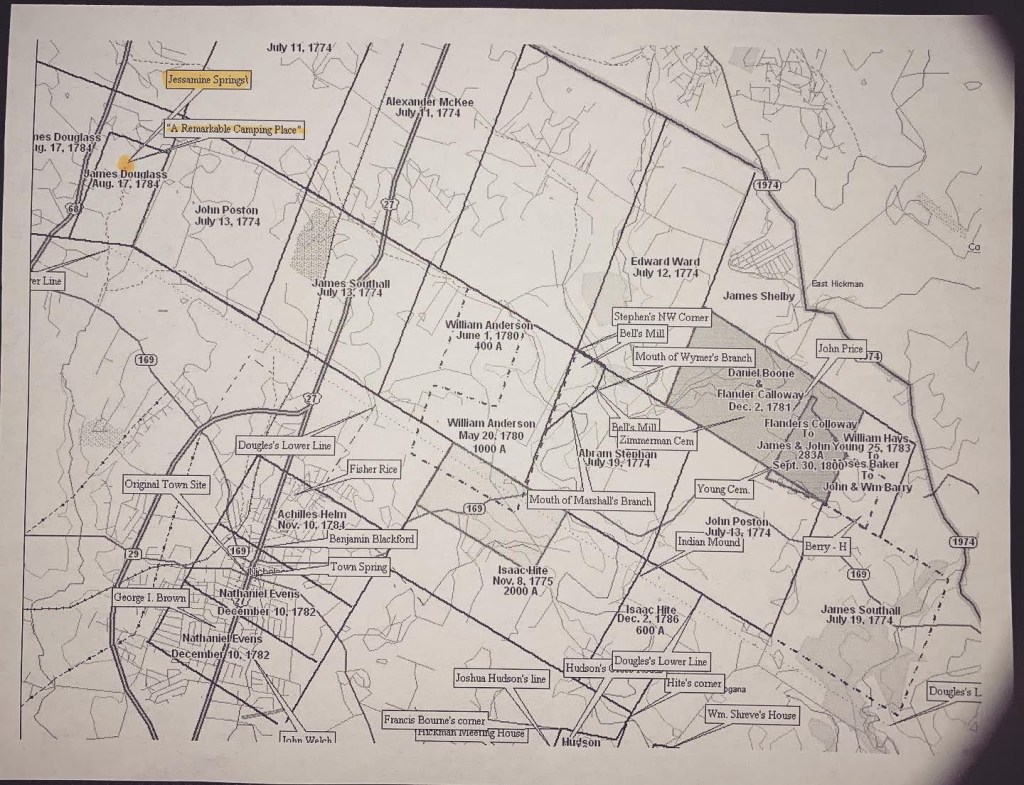
An interesting notation on the survey map pinpoints the springs of Jessamine Creek with “A Remarkable Camping Place” which leaves me wondering – Did Daniel Boone camp at that spot?
I spent most weekends of my youth on the road to and from my grandparents’ house in Nicholasville, so much so that I could follow it in my mind, specifically after exiting I-64 at Frankfort/Versailles. Passing through Woodford Co along that stretch of horse farms leading into downtown Versailles is picturesque. In my adolescent years, I resented having to go but now find myself full circle longing to spend more time in and around the places of my parents’ youth.
Both of my parents were born at home in Jessamine County – Dad, at the Mathews home place, Harrodsburg Road, and Mom, in Little Hickman, near Lock 8 of the Kentucky River. Eventually, they were neighbors on Richmond Road near downtown Nicholasville and as the story goes, he gave her a ride home from work one afternoon.
In 1798, the town of Nicholasville was laid out and named for General Nicholas, while Jessamine Co was created from part of Fayette Co and named for Jessamine Creek. Historical accounts note in 1774 surveyor James Douglass discovered a creek which he named for his eldest daughter Jessamine. Other accounts note the county was named by Col. John Price for the prevalence of Jessamine flowers, also known as jasmine. And, a bit of oral tradition describes a tragic account that Jessamine Douglass, daughter of James Douglass, was sitting alone overlooking a creek when she was attacked by an Indian. There are competing beliefs for the validity of this story and some who debunk it are adamant against its truth. As best I can tell, there is nothing definitive discovered to date but that is somewhat inherent in oral traditions.
Based on artifacts I’ve found, there was a landowner early in the settling of the county named James Douglass. A survey map with notations of Daniel Boone indicates as of August 17, 1784, Douglass owned property adjacent to present-day US-68 (Harrodsburg Road). Part of this property was later acquired by my great-great-grandfather Pleasant Cook and stayed in the family until the late 1960s. It was the home place for my father, his siblings and parents.
An interesting notation on the survey map pinpoints the springs of Jessamine Creek with “A Remarkable Camping Place” which leaves me wondering – Did Daniel Boone camp at that spot?
Credits to: Jessamine County Historical Society map image and the work of countless researchers before me, and to my cousin Jeff Mathews for sharing family artifacts that kickstarted my obsession.
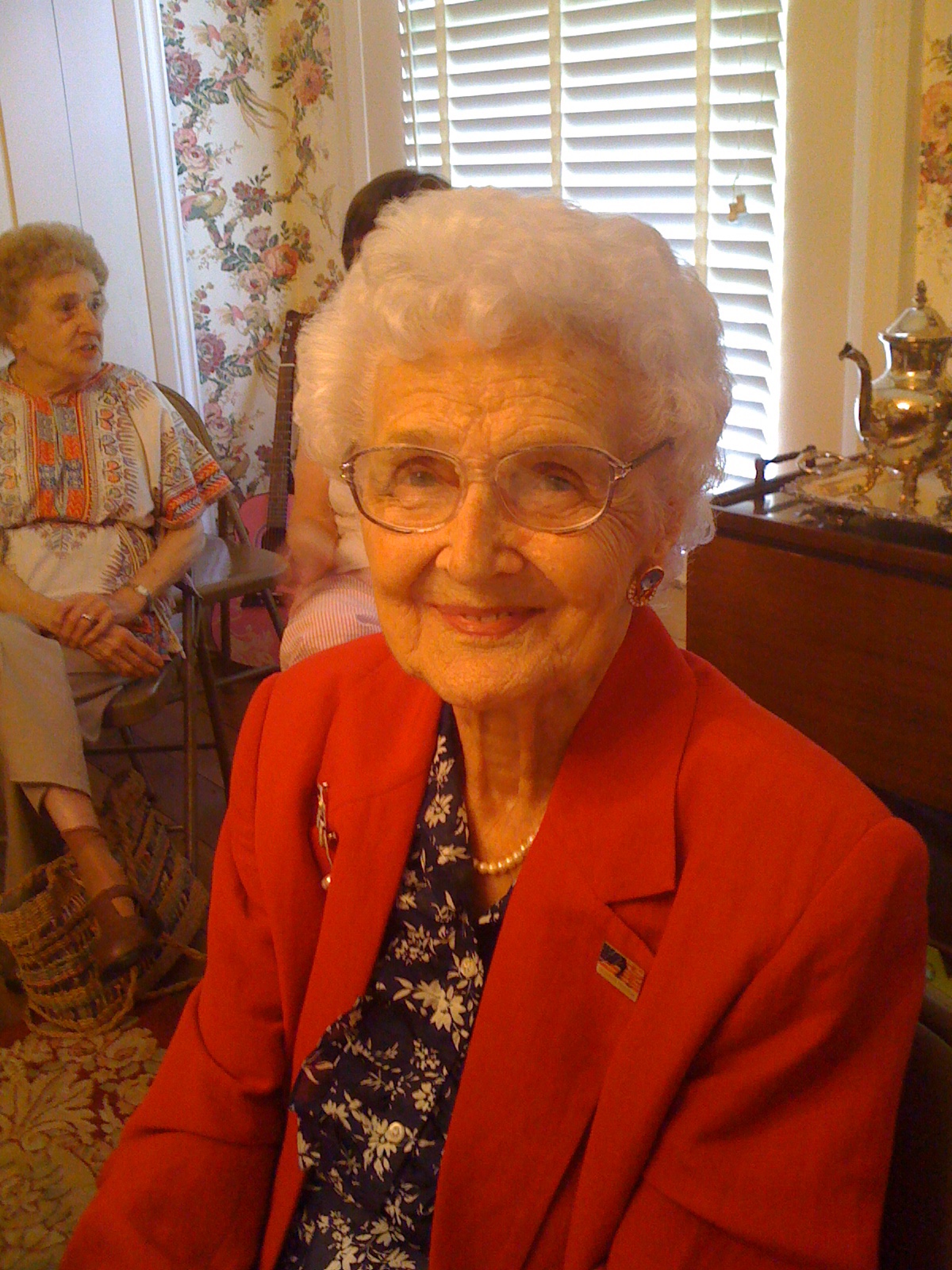
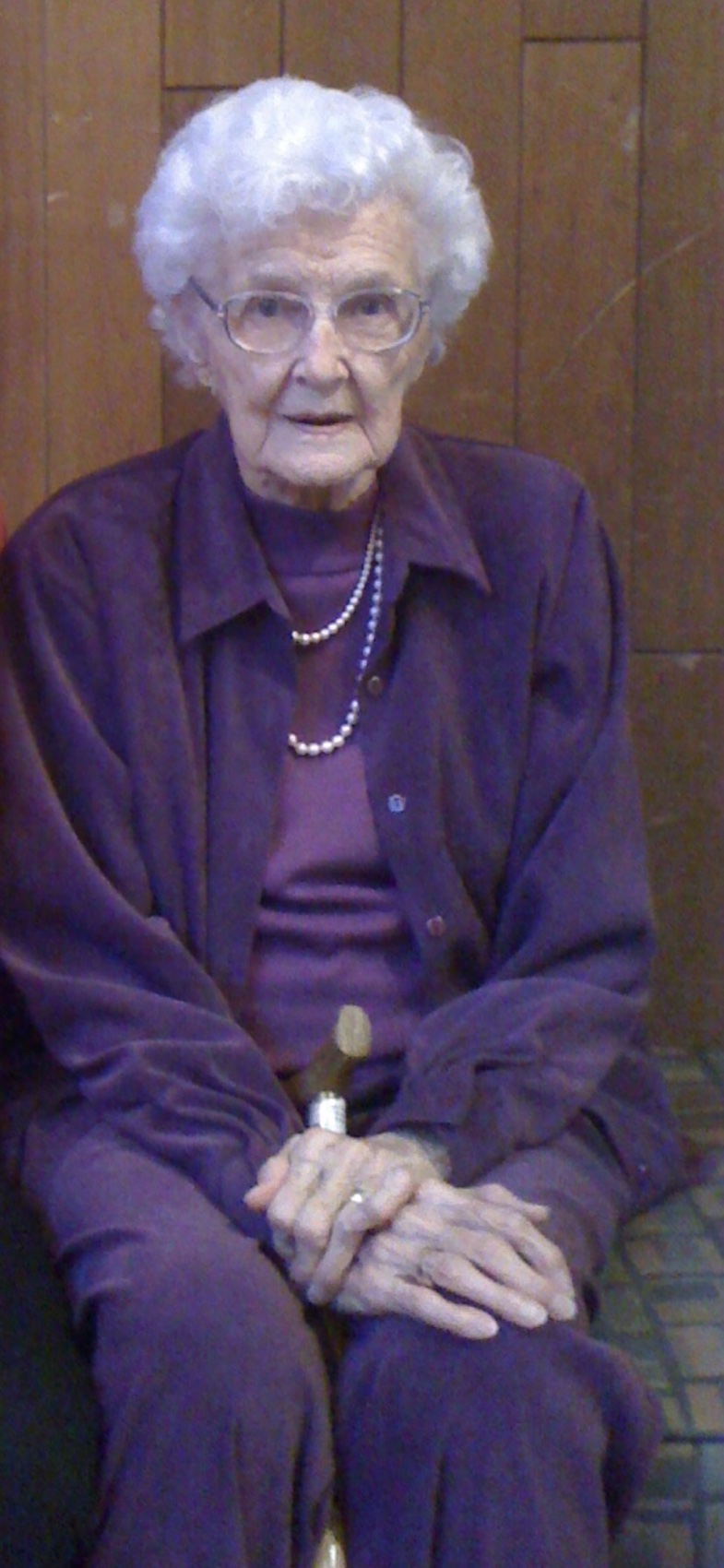
I’ve had many thoughts and phrases, quotes in her own voice floating around in my head these past few days. Cutters’ heart stopped beating Thursday morning. She was at Hosparus, Norton downtown Louisville, having been moved there from my parents’ home the night before due to congestive heart failure. Our family has been together for the funeral and the obituary has been published. Funerals bring families together but Cutters had such a way of doing that in all her living glory.
Her home was a hub of activity. As a guest, you were always offered a glass of sweet iced tea, something good to eat that was usually from the garden. The tea, freshly made that morning and filled to the rim of a signature orange Tupperware pitcher with the matching lid. This was always perched in the same top-shelf position of her pristinely maintained refrigerator. Cutters’ cooking, specifically corn, green beans and homemade bread (more on this later) are the stuff of legend.
Holidays were special and the extended family all looked forward to the tradition of gathering at Cutters’ home to eat dinner and exchange gifts. As our group size grew, we instituted a one-gift, even-exchange policy but Cutters was always exempt from this rule. Each year she had a stack of colorful boxes and she was known to take her time, as if savoring the suspense, when opening each one. She had a quiet meticulousness about her – whether using a letter opener to separate the tape from the wrapping on a gift or how she would keep her Tupperware and cabinets so organized. Her home was a reliable map for mindful intention – everything in its place throughout all the years I visited.
She took this quality philosophy with her on her travels. You could tell Cutters had been in your home for a visit – your pantry became organized, there was a pitcher of sweet tea in the refrigerator and your mayonnaise jar was wiped clean by approximately one finger’s length from the rim all around the circumference. That was a signature move. Wiping jars clean and a metaphor for how she left everything better in her wake. She created with lovely hands ever in motion.
I learned so much about life from Cutters but less from her words and more from how she lived her life. As St. Francis said “Preach the Gospel each day and, when necessary, use words.” She epitomized this. Her pastor spoke that “Violet lived the fruits of The Spirit.” As he read each one, the layers of her were confirmed – Love, Joy, Peace, Patience, Kindness, Goodness, Faithfulness, Gentleness, Self-control.
How did she do it? How did she live to be more than 100 years, as she did? It was only the past year that she appeared challenged by her age. My granddaddy died in 1977 and she survived him all these years living on her own. In her late 90s, she rebounded from two falls that resulted in broken bones and long recovery. She was widowed for 37 years, retired from working 40 years ago and only needed palliative care in her final year of living. I think of the chapters of her life and how I was blessed to be part of the final chapters, especially. Caring for Cutters had a profound effect on my soul. It was a holy experience.
She was born in 1913 – a year after the Titanic sank, for a point of reference. I did not know the young girl who lived to see World War I, the Great Depression, Hitler, World War II, the Korean & Vietnam wars, and modern day conflicts. A farmer’s wife’s life is a harsh one in even the best of circumstances and yet, how did she do it? As my cousin Richard noted in his eulogy, life expectancy for a female born in 1913 was around 55 years. And, as he so beautifully stated, “she did it so well she got to do it twice.”
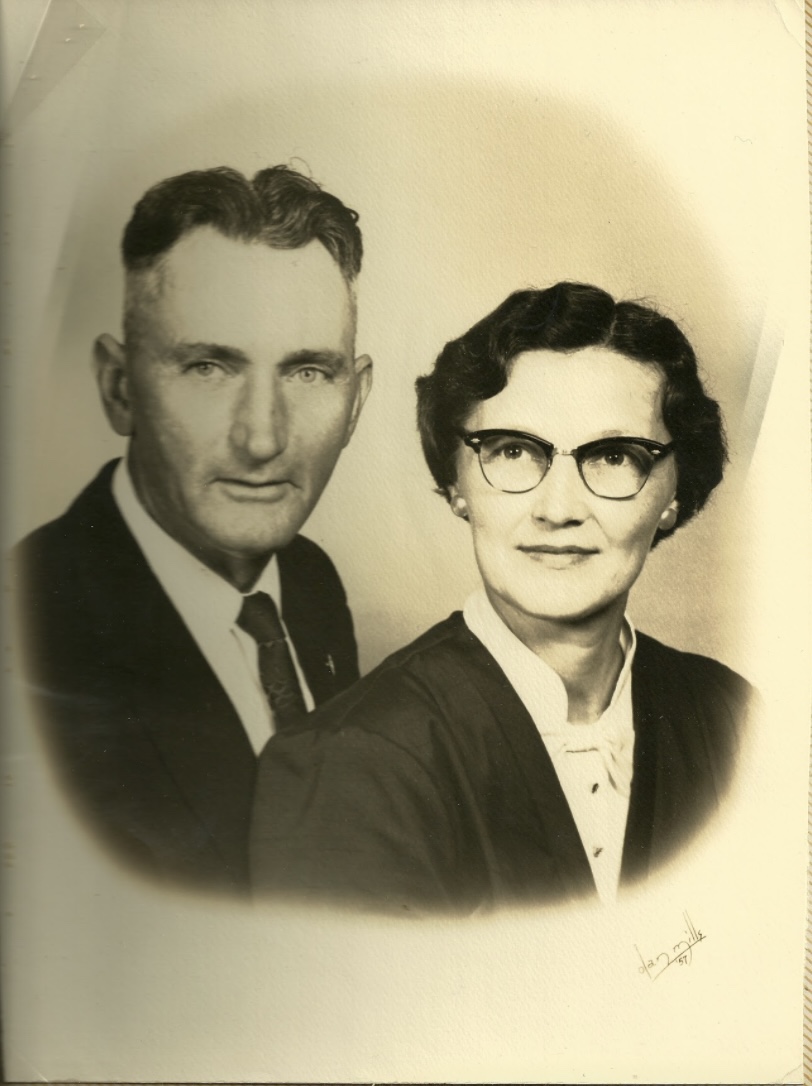
Cutters was one of five children born to Manfred Fayne and Daisy Easley in Jessamine Co, KY. She had a sister, Hazel, and three brothers – Ralph, Ray, and Bill. Cutters and Granddaddy met at their church, Wesley Chapel United Methodist, where she remained a member all her life. In fact, she was born in the house next door to the church on Sugar Creek Pike. They attended different schools but their families knew each other from Wesley Chapel. He was a farmer but later in life, when I knew him, he was a man of many keys as a security guard or something. He would sit with me at the kitchen table and the keys hanging off the ring seemed to always be in motion. I remember playing with them. I was in 4th grade when he died. Our family was living in Pittsburgh, PA and I remember the sting of the late night intrusion by the overhead light as mom woke us to pack up for the sudden trip home. I probably didn’t understand or know why but I am sure I knew it wasn’t good. I can’t remember but imagine it was a longer than usual drive back to Kentucky.
Full circle, here we were back at Hager & Cundiff Funeral Home. Granddaddy’s service was held there in 1977, very soon after my grandmother Fanny Dean Corman Mathews’ funeral, my dad’s mother. That was a hard year for my parents who each lost a parent. Mom didn’t want to move very far from Cutters and Louisville was about as far as she was comfortable. So, Pennsylvania was a stretch of one year that was hard for all of us. My own 4th grade tribulations of that year can be addressed later.
Cutters made this life better for all who knew her, and possibly for those who didn’t have the opportunity. Though her heart stopped, her loving legacy lives on in ways both small and magnanimous. Cutters inspires me to live more as she did.
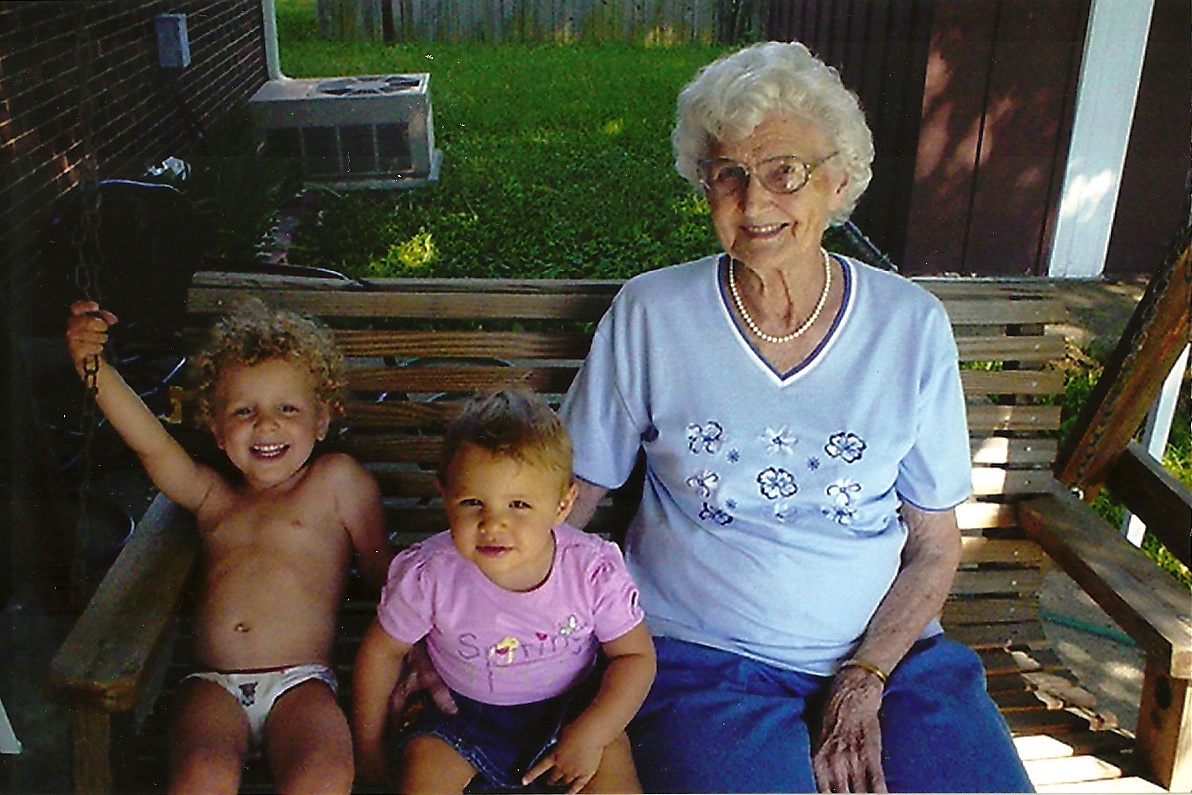
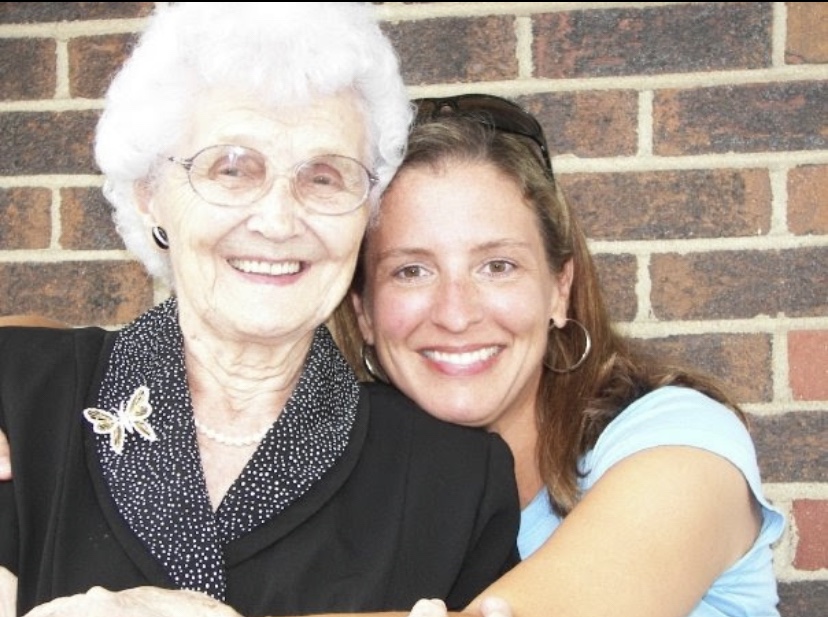
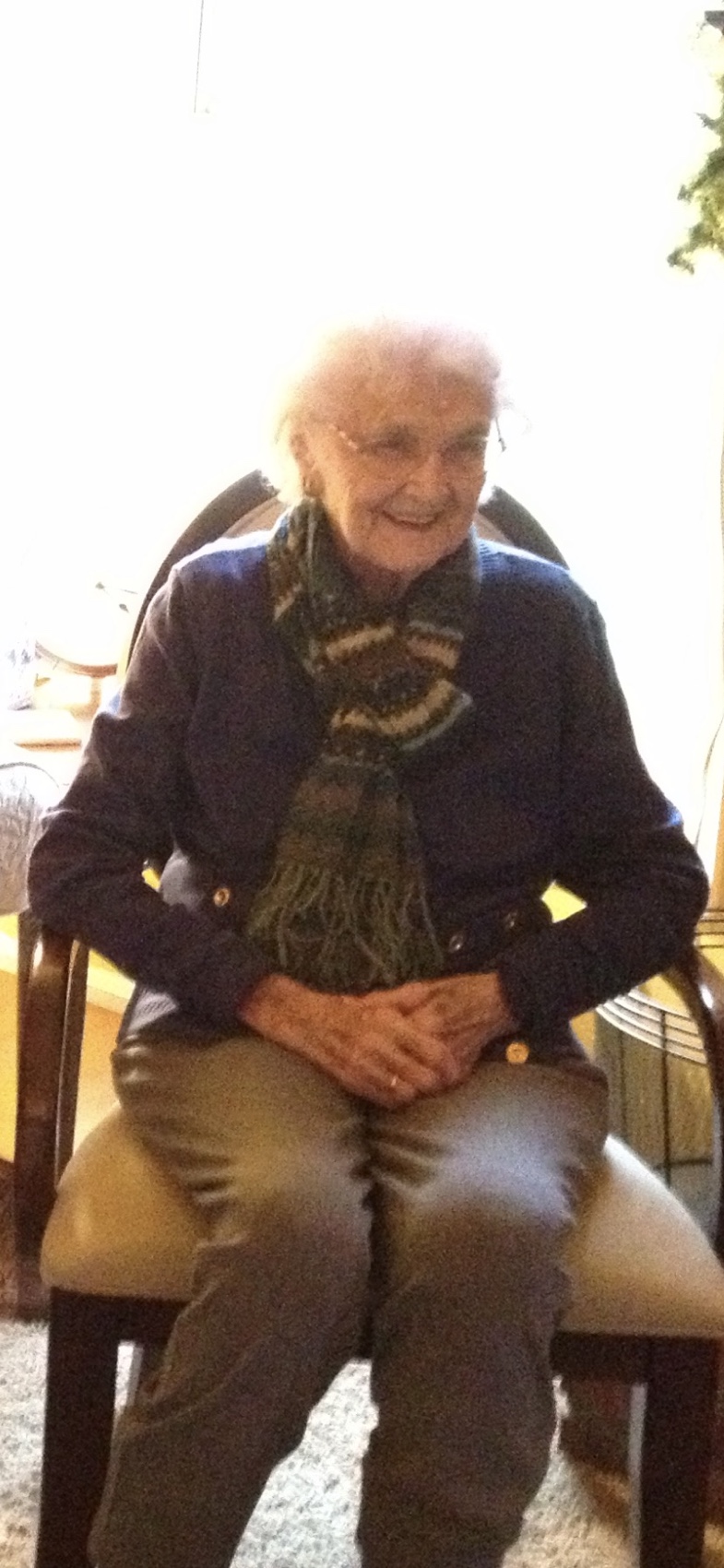
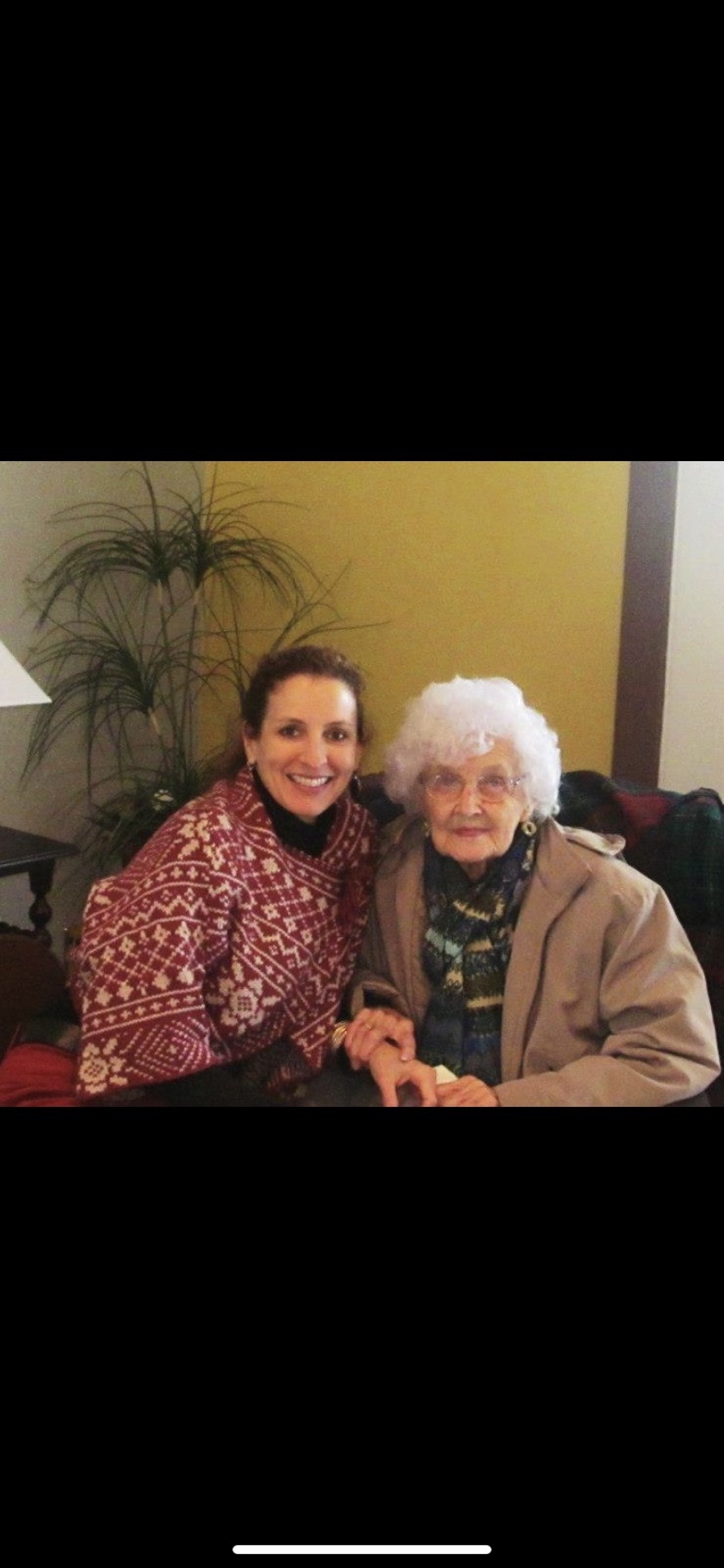
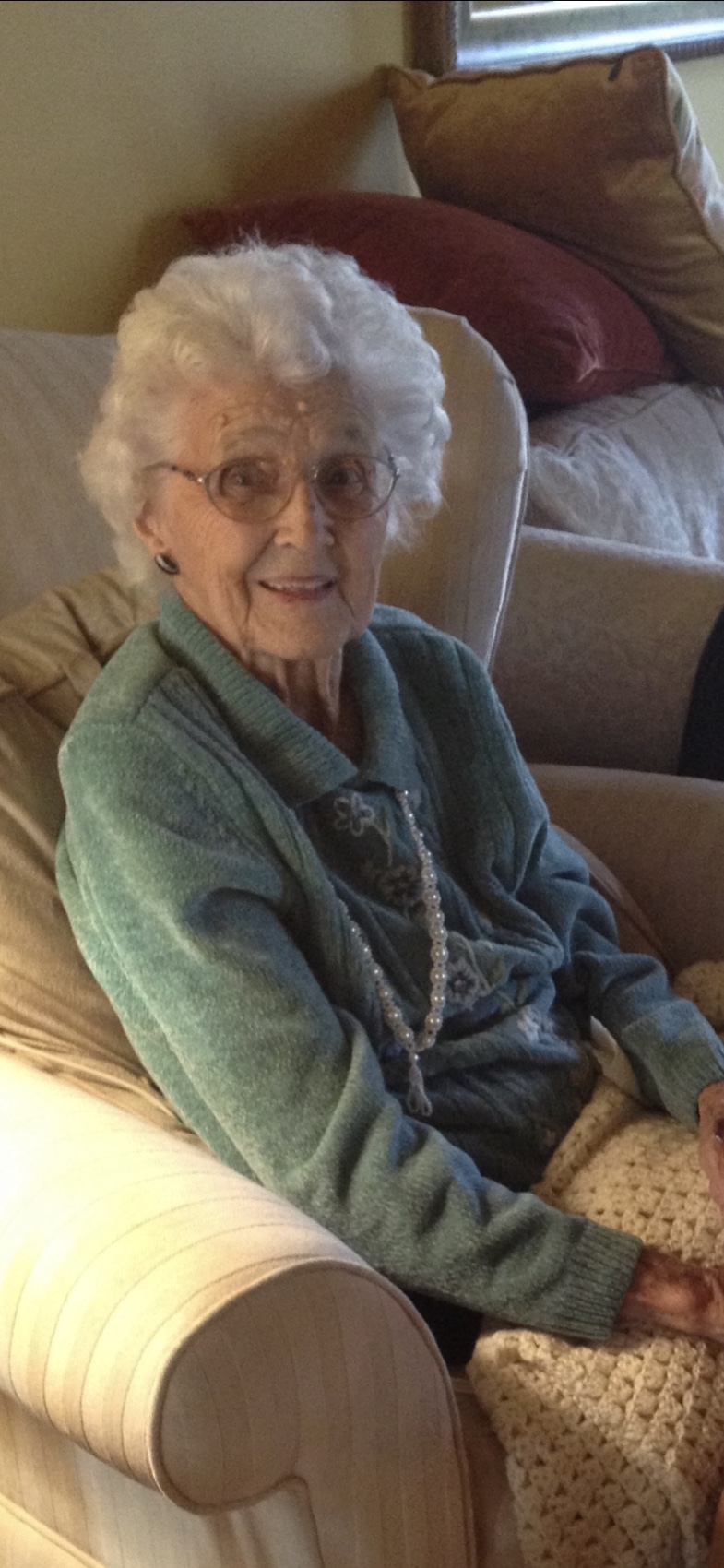
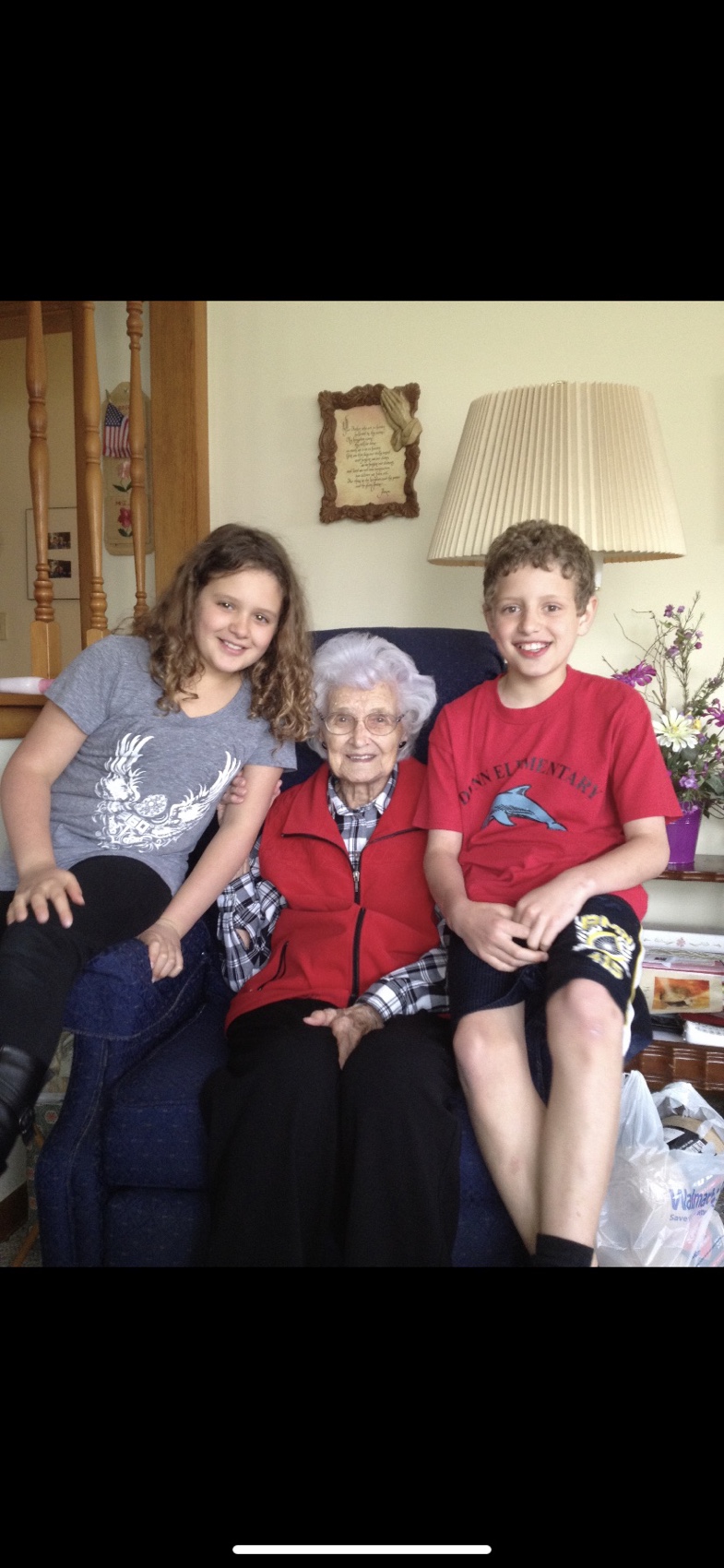
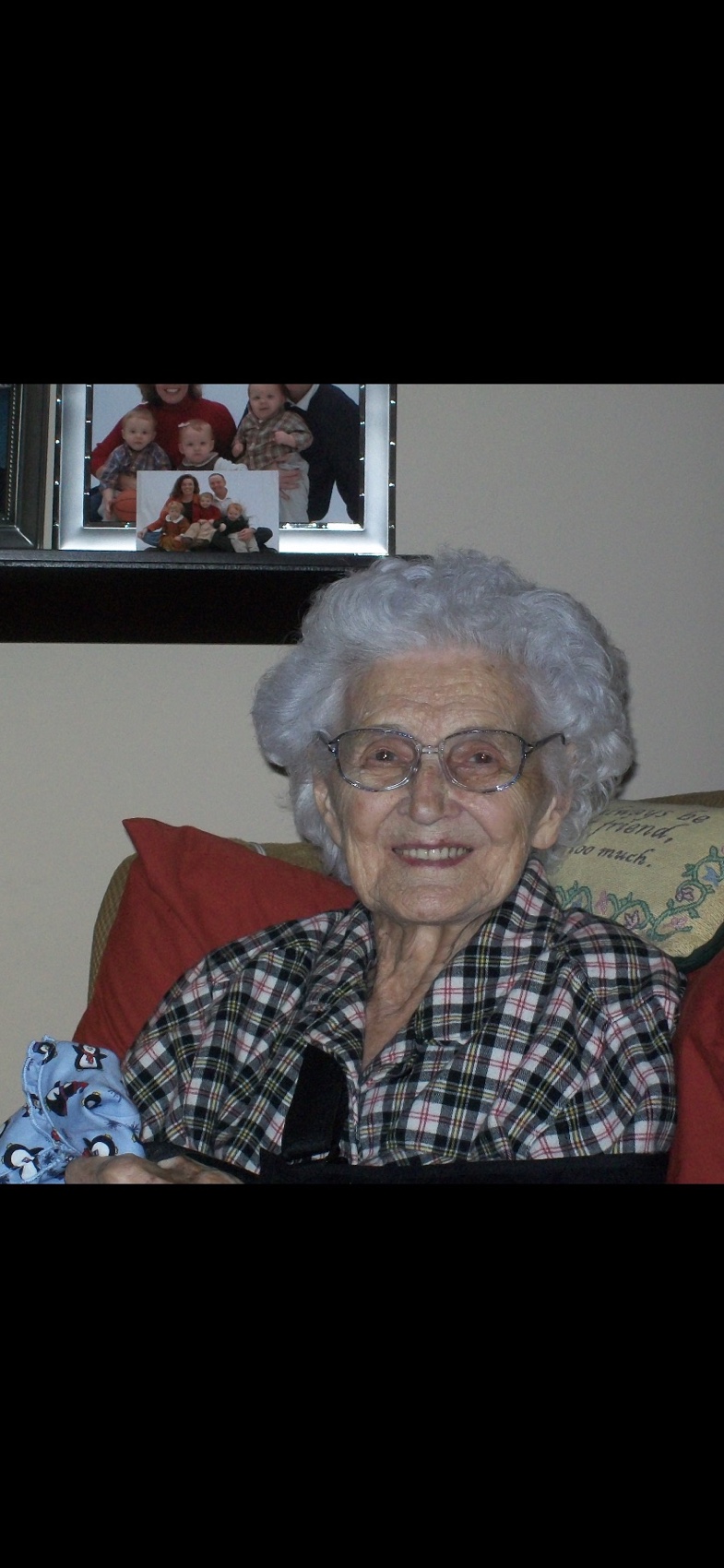
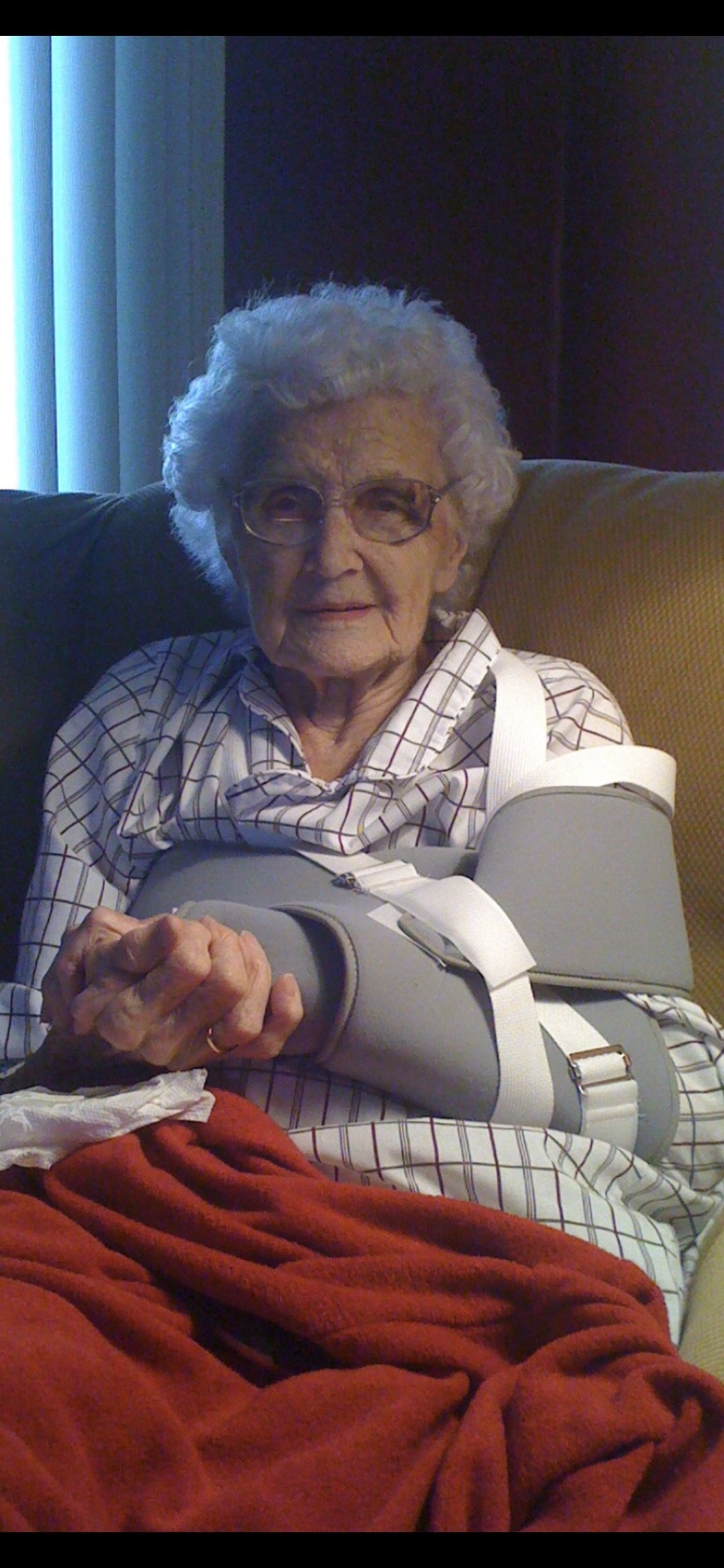
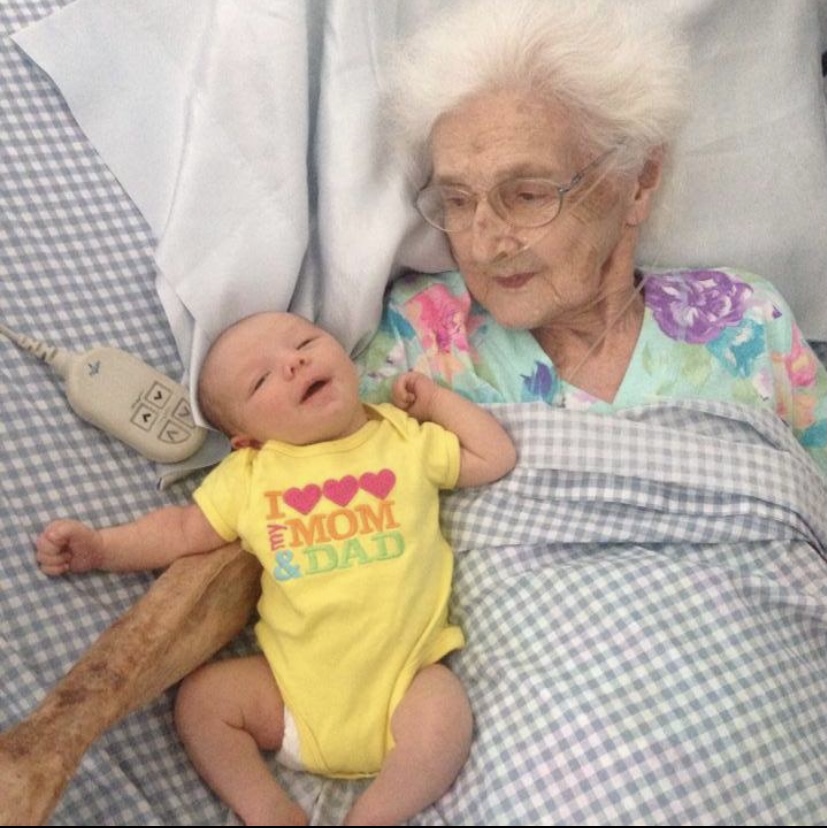
Birthday celebration Camp NelsonMy babies with their great-grandmother on her porch swingCutters with me on her front porchThanksgiving at McCanns’ in CrestwoodMe & Cutters Christmas NicholasvilleBeautiful CuttersCutters & me, family Thanksgiving at Barren River Park resortCutters Thanksgiving CrestwoodCutters telling funny stories to my babies at her home in NicholasvilleCutters visiting the Mathews in LouisvilleCutters at Barren River State ResortRecuperating from a broken shoulderBeautiful VioletClyde & VioletCutters meeting her great granddaughterSome Cutters moments
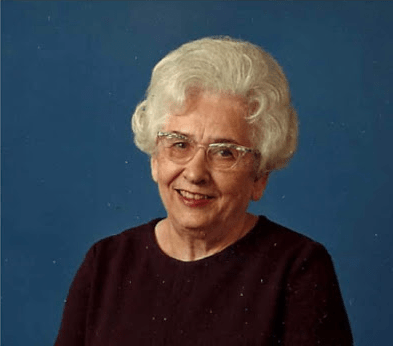
In the mid 1970s, retired school teacher Fanny Dean (Corman) Mathews self-published a compilation of genealogy research she had conducted over many years. The nearly 200-page publication was the product of building on a fellow kinsman’s tree published in 1916 Carlisle PA by Charles Cornman.
When I think of how she conducted her research in contrast to the modern relative ease for finding resources on the Internet, I am all the more inspired by her work and the tenacity that must have been required. She wrote letters – no such thing as email then. [Child, can you EVEN imagine it?] Her focus appears to have been recording the demographic details – births, marriages, siblings, deaths, locations, etc. As it was, she was working with knowledge of two of her own 32 great-grandparents, if not more.
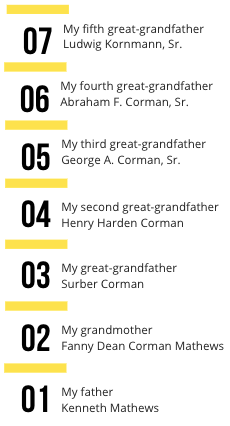
The Corman surname is widely known throughout central Kentucky and has evolved from the original spelling – Kornmann. The pioneer ancestor of this paternal family tree branch was born in 1713 near Munich, Germany. At 24 years old, he emigrated to America – sailing from Rotterdam and landing in Philadelphia in 1737. Ludwig Kornmann, Sr. and his wife were early settlers and eventually, they made a home in Lancaster, PA. Their seventh child served under Gen. Washington in the notorious winter of Valley Forge.
Their eleventh child and my direct ancestor, son Abraham Cornman, Sr., arrived in Jessamine Co, Kentucky and had thirteen children of his own – five of whom are mapped in the two Kornmann-family tree publications. Numerous resources in Jessamine Co KY archival material indicate these Corman siblings lived in the same vicinity on Jessamine Creek three miles southwest of Nicholasville.
As Abraham of The Bible and the stars of the sky, the Abraham Corman family prospered and multiplied. An enclave of German Protestants representing other surnames of my family tree included Earthenhousers, Easleys, Funks, Grows, Rhorers, Rices, and Yosts. These “United Brethren” as they were known were members of the Morovian Church. The original Morovian Church, located on present-day Short Shun Pike, was also the site of a school.
Abraham Sr.’s third child, son George A. Corman, Sr., served as a private for Kentucky’s volunteer Militia in the War of 1812 and fought along with his younger brother, John, in the Battle of River Raisin. John Corman, just fifteen years old, has been cited as firing the first shot at this conflict.
Unlike the families before him, my paternal great-grandfather, Surber, was an only child. This will continue to be a question that I seek to answer in my research. Surber inspired my grandmother Fanny Dean – along with her siblings – to serve as active members of the numerous Corman Family branches quite literally spread out across the United States. The annual Corman family reunion was a significantly attended occasion bringing travelers from near and far. I feel a kind of melancholy that we do not still gather.
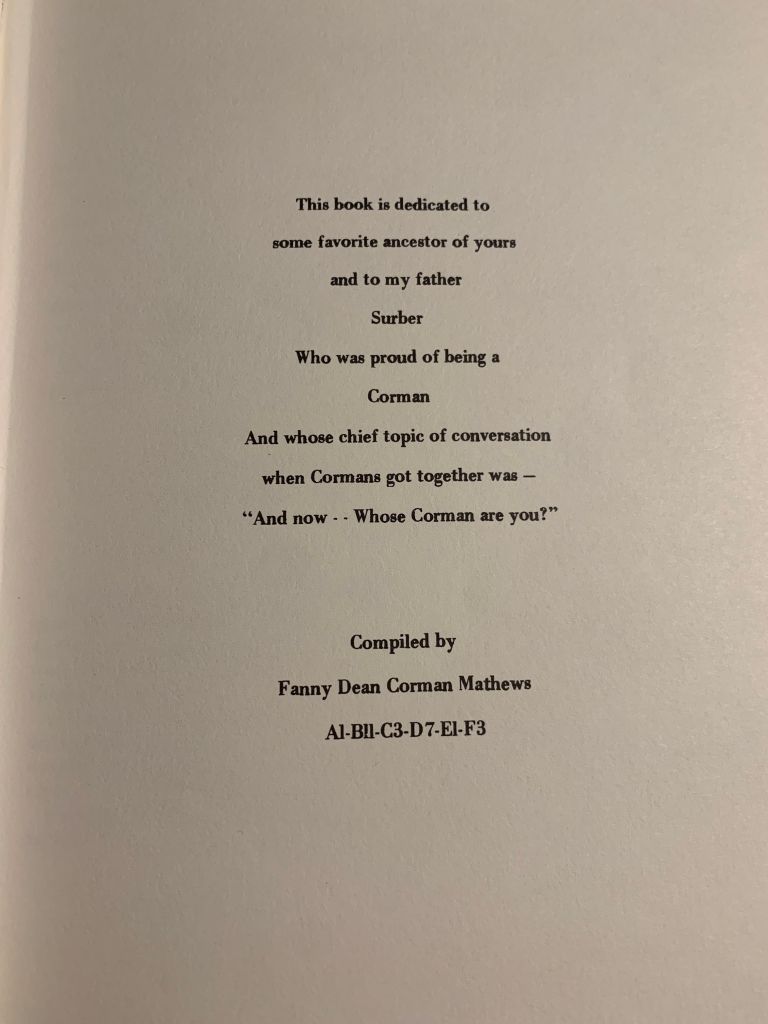
Forward from “Whose Corman Are You?”
“This book is dedicated to
some favorite ancestor of yours
and to my father
Surber
Who was proud of being a Corman
And whose chief topic of conversation
when Cormans got together was —
“And now…Whose Corman are you?”
Compiled by
Fanny Dean Corman Mathews
A3-B11-C3-D7-E1-F3
My grandmother was a voracious reader and I suspect she went to the library far more frequently in a week than to church. I grew up knowing of her book. And, it delighted little me to no end that my name and the names of family members appeared in the book. It was big in my little world and I was somebody in a way that had not been validated as such before. Fast forward to today, this publication has taken on a different significance. It is a road map. With fresh eyes, I read Fanny Dean’s call to action on the inside cover, I think of the 128 individuals that were my fifth-great grandparents and all their stories. It excites me to think of all the possibilities waiting to be discovered.
As if her own voice speaking these words to me –
“It is hoped that this information will make it easier for anyone who wishes to carry the work further.”
My family’s immigration stories appear not to be those that passed through Ellis Island. This was surprising to me. In my youth, I made assumptions because I did not know any differently. Scenes from The Godfather films, also recently, Hitch, books I’ve read, and other lessons learned in school, painted mental images of some wide-eyed young European family passing slowly along into the harbor in the shadow of Lady Liberty. I allowed myself to conclude that eventually I would research the archived immigration resources for revelations that would confirm my imagined narrative.
I base all my research on the premise “if what I have pieced together is accurate.” I am learning – as I attested above – I have a tendency to conclude with little evidence and sprinkle that with romance. Then, BOOM. Fortunately, the tools of modern genealogical research satisfy the other side of my dichotomy – the need for facts.
Therefore, if my research continues to be affirmed, my ancestors arrived to Kentucky in the late 1700s to early 1800s most directly from North Carolina, Pennsylvania and Virginia. Indeed, these families were among the earliest settlers of Kentucky. Some likely traveled Daniel Boone’s Wilderness Trail when the clearings still held those aromas of newly felled wood and freshly turned soil. Ultimately, I am finding these families lived and farmed predominantly in the central or Bluegrass region of Kentucky. You can’t get much more romantic than that.
My goal continues to be discovering the facts, sharing revelations and stitching these together with romance in bringing my ancestors’ stories to life. I welcome you to follow along.
lessons deeply, profoundly echoing through generations.
Resonating over 130 years,
So dance on you dervish
whirling to the glory of all
before, after, below and above
proof for what we carry in our DNA.
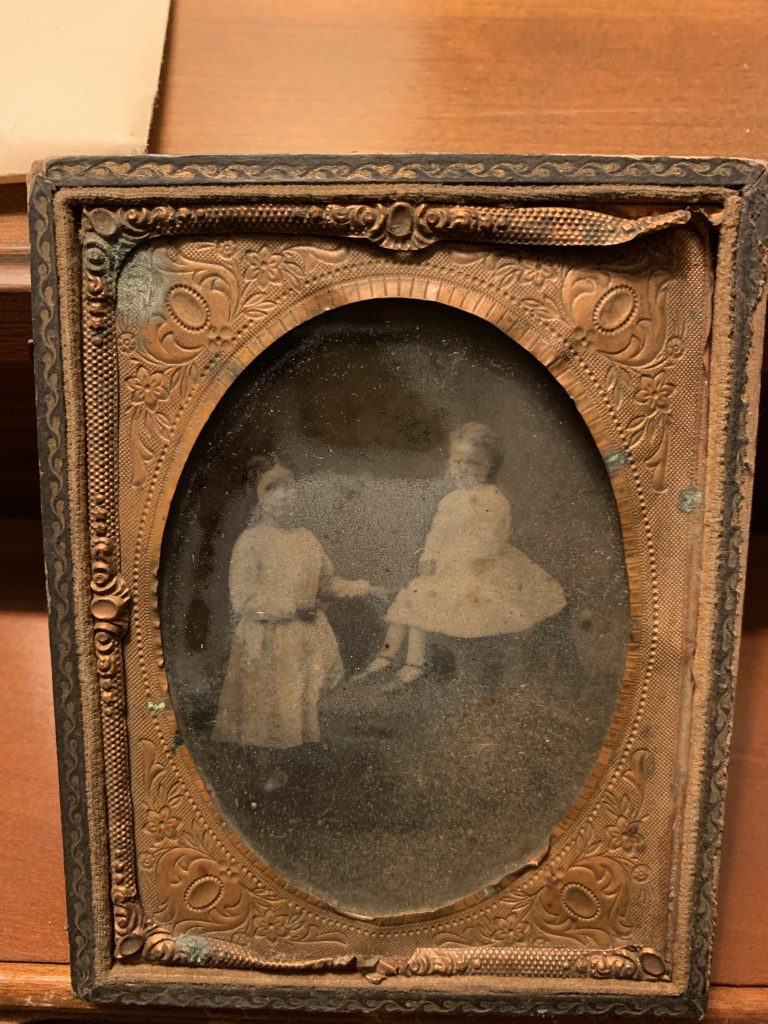
Sisters Martha Jane Bradshaw and Susie “Mattie” Bradshaw, estimated soon after the 1886 death of their mother, Frances Jane Murphy Bradshaw (framed in copper with all elements fused together such that the image cannot be separated from the packaging that is potentially more than 130 years old)
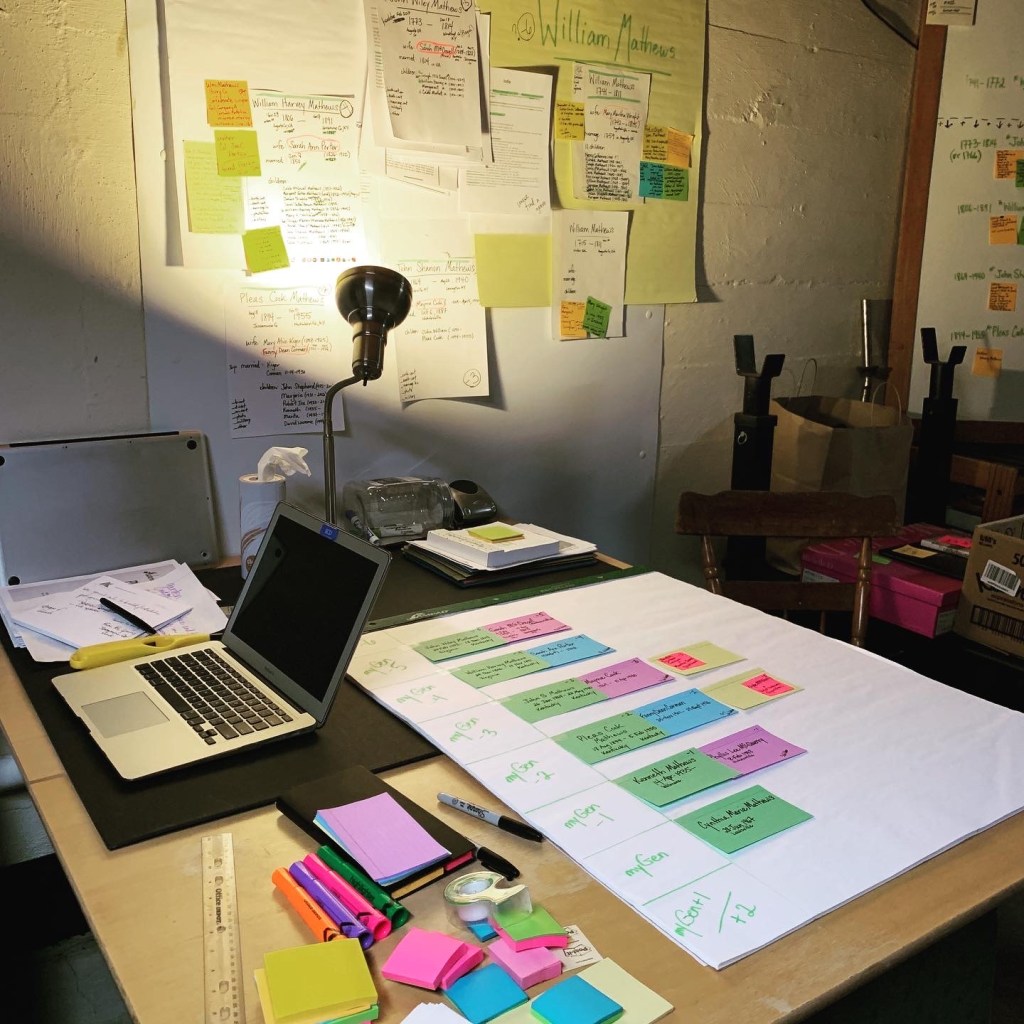
The scope of this current project (updated August 2022) is the result of 12 years active research and 3 years in earnest. Ancestry.com has been an invaluable tool both for discovery and organization. The scaffold is set. I am confident in the fourth- and fifth-generation connections and have acquired enough formal documentation to support the validity of research to all eight sets of great-great grandparents.
The next phase of research is to build the narratives to better understand the lives of these ancestors. And, to dig even deeper with confidence in reaching the far branches. Gratitude for the modern advances and tools.










 that Kentucky girl