
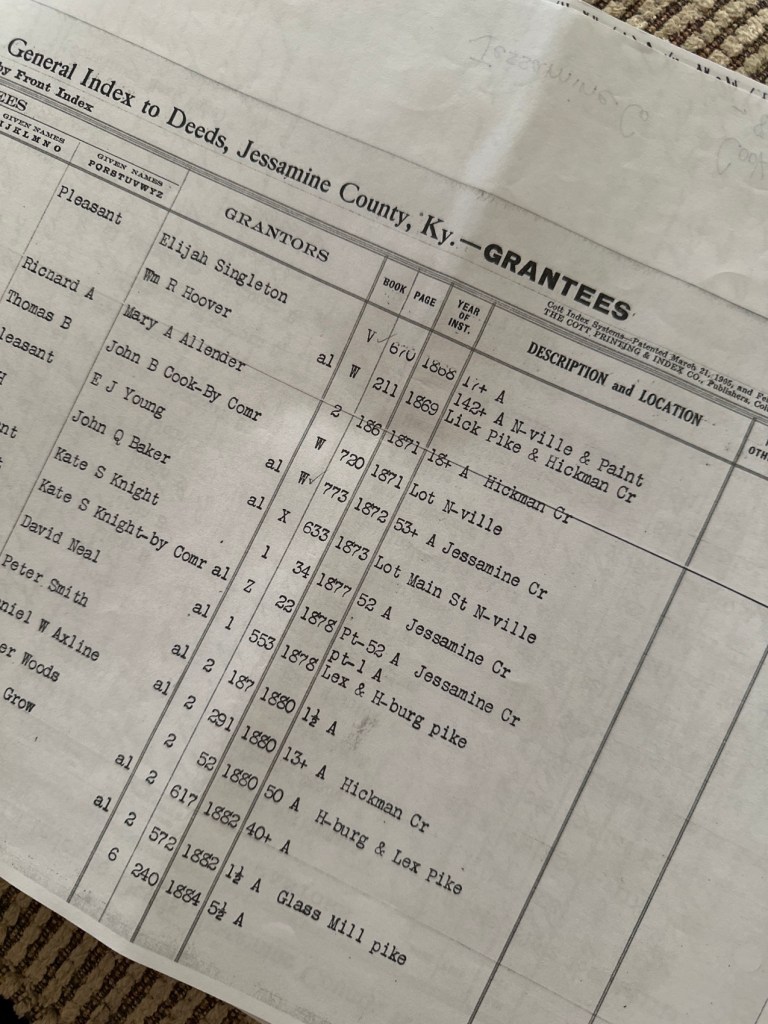
In the earliest of legal records, you will find a certain style of handwritten accounts when transactions became legally binding. Surprisingly few scribbled errors to which I give mad respect, particularly imagining a quill and ink well as the tools. Esoteric terms and colloquialisms in cursive on big pages can be overwhelming at first. Thankfully, at some point, there was a transition to typewritten records, as you see in the photo above, when later those earliest records were indexed.
Make a list using indexes
Here are some things I learned as I fumbled my way through my first visit to a county clerk land office. It happened to be Jessamine County County Clerk’s land records office located in the courthouse, downtown Nicholasville, KY. We arrived on a day when a wonderfully helpful fellow researcher offered up tips. She was in the office for title research and could tell I was without a clue. Soon, I got the basics and took off, as did Dad who wanted to walk around the town a bit. We were both happily engaged in our pursuits so it was a win, win.
First, I learned these indexes are listed alphabetically by surname groups. I started with my parents’ names and opened the Grantee records index first. From these indexes, I was able to note the names of the parties, the year recorded, a Volume and Page reference and a brief description. Usually, this was an acreage notation in the index, if a land record.
After jotting down my list of those references, next I turned to the bound records index of the Grantors – a different set of books. The two sets of lists served as my road map for moving forward in the research. I learned a great deal by trial and error.
Ledger volumes
In essence, you work backwards from the Indexes by compiling a listing of name/volume/page references. Next, to locate the full language of the record, you go pull out the respective volume. The deed records themselves were handwritten on tabloid-size paper and bound into large, heavy volumes. Records were captured chronologically within these oversize ledgers.
In each of the counties I have visited to research, the ledger volumes are stored on open shelving. Some storage space is limited and the older records are not as accessible or prominent. Because I could not possibly stay the length of time it would take to transcribe these resources, I needed to make copies.
Be prepared for a self-service situation in both reaching shelves and copying pages. The preservationist in me was especially careful in handling what was at times a delicate situation with pages showing wear and tear from the years.
My personal preference is to have actual size copies but it is more common to get reduced size pages. Take cash with you for any copies you make. At this time, capturing cellphone images is against Kentucky law so don’t try. This is precisely why I do not have an image to share of the impressive shelving of resources. You just need to go check it out yourself, in person.
One thing I find interesting is how the records have evolved. This county began with Book A~Book Z, then numeral 1 and forward. When you see these listings and references in research, it is safe to assume the oldest records are in volumes at the beginning of the alphabet. It may be helpful to find out what year the county was founded. The evolution of Kentucky’s current 120 counties from the original 3 counties can make this aspect of research a bit daunting. Stick with it, I say.

 that Kentucky girl