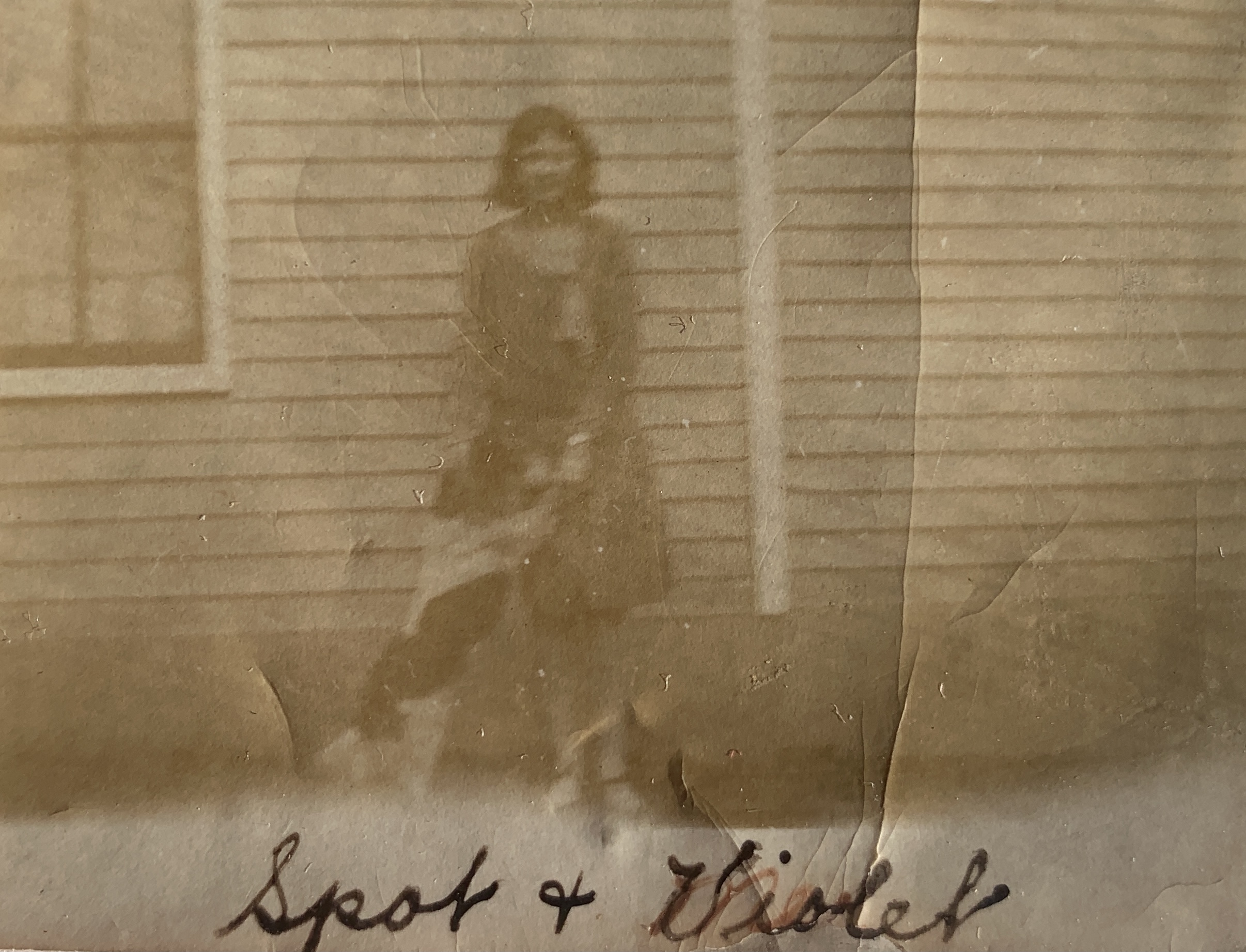
Spot, the Faynes’ farm dog, from my grandmother’s youth. Violet Fayne and her family lived in and around Little Hickman along Sugar Creek Pike in Jessamine County. She was the middle sibling of the five children and was born in June 1913. If she was still living at home when this photograph was taken, it would be circa 1924-1929.
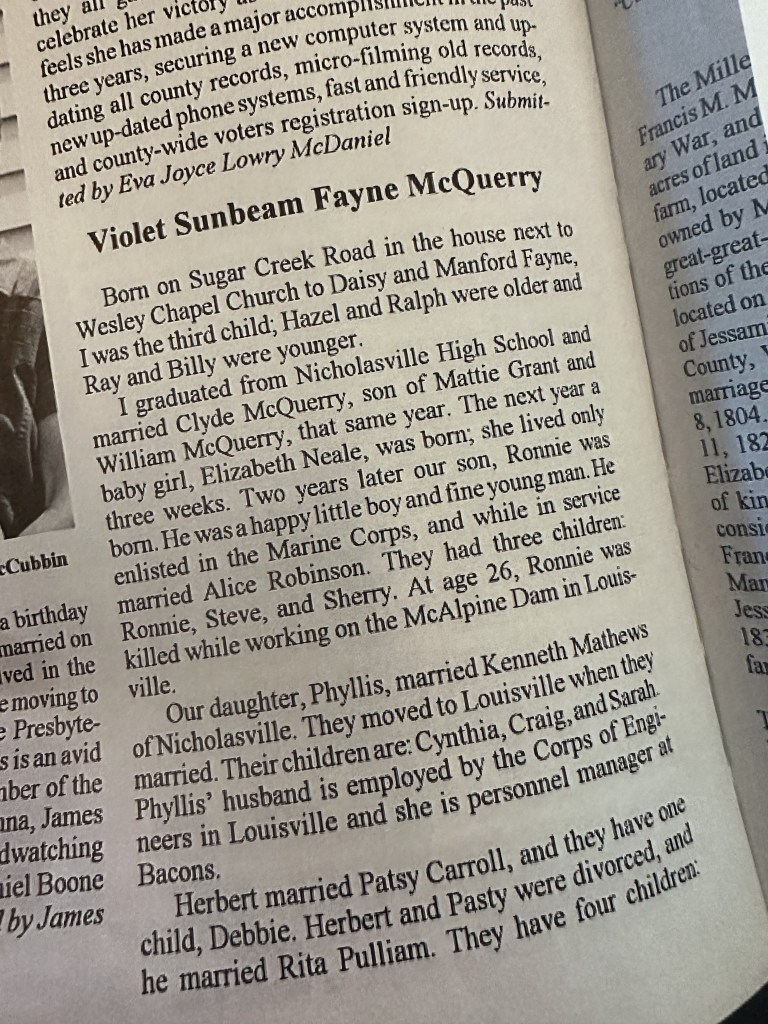
A resource* housed in the Jessamine County Public Library on Main Street, Nicholasville, KY, was published as a commemorative Jessamine County history and included individual citizens’ written accounts. My grandmother, Cutters, contributed her own biography which was included in this publication.
What I find funny or ironic is that whoever proofread or otherwise made an editorial decision about spelling made one critical error. This error is a longstanding point of discussion among our family.
At the end of her biography, Violet cites her nickname. Anyone who knew her called her “Cutters” but some would mistakenly say “Cutter” much to the chagrin of the ones who say “Cutters.” She would never have written it incorrectly. Someone made that typo in the final printing.
Violet Sunbeam Fayne McQuerry
Born on Sugar Creek Road in the house next to Wesley Chapel Church to Daisy and Manford Fayne, I was the third child; Hazel and Ralph were older and Ray and Billy were younger.
I graduated from Nicholasville High School and married Clyde McQuerry, son of Mattie Grant and William McQuerry, that same year. The next year a baby girl, Elizabeth Neale, was born; she lived only three weeks. Two years later our son, Ronnie was born. He was a happy little boy and fine young man. He enlisted in the Marine Corps, and while in service married Alice Robinson. The had three children: Ronnie, Steve, and Sherry. At age 26, Ronnie was killed while working on the McAlpine Dam in Louisville.
Our daughter, Phyllis, married Kenneth Mathews of Nicholasville. They moved to Louisville when they married. Their children are Cynthia, Craig and Sarah. Phyllis’ husband is employed by the Corps of Engineers in Louisville and she is personnel manager of Bacons.
Herbert married Patsy Carroll, and they have one child, Debbie. Herbert and Patsy were divorced, and he married Rita Pulliam. They have four children: Michelle, Macon, Tracy, and Brooke. Herbert enlisted in the Army for three years. Prior to his first married, he worked for IBM and upon his return from the Army, he returned to IBM and was transferred to Oklahoma City, where he met his second wife. He is presently employed by Eastman Kodak Company and lives in Nashville.
I worked in Martin’s Department Store in Nicholasville for seven years and retired from Montgomery Ward Credit Department in 1978.
My husband died in 1977 at the age of 69. With my seven great-grandchildren, my church, and volunteer work, I lead a very rewarding life. Everyone calls me “Cutter.” Violet F. McQuerry
Excerpt from Jessamine County reference (*will update this post when I find my notes with the proper citation). Newbie researcher lesson.
The example here gives me pause as I research genealogy archives. Records are only as reliable as the occasional human error and typos. This is ever in my mind as I try to distinguish the “Mathews” from the “Matthews” as well as when they are one and the same. I am not deterred.
“Everyone calls me Cutter.” Ummm, nope. Just those that don’t know better.
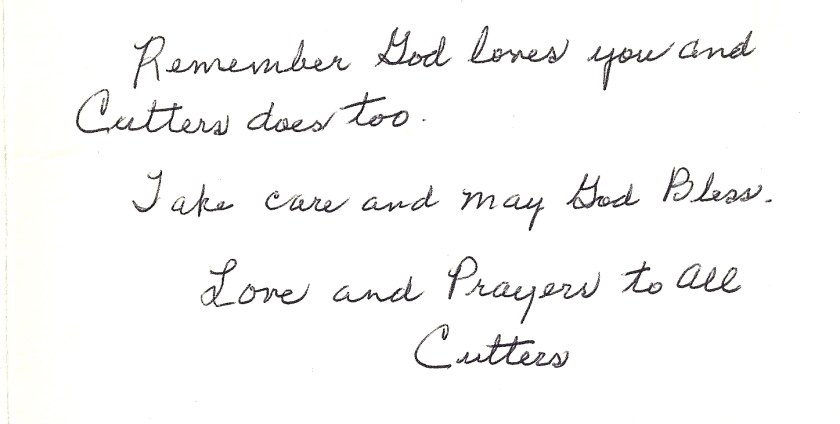
Violet McQuerry became Cutters in her grandmother years. She had a knack for keeping up with birthdays. Like me, cousins would receive a sweet, greeting card each year with a handwritten note in which she would wish happy birthday and provide a slice of life couple of paragraphs from her world. Friends coming to call, the weather and the like.
I remember many years she enclosed a check, never more than $5 or $10. At some point, I stopped cashing them because I liked having the check, itself. This was well before mobile deposits and the thought of forfeiting the money never outweighed wanting to keep her gift – just as it was. Invariably, she ended her notes with a signature. Not just her signed name, I mean. Her signature appears below:
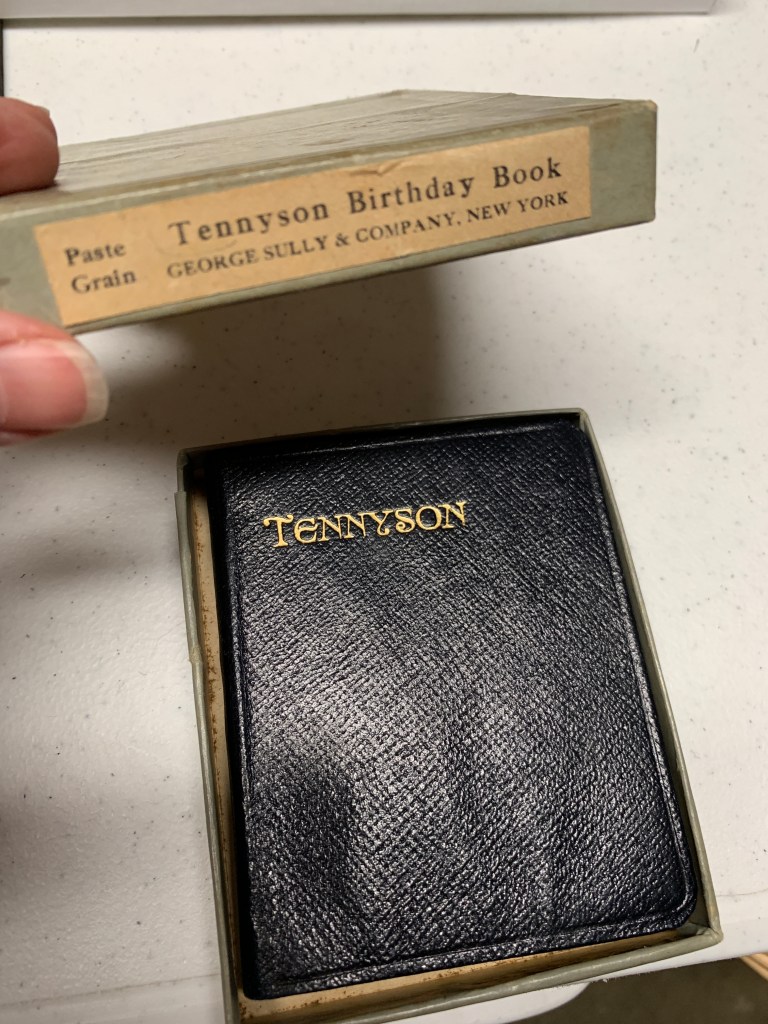
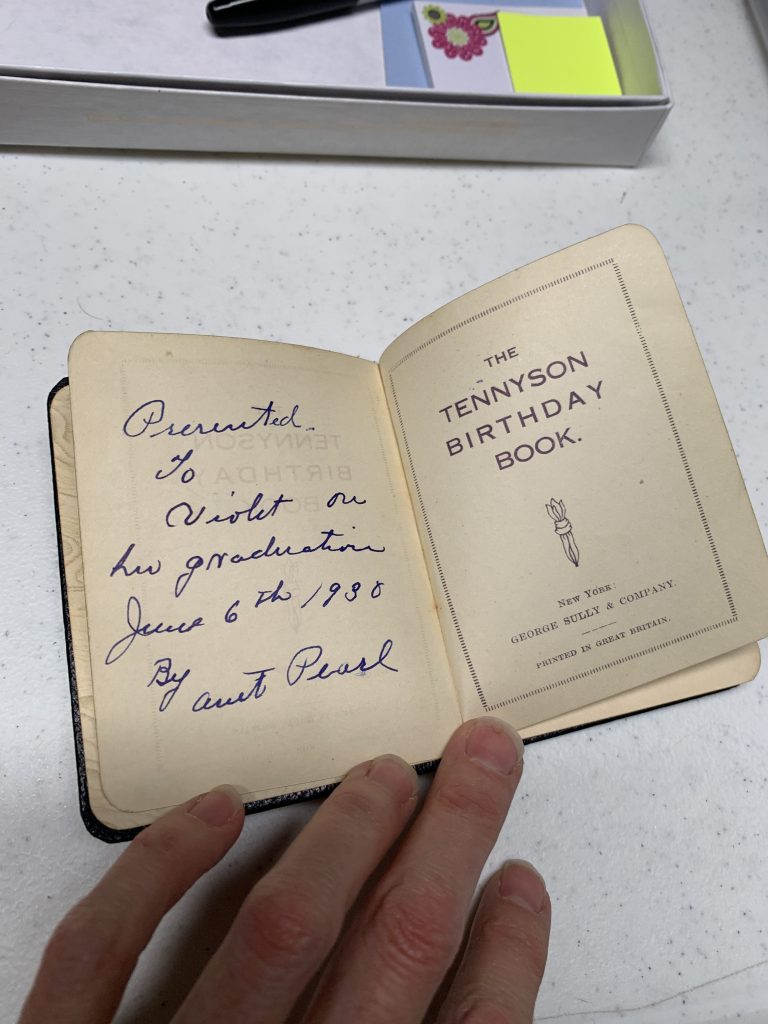
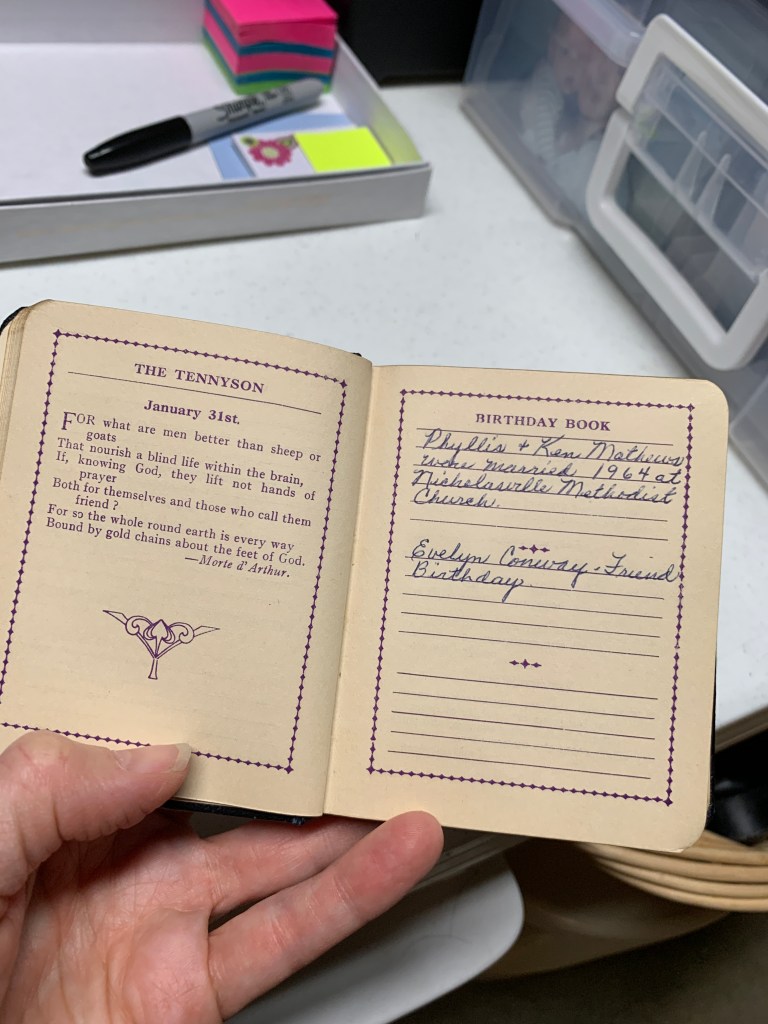
She gave me her first birthday book. A pocket-sized “Tennyson Birthday Book” made in England and sprinkled with quotes throughout the daily, lined sections for recording details. She received it from her maternal Aunt Pearl upon graduating high school in 1930. I believe this was the foundation of Cutters’ lifelong practice of recording and commemorating important family dates.
I found this book helpful in clarifying some answers to questions that were eluding me. And, numerous opportunities to read between the lines of love. Cutters’ love.
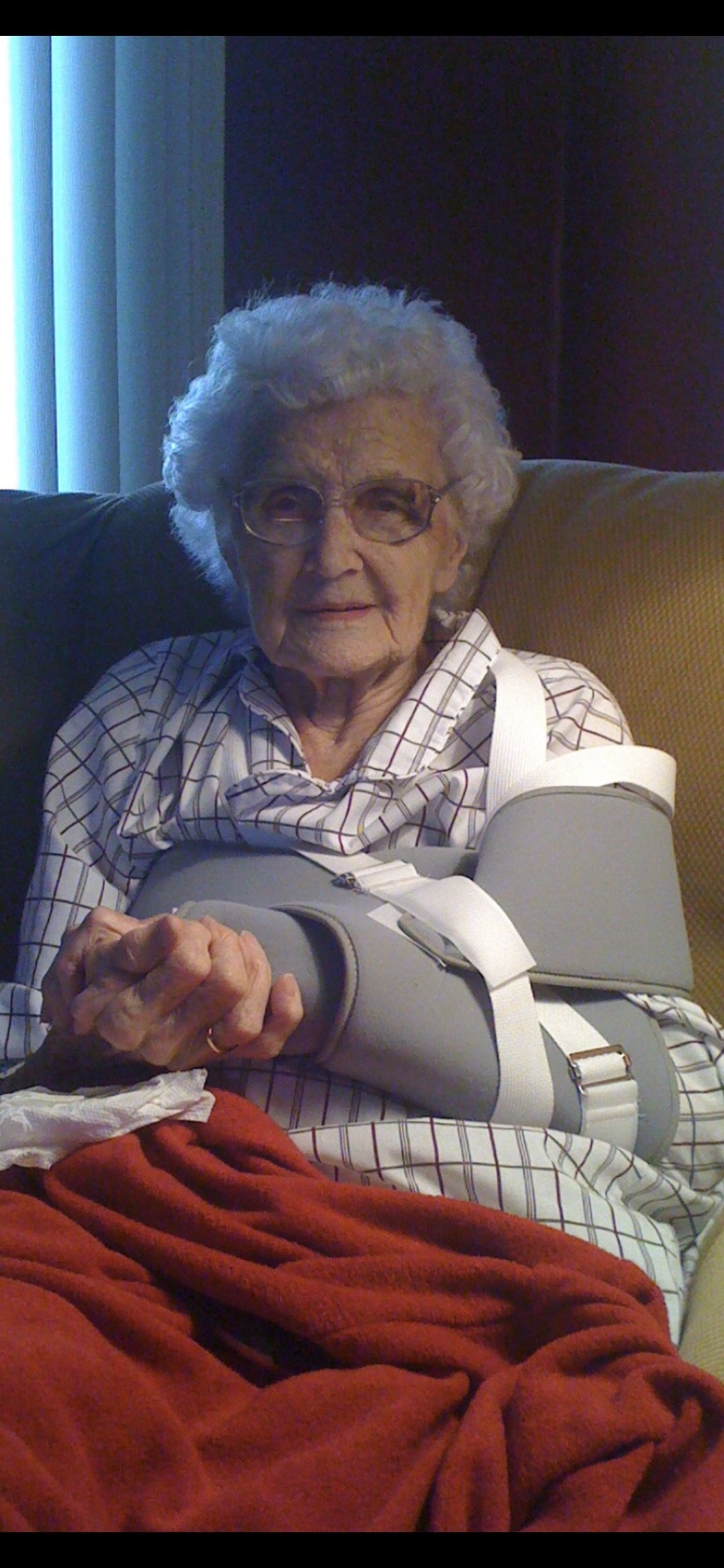
Cutters came to stay with my parents while recuperating from broken bones after a fall. As it turns out, she came back more than once from broken bones. Would you believe it was in the 90s of her lifetime, though? Truth.
100 years and still learning
My grandmother, Cutters, lived to be 101. Only the final year to 18-months was limited by physical constraints. Her years between 1977 to 2013 were lived independently within community after Granddaddy died May 1977. This original aging-in-place home support network she inspired, and to which she contributed, is but one of the blessings from Jessamine County to me.
Only a small number of times she needed assistance in recuperation and mobility. Her children, Phyllis & Herbert, took good care of Cutters, their Mother. The love shared in her family I can only hope to honor, in turn. I have learned to look for ways to live her lessons again. Practicing loving service to others. She loved Jesus.
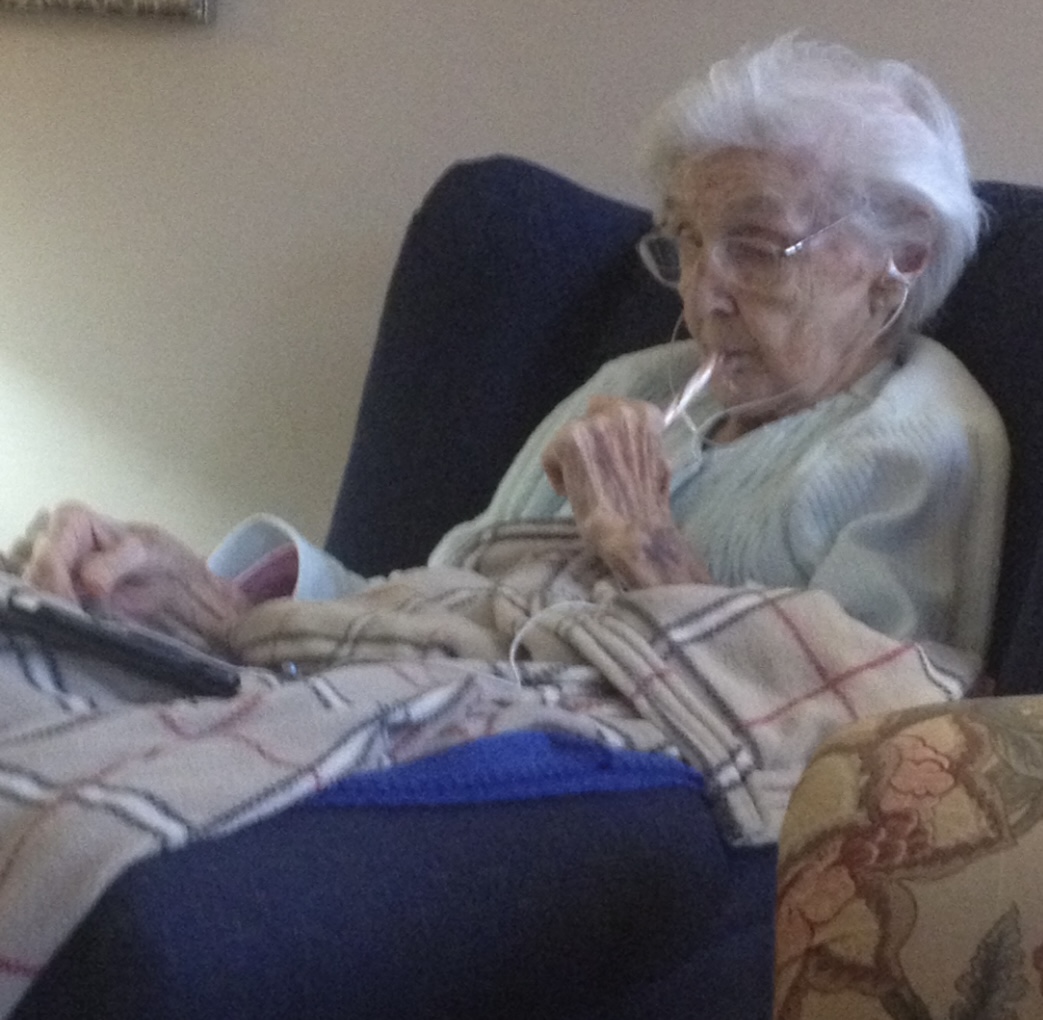
In this image, Cutters is seated in a recliner with pillows reinforcing her resting collar bone and shoulder. She holds a 21st century mobile device in her Roman chiseled masterpiece of hands and somehow that irony works. In her other hand, she is connected by mouth to a red and white striped peppermint candy cane. In Burberry wrapped and earphones in full effect. To the uninitiated, I say sorry. That so many will never know how amazingly this woman’s life impacted others. Thankfully, I am one who witnessed and can relive stories with my own loved ones.
With her hands, she worked making food and a home for family, friends, homemakers and those in need. This included her elderly father in his widowed years. She prepared fresh-from-the-farm meals, with green beans, corn, tomatoes and more. With her hands, she endured. She held the dying body of her first born child.
Those hands have richer lives all their own, what stories they could tell and energy they emit even now only in a photograph. And, the typing fingers of those same hands would let you know in no uncertain terms if she did not approve of something you shared on Facebook. Yes, she was active on Facebook. And that was also after she was 90yo.
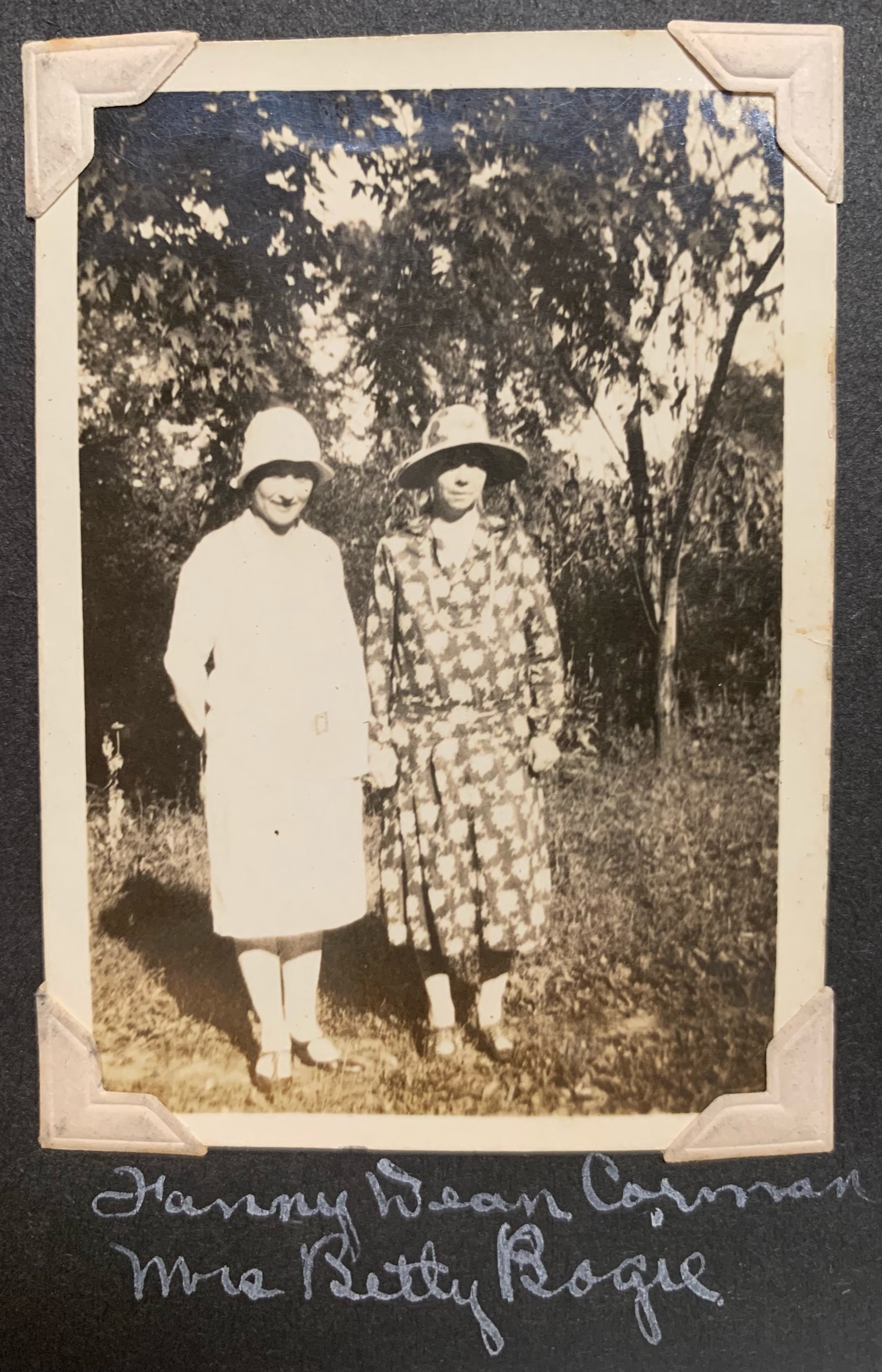
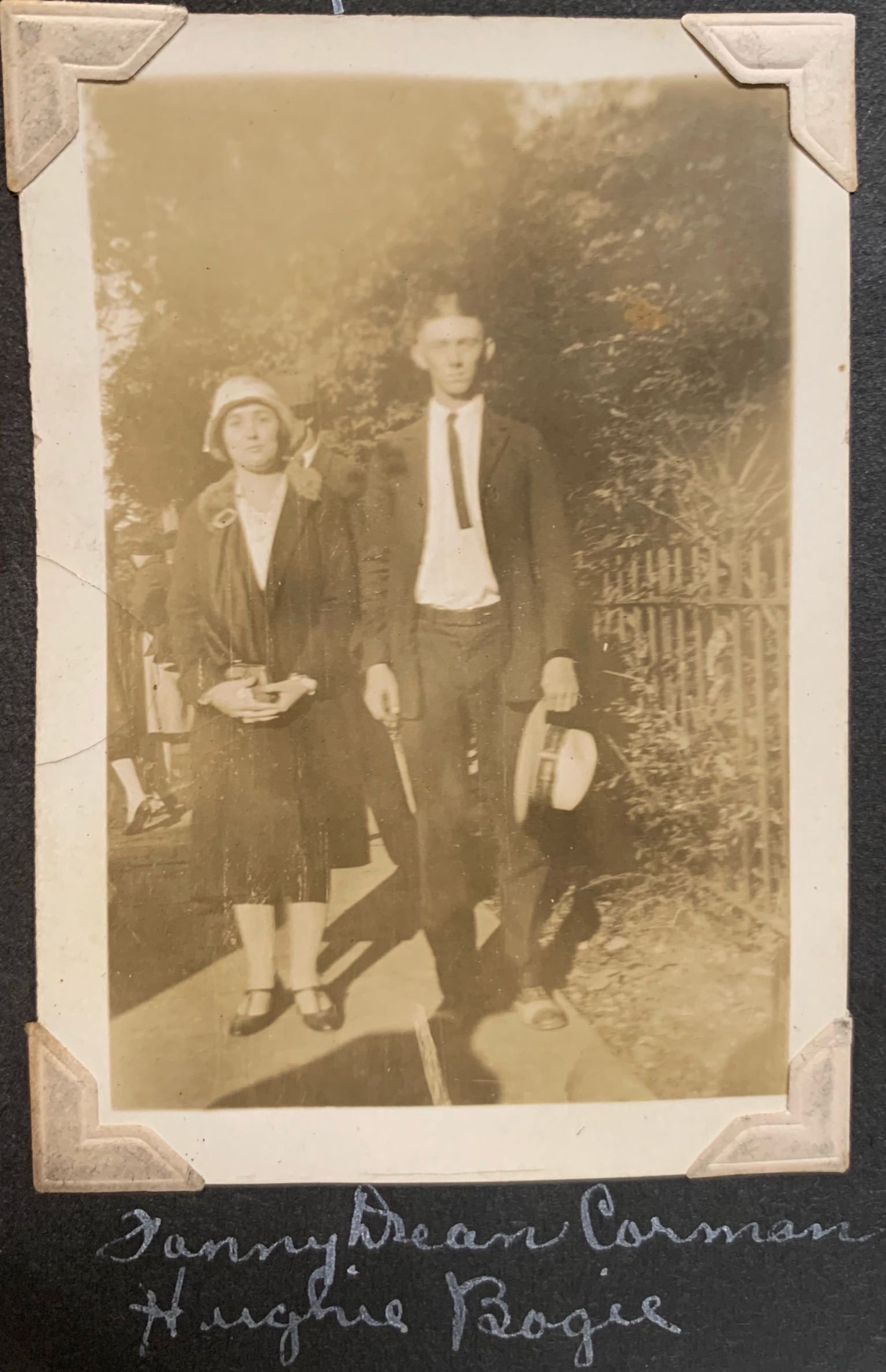
Here’s what I learned: These photos are all related and appear to be around the 1920s-1930s. Firstly, my grandmother Fanny Dean is in each one and she is approximately the same age in each. Also, three different members of the Bogie family are featured.
A quick check in ancestry.com & Google search located Betty Dean Bogie, mother of Rella, who lived in Nicholasville, KY the same time as my grandmother and who is buried in Maple Grove cemetery, as are many of my family members, including my grandmother.
My 28yo grandmother was a school teacher early in her career when in November 1930, she married a 36yo widower with a 5yo son. I do not know how they met or reconnected when she returned to Jessamine County from Missouri. Historically, rural one-room schoolhouses served concurrently varying ages of students from the adjacent communities. In those years teaching, Fanny Dean would board with families in a particular area where she taught. This period aligns with the timeline of her life as I understand it. Maybe she resided with the Bogie family during one of those stints. That is one theory.
Another is that Fanny “Dean” and Betty “Dean” may have been relations of some kind. Whether family or patrons, this family was significant to my grandmother. I did not find any references to Hughie in Fanny Dean’s writings but he is also the child of Betty according to some quick ancestry.com searching for connections.
Rella Bogie with Fanny Dean Corman (Jessamine County, KY)Fanny Dean Corman with Mrs. Betty Bogie (Jessamine County, KY)Fanny Dean Corman with Hughie Bogie (Jessamine County, KY)
that.Kentucky.girl
A 6th-generation Kentuckian on a journey to find out – follow along
Clyde McQuerry (22 years old) married Violet Fayne (17 years old) on December 24, 1930 in Jessamine County, KY.
A Christmas Eve wedding
A courtin’ scene – Clyde Herbert McQuerry and Violet Sunbeam Fayne, my maternal grandparents circa 1928-30, Sugar Creek Pike, Little Hickman, Jessamine County, Kentucky
The phrase “don’t make ’em like they used to” comes to mind. I look at these young faces and see the beginning of a love story that spanned nearly a century. Look at their arms, hands. Entwined and naturally fitted together. A metaphor for their lives. Even after Clyde died from cancer in 1977, Cutters kept their connection a daily practice. She wrote to him in her diaries, everyday for 35 years until she could no longer see well enough to write. She reached 100 years before that happened.
Both families were members of Wesley Chapel on Sugar Creek Pike, Cutters was born next door to their church, which is where they met, although they did attend different schools. The McQuerrys lived on a large, likely multi-generational farm south on the banks of the Kentucky River. Up the hill from there on Sugar Creek Pike was (and is) Wesley Chapel and neighboring Fayne family. Her utter goodness must have shot through him like a lightning bolt. Or, what if it was a slow burn, like they played together as kids? Both born and raised in a rural church community, it is within the realm of possibility. (I will ask Daddy Mac & ‘Tuh.)
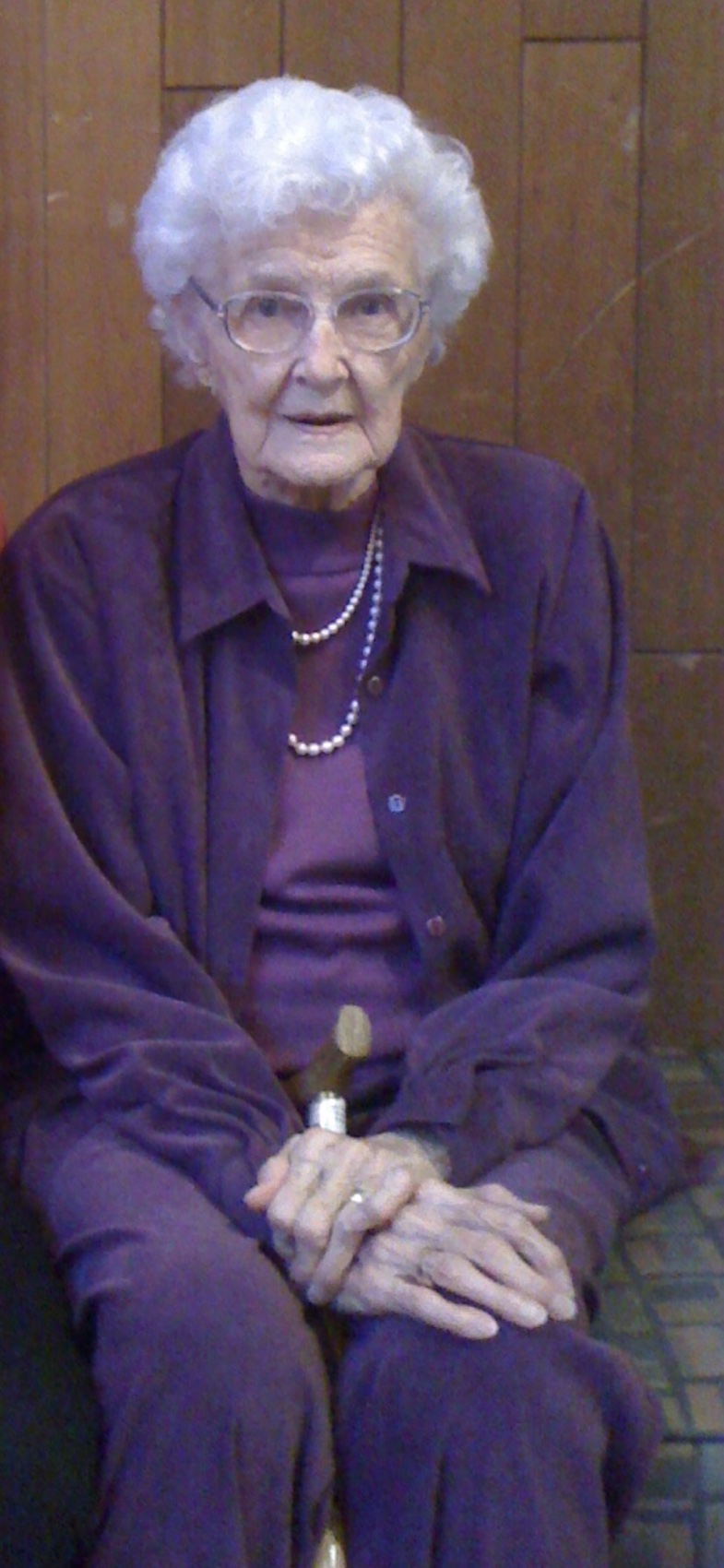
She carried a quiet wholeness and holiness, fingers ever in motion creating something for sharing like legendary bread and crocheted afghans. Cutters, as I knew Violet much later in her life, had this look at times of a far away thought. Her pause was nearly always just to the point you felt the need to pick up a dropped thread. You’d even inhale to speak, then suddenly, she released, nailing the reply. She reflected before speaking her wisdom and I suppose it was by the lessons along the way. She knew EXACTLY what was going on but she had to reflect and, in doing so, to compel you the same. In her presence you’d welcome the pause. She also delivered zingers with impeccable timing. Very clever. It was fun to giggle with Cutters.
The Cutters I knew also carried a sadness reminiscent of long-suffering as in The Bible. She carried it selflessly, though. She could experience joy and you can be sure if you were in her presence the light of that joy was always bright and it shone on you. Always, even in pain and brokenness, she spread light. And, she knew brokenness.
The proximity of Wesley Chapel to the house where Cutters (Violet Sunbeam Fayne McQuerry) was born on Sugar Creek Pike, Jessamine County, KY. Photo: C. Mathews taken on a Ya-Ya’s trip in 2020, 107 years after.
But, in this moment, Clyde, my grandfather at 22 years-old, and Violet, my grandmother at 17 years-old, were in love and embarking together on the future. Christmas Eve. It was a Wednesday. It was 1930. Was it magical? How I hope there may have been a photo I might discover. When did Clyde know she was an angel walking among us? Did he whisper to her “I want to marry you on Christmas?”
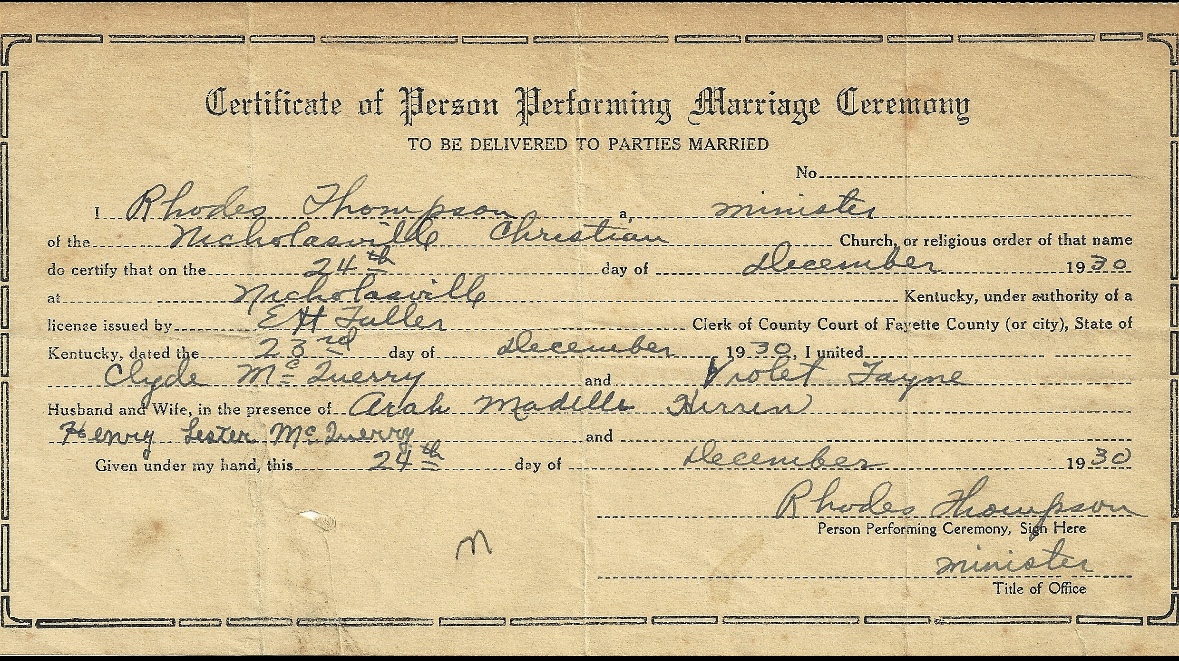
The McQuerry-Fayne marriage ceremony was conducted at the parsonage of Rhodes Thompson, minister of the Nicholasville Christian church. [NOTE: I would like to locate this minister’s home address in future research.] You might wonder why the wedding ceremony did not take place at their own church, nor with their own minister. I wonder about that, also. Maybe these “crazy kids” had a reason.
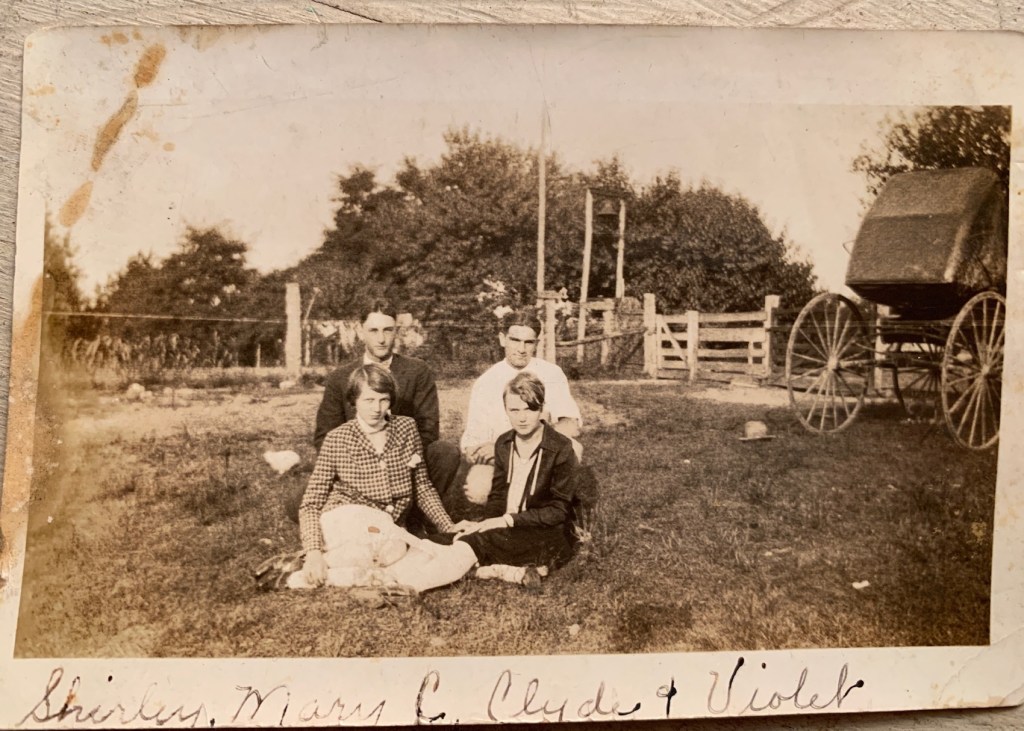
Shirley (unk), Mary C (unk), Clyde & Violet date unrecorded, circa 1928
She had graduated from high school in the summer. She was a teenager, they were young’ns. So, you graduate high school and you plan to be married at Christmas? Don’t you wonder what the “kids” talked about then? Their connection to the outside world was through radio, newspapers, telegrams and word of mouth. The Wall Street Crash had occurred in October 1929 and now, one year later, people were IN the Great Depression. Also, prohibition was in effect, but I don’t think either of them drank alcohol ever.
In the photograph of four friends, you can see what looks like a buckboard in the corner, a fence and a large wooden gate. It reminds me of watching Little House on the Prairie growing up. Cutters liked to watch the TV show, also. I have a litany of “LHotP” stories. That Pa, though. More for another time.
Certificate of Person Performing Marriage Ceremony
TO BE DELIVERED TO PARTIES MARRIED
I, Rhodes Thompson, minister of the Nicholasville Christian Church or religious order of that name do certify that on the 24th day of December 1930 at Nicholasville Kentucky, under authority of a license issued by E. H. Fuller, Clerk of County Court of Fayette County (or city), State of Kentucky, dated the 23rd day of December 1930, I united Clyde McQuerry and Violet Fayne Husband and Wife in the presence of Arab Madilla Herrin(sp?), Henry Lester McQuerry Given under my hand this 24th day of December 1930.
Person Performing Ceremony, Sign Here – Rhodes Thompson
Title of Office – minister
Witnessed by two people: A. M. H. (need help deciphering what is both hard to read and completely unfamiliar) and Henry Lester McQuerry. Should I expect to see a vouchsafe for the bride (because I do)? Where is the implication for her parents’ permission in this process? Or, was that not a thing? Their minister and her family are not represented on the certificate. I mean, where were HER people? Where was Big Mother and Ol’Daddy?
Celebrating Christmas for me was never complete until going with family to “Cutters’ Christmas.” I would venture to guess any of the cousins would say the same. The annual tradition remained a deeply special occasion for decades and maybe that was how Violet chose to honor their special day and her love Clyde each year.
Merry Christmas Eve and Happy Anniversary to you, Clyde and Violet. May you be entwined around each other celebrating for eternity.
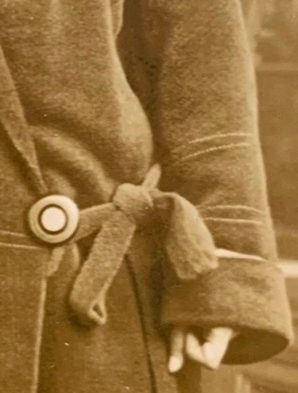
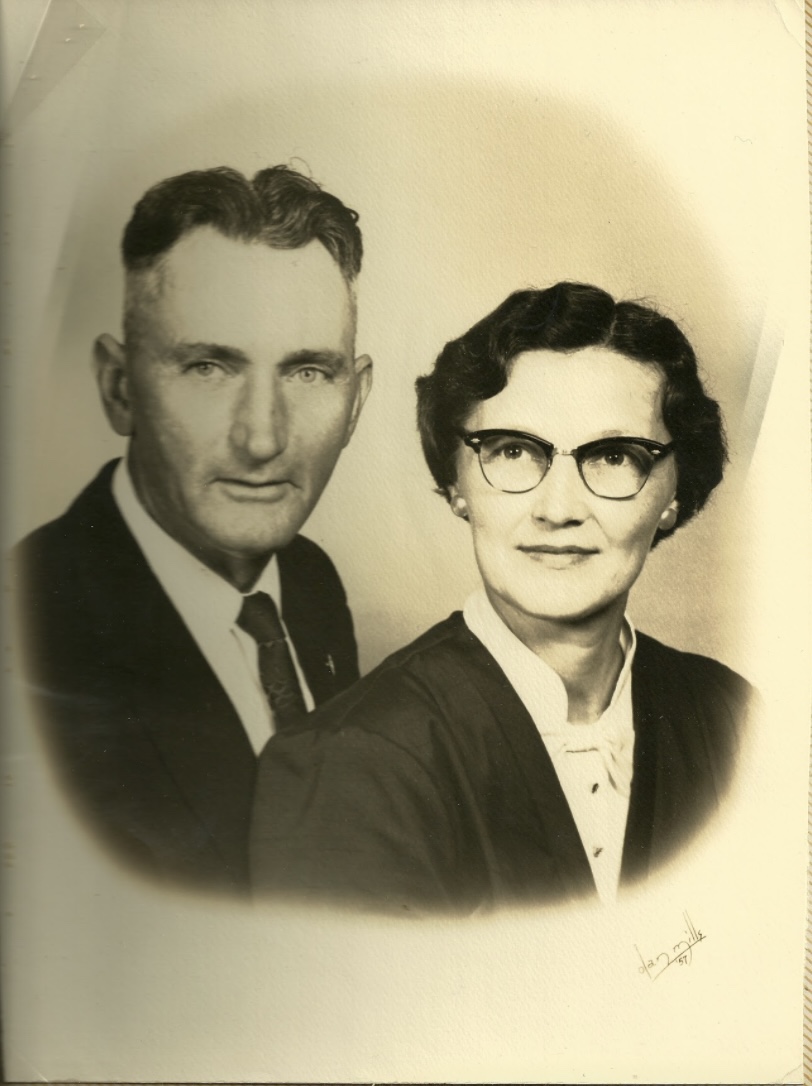
They don’t make ’em like they used to. That coat – Is it a heavy wool? What is the collar – fur? Details of the coat fastener fascinate me.
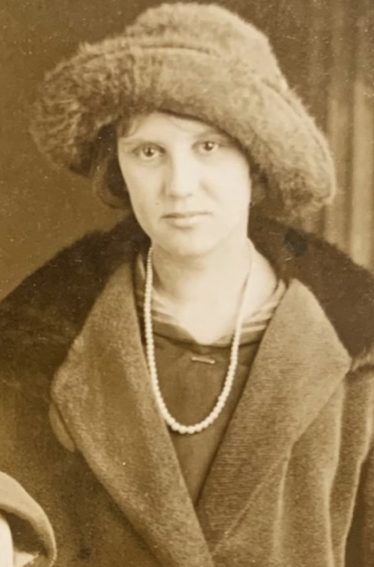
A single strand of pearls.
A woolen felt hat, perhaps. I can’t place the texture.
Have you ever wondered if you should have been born in a different era?
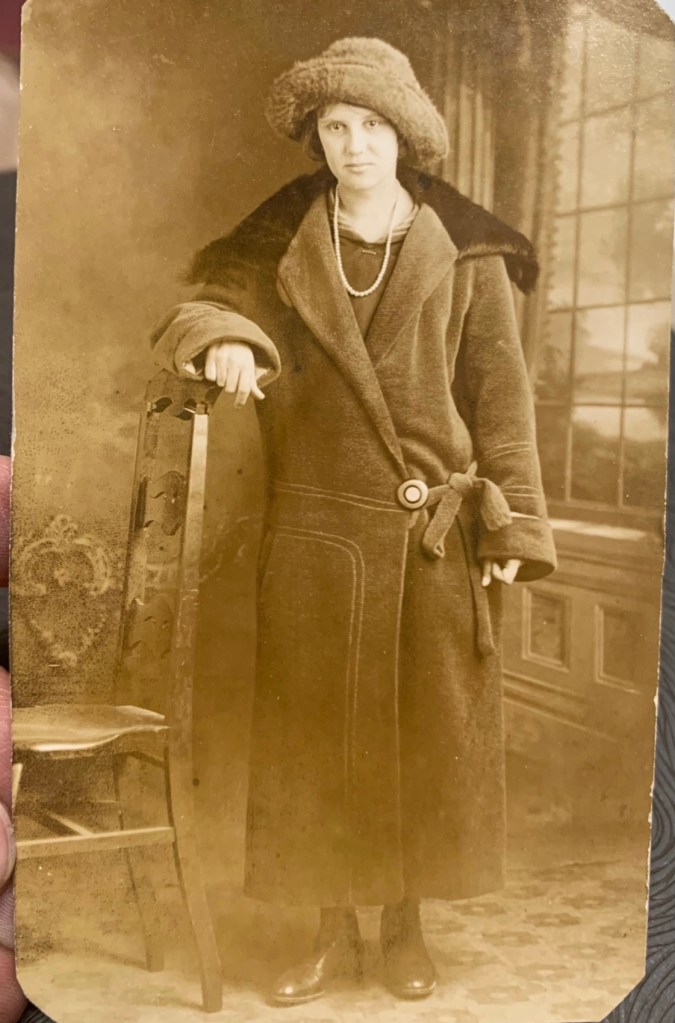
What catches your eye first? Her classic beauty, the direct gaze. One hand draped in a relaxed state while the other shaped as a relaxed fist. Feet somewhere between first and second position. Is the background a painted backdrop with a real, high-back chair?
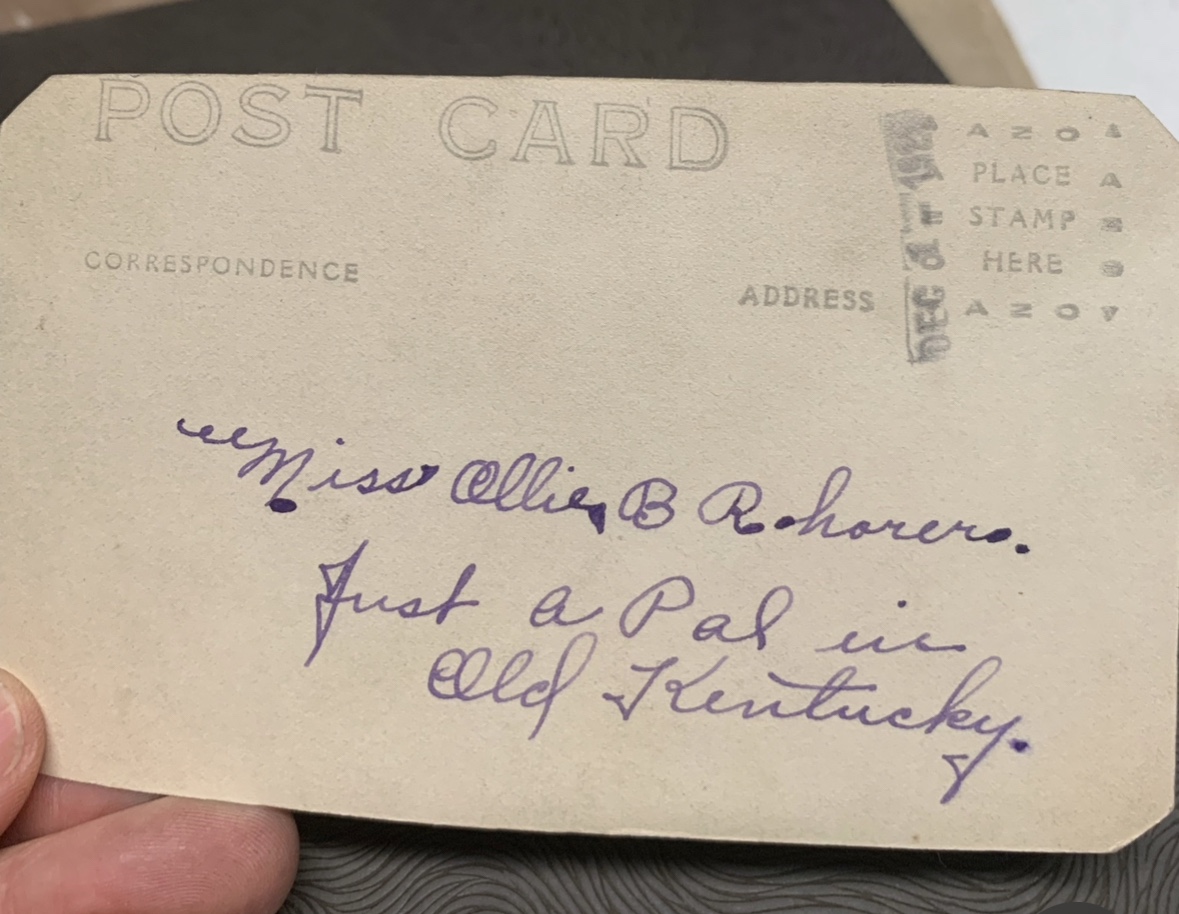
I look forward to learning more about this woman and her connection to the family. She may have married a Corman and her maiden name Rhorer is listed among the earliest settlers of the county from the Morovian community, the United Brethren. The 1920 US Census shows her family lived near the Corman siblings enclave south of Nicholasville, Jessamine Co, KY. The Rhorer family cemetery is near the Corman family cemetery on Bethel Pike.
I’ve had many thoughts and phrases, quotes in her own voice floating around in my head these past few days. Cutters’ heart stopped beating Thursday morning. She was at Hosparus, Norton downtown Louisville, having been moved there from my parents’ home the night before due to congestive heart failure. Our family has been together for the funeral and the obituary has been published. Funerals bring families together but Cutters had such a way of doing that in all her living glory.
Her home was a hub of activity. As a guest, you were always offered a glass of sweet iced tea, something good to eat that was usually from the garden. The tea, freshly made that morning and filled to the rim of a signature orange Tupperware pitcher with the matching lid. This was always perched in the same top-shelf position of her pristinely maintained refrigerator. Cutters’ cooking, specifically corn, green beans and homemade bread (more on this later) are the stuff of legend.
Holidays were special and the extended family all looked forward to the tradition of gathering at Cutters’ home to eat dinner and exchange gifts. As our group size grew, we instituted a one-gift, even-exchange policy but Cutters was always exempt from this rule. Each year she had a stack of colorful boxes and she was known to take her time, as if savoring the suspense, when opening each one. She had a quiet meticulousness about her – whether using a letter opener to separate the tape from the wrapping on a gift or how she would keep her Tupperware and cabinets so organized. Her home was a reliable map for mindful intention – everything in its place throughout all the years I visited.
She took this quality philosophy with her on her travels. You could tell Cutters had been in your home for a visit – your pantry became organized, there was a pitcher of sweet tea in the refrigerator and your mayonnaise jar was wiped clean by approximately one finger’s length from the rim all around the circumference. That was a signature move. Wiping jars clean and a metaphor for how she left everything better in her wake. She created with lovely hands ever in motion.
I learned so much about life from Cutters but less from her words and more from how she lived her life. As St. Francis said “Preach the Gospel each day and, when necessary, use words.” She epitomized this. Her pastor spoke that “Violet lived the fruits of The Spirit.” As he read each one, the layers of her were confirmed – Love, Joy, Peace, Patience, Kindness, Goodness, Faithfulness, Gentleness, Self-control.
How did she do it? How did she live to be more than 100 years, as she did? It was only the past year that she appeared challenged by her age. My granddaddy died in 1977 and she survived him all these years living on her own. In her late 90s, she rebounded from two falls that resulted in broken bones and long recovery. She was widowed for 37 years, retired from working 40 years ago and only needed palliative care in her final year of living. I think of the chapters of her life and how I was blessed to be part of the final chapters, especially. Caring for Cutters had a profound effect on my soul. It was a holy experience.
She was born in 1913 – a year after the Titanic sank, for a point of reference. I did not know the young girl who lived to see World War I, the Great Depression, Hitler, World War II, the Korean & Vietnam wars, and modern day conflicts. A farmer’s wife’s life is a harsh one in even the best of circumstances and yet, how did she do it? As my cousin Richard noted in his eulogy, life expectancy for a female born in 1913 was around 55 years. And, as he so beautifully stated, “she did it so well she got to do it twice.”
Cutters was one of five children born to Manfred Fayne and Daisy Easley in Jessamine Co, KY. She had a sister, Hazel, and three brothers – Ralph, Ray, and Bill. Cutters and Granddaddy met at their church, Wesley Chapel United Methodist, where she remained a member all her life. In fact, she was born in the house next door to the church on Sugar Creek Pike. They attended different schools but their families knew each other from Wesley Chapel. He was a farmer but later in life, when I knew him, he was a man of many keys as a security guard or something. He would sit with me at the kitchen table and the keys hanging off the ring seemed to always be in motion. I remember playing with them. I was in 4th grade when he died. Our family was living in Pittsburgh, PA and I remember the sting of the late night intrusion by the overhead light as mom woke us to pack up for the sudden trip home. I probably didn’t understand or know why but I am sure I knew it wasn’t good. I can’t remember but imagine it was a longer than usual drive back to Kentucky.
Full circle, here we were back at Hager & Cundiff Funeral Home. Granddaddy’s service was held there in 1977, very soon after my grandmother Fanny Dean Corman Mathews’ funeral, my dad’s mother. That was a hard year for my parents who each lost a parent. Mom didn’t want to move very far from Cutters and Louisville was about as far as she was comfortable. So, Pennsylvania was a stretch of one year that was hard for all of us. My own 4th grade tribulations of that year can be addressed later.
Cutters made this life better for all who knew her, and possibly for those who didn’t have the opportunity. Though her heart stopped, her loving legacy lives on in ways both small and magnanimous. Cutters inspires me to live more as she did.
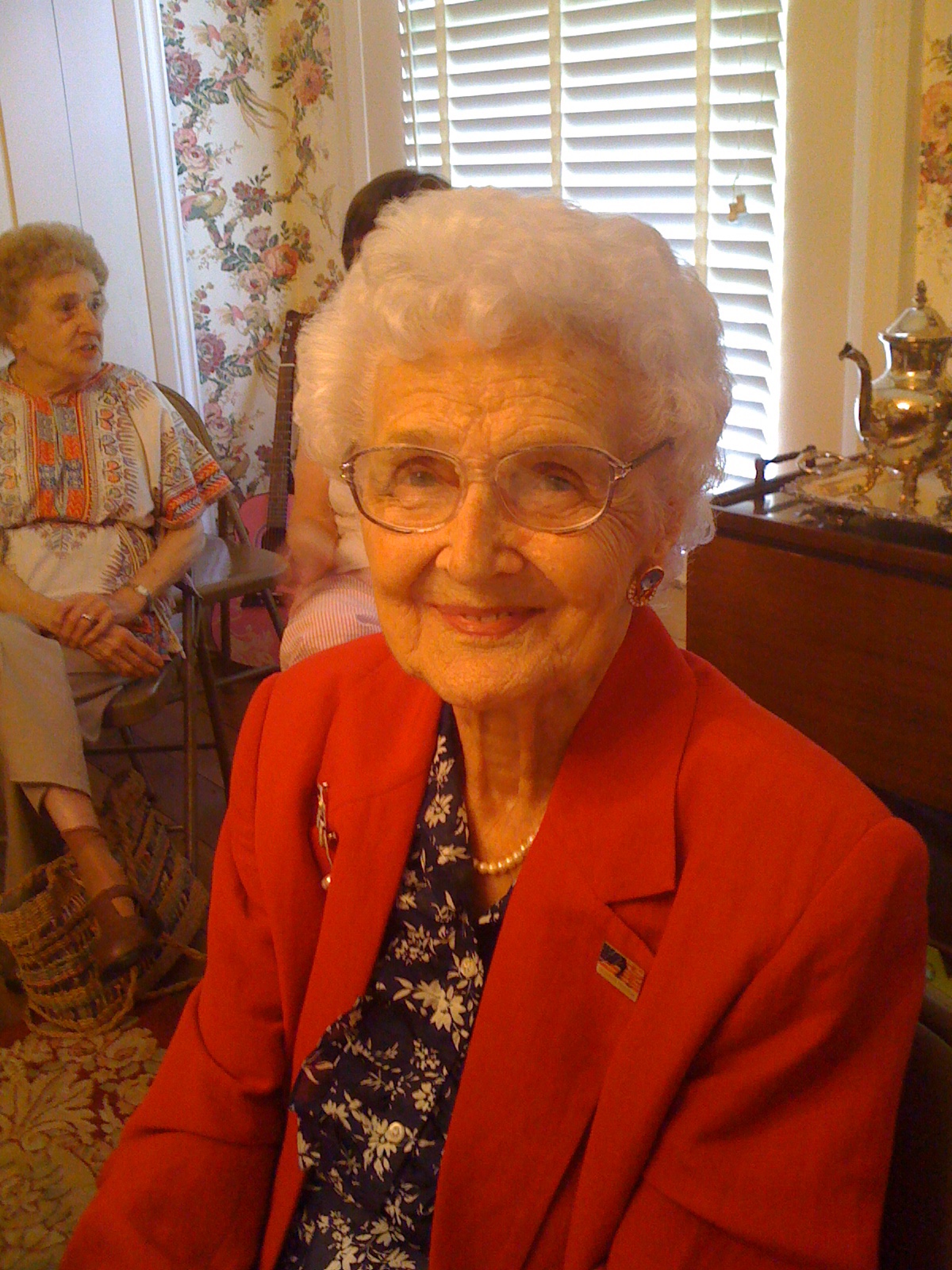
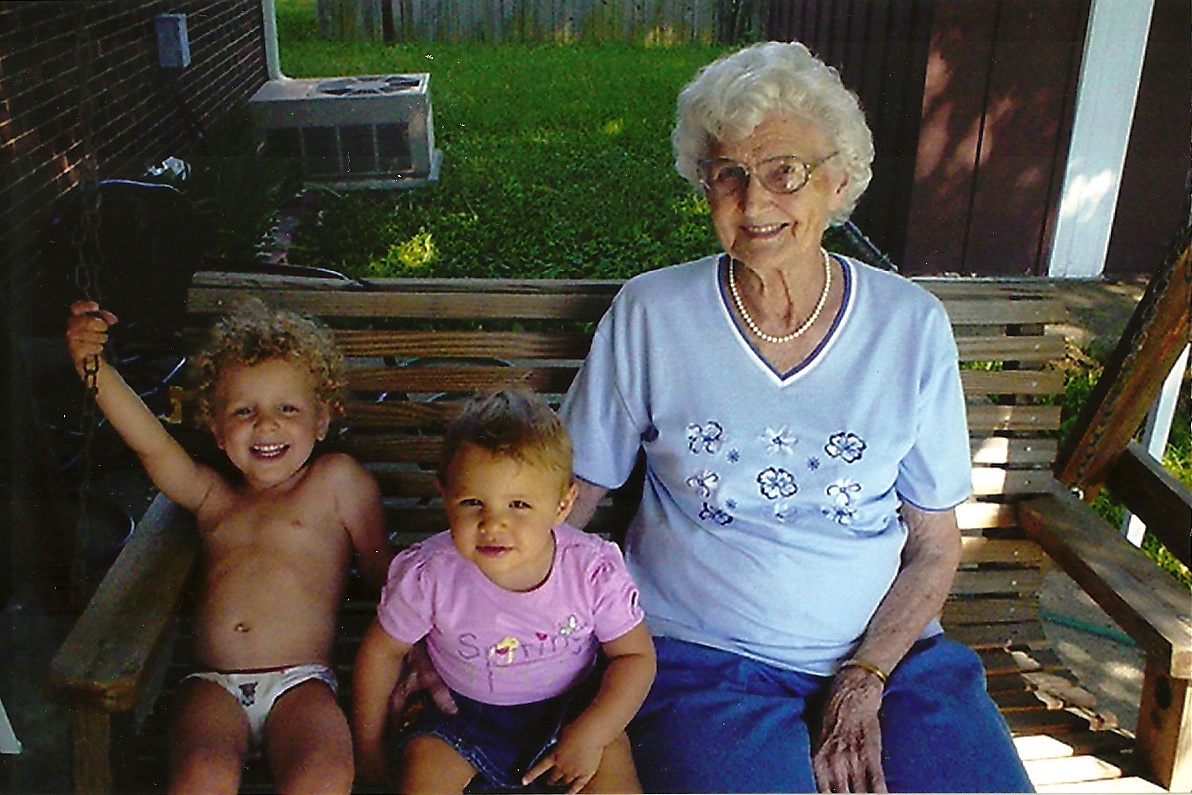
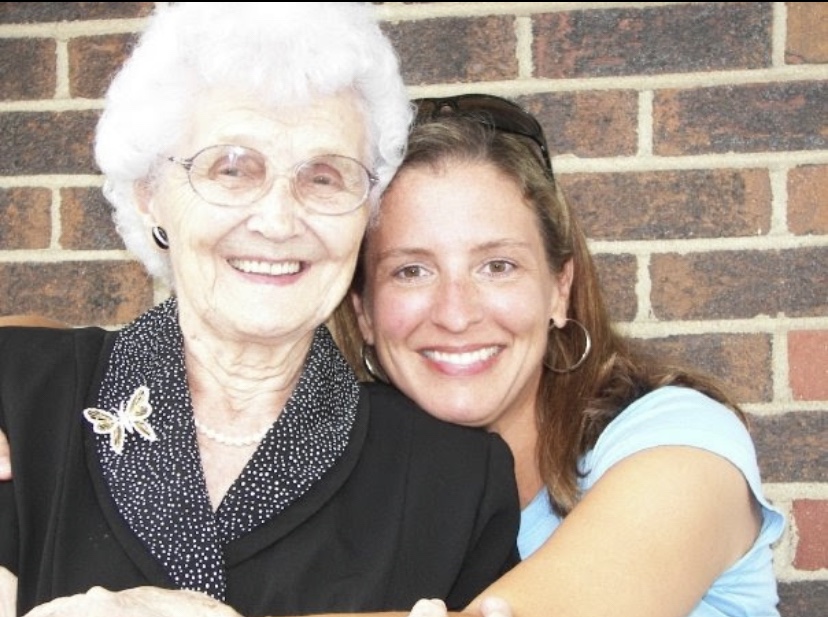
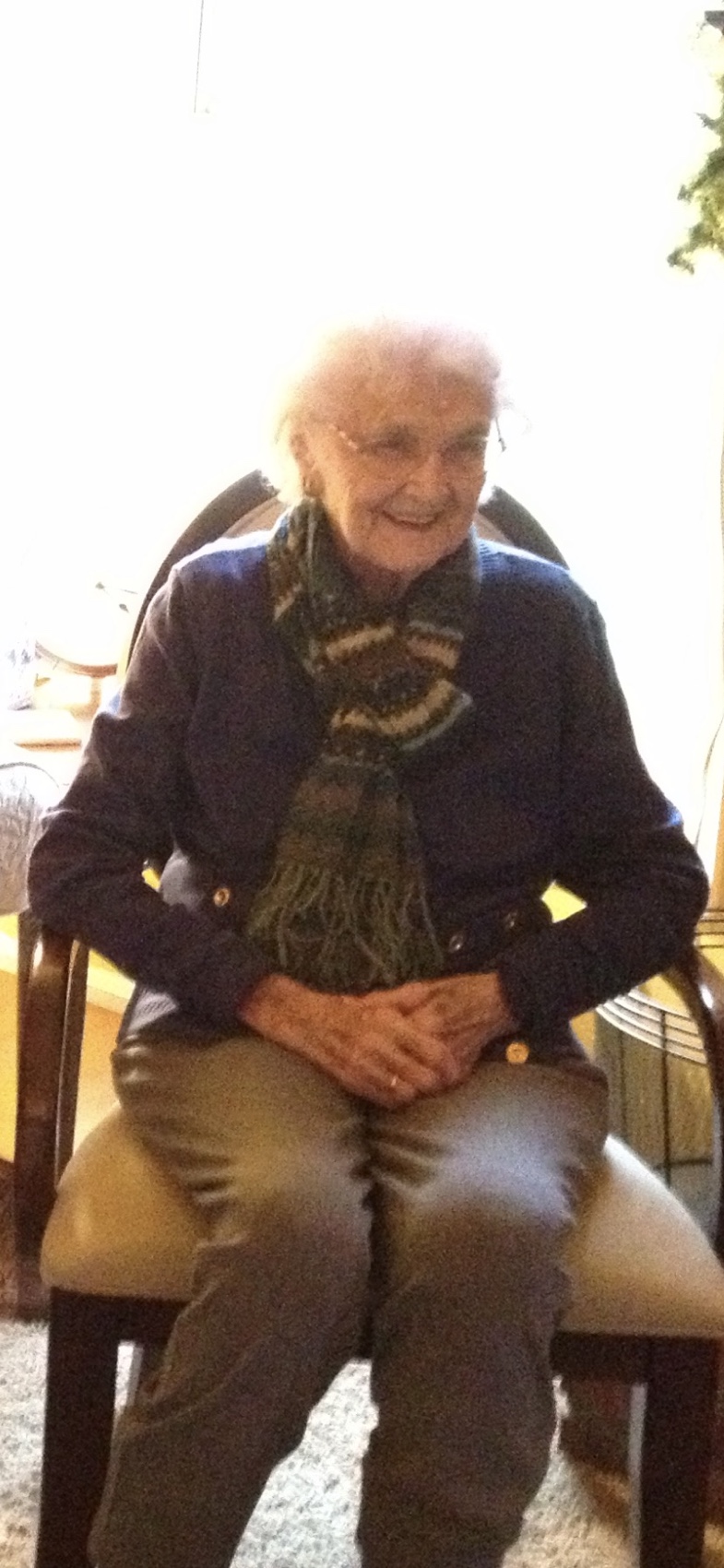
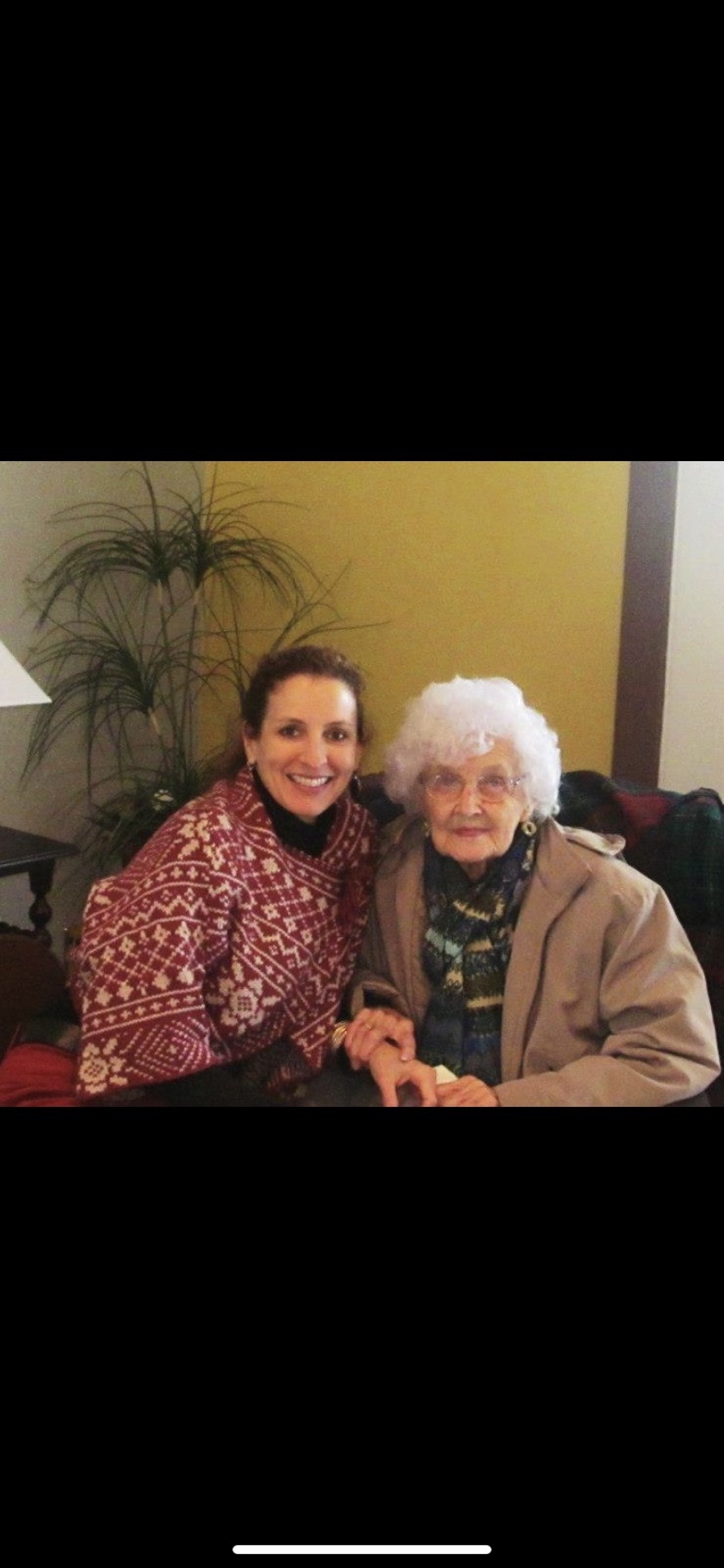
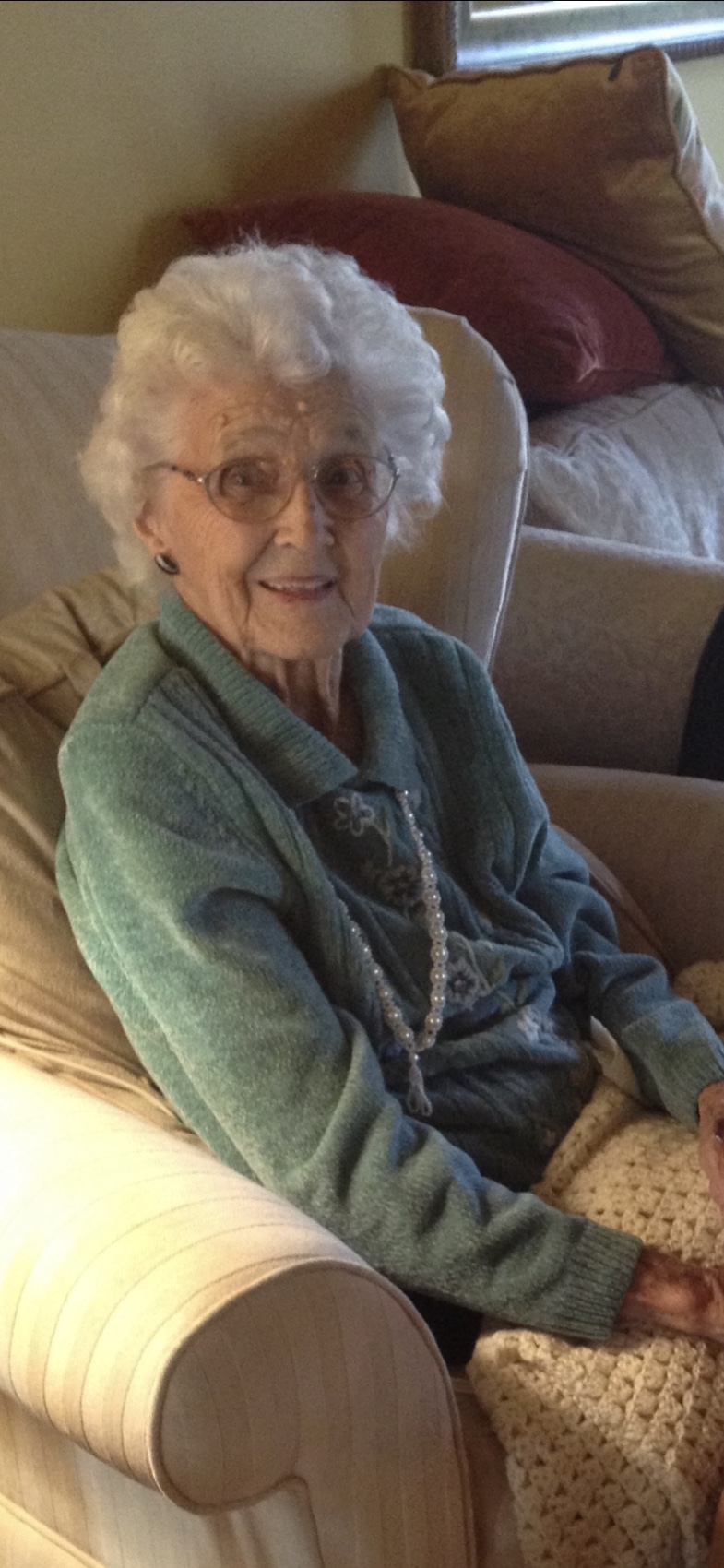
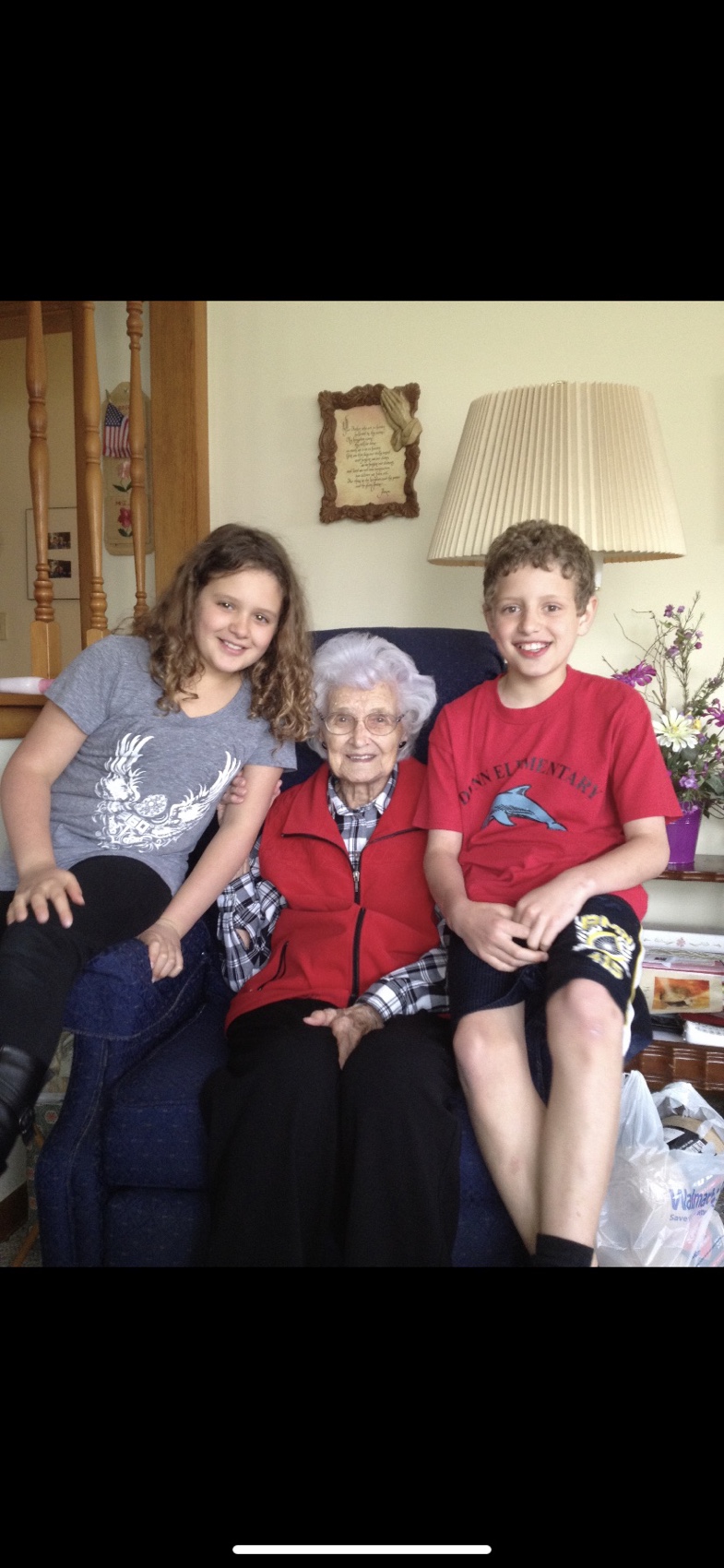
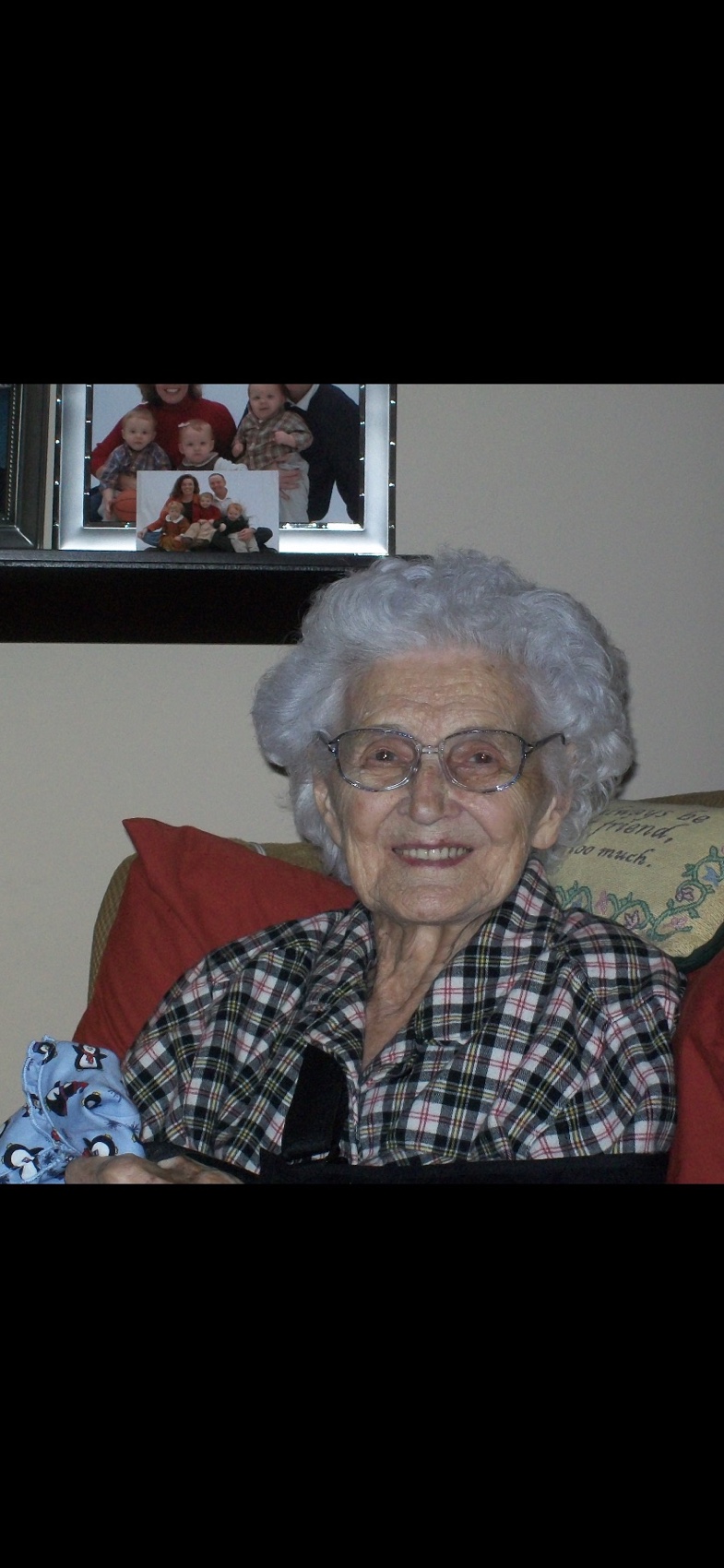
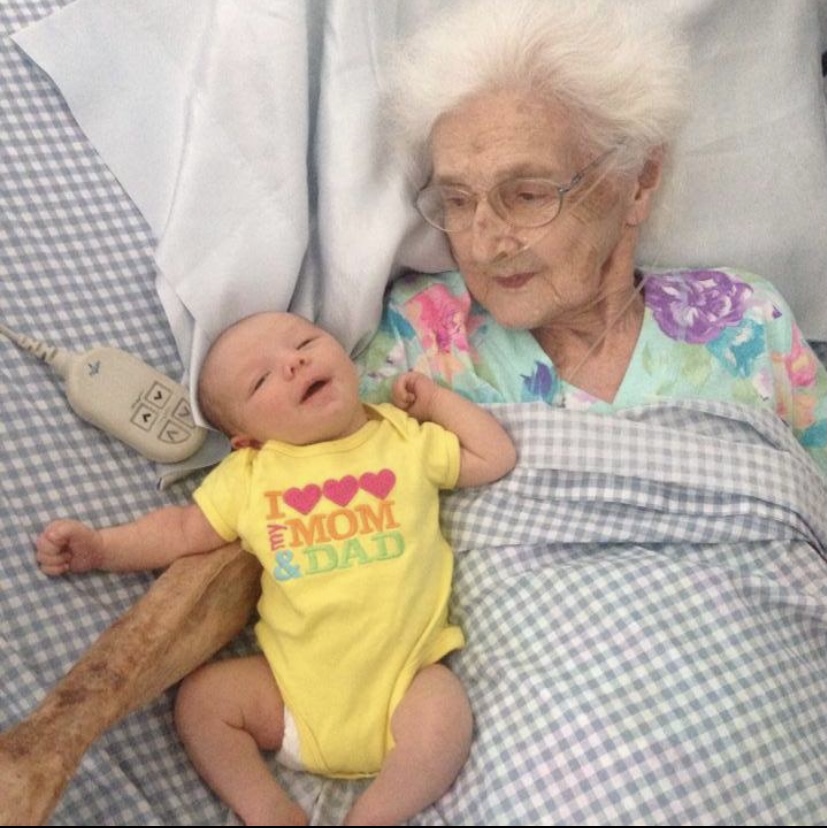
Birthday celebration Camp NelsonMy babies with their great-grandmother on her porch swingCutters with me on her front porchThanksgiving at McCanns’ in CrestwoodMe & Cutters Christmas NicholasvilleBeautiful CuttersCutters & me, family Thanksgiving at Barren River Park resortCutters Thanksgiving CrestwoodCutters telling funny stories to my babies at her home in NicholasvilleCutters visiting the Mathews in LouisvilleCutters at Barren River State ResortRecuperating from a broken shoulderBeautiful VioletClyde & VioletCutters meeting her great granddaughterSome Cutters moments
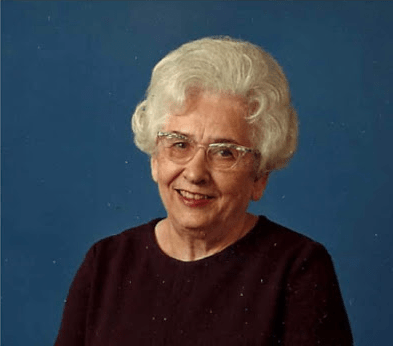
In the mid 1970s, retired school teacher Fanny Dean (Corman) Mathews self-published a compilation of genealogy research she had conducted over many years. The nearly 200-page publication was the product of building on a fellow kinsman’s tree published in 1916 Carlisle PA by Charles Cornman.
When I think of how she conducted her research in contrast to the modern relative ease for finding resources on the Internet, I am all the more inspired by her work and the tenacity that must have been required. She wrote letters – no such thing as email then. [Child, can you EVEN imagine it?] Her focus appears to have been recording the demographic details – births, marriages, siblings, deaths, locations, etc. As it was, she was working with knowledge of two of her own 32 great-grandparents, if not more.
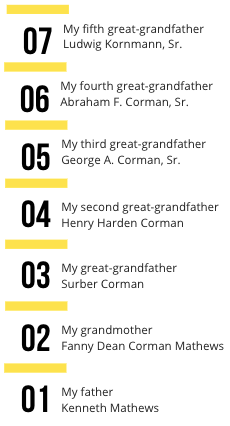
The Corman surname is widely known throughout central Kentucky and has evolved from the original spelling – Kornmann. The pioneer ancestor of this paternal family tree branch was born in 1713 near Munich, Germany. At 24 years old, he emigrated to America – sailing from Rotterdam and landing in Philadelphia in 1737. Ludwig Kornmann, Sr. and his wife were early settlers and eventually, they made a home in Lancaster, PA. Their seventh child served under Gen. Washington in the notorious winter of Valley Forge.
Their eleventh child and my direct ancestor, son Abraham Cornman, Sr., arrived in Jessamine Co, Kentucky and had thirteen children of his own – five of whom are mapped in the two Kornmann-family tree publications. Numerous resources in Jessamine Co KY archival material indicate these Corman siblings lived in the same vicinity on Jessamine Creek three miles southwest of Nicholasville.
As Abraham of The Bible and the stars of the sky, the Abraham Corman family prospered and multiplied. An enclave of German Protestants representing other surnames of my family tree included Earthenhousers, Easleys, Funks, Grows, Rhorers, Rices, and Yosts. These “United Brethren” as they were known were members of the Morovian Church. The original Morovian Church, located on present-day Short Shun Pike, was also the site of a school.
Abraham Sr.’s third child, son George A. Corman, Sr., served as a private for Kentucky’s volunteer Militia in the War of 1812 and fought along with his younger brother, John, in the Battle of River Raisin. John Corman, just fifteen years old, has been cited as firing the first shot at this conflict.
Unlike the families before him, my paternal great-grandfather, Surber, was an only child. This will continue to be a question that I seek to answer in my research. Surber inspired my grandmother Fanny Dean – along with her siblings – to serve as active members of the numerous Corman Family branches quite literally spread out across the United States. The annual Corman family reunion was a significantly attended occasion bringing travelers from near and far. I feel a kind of melancholy that we do not still gather.
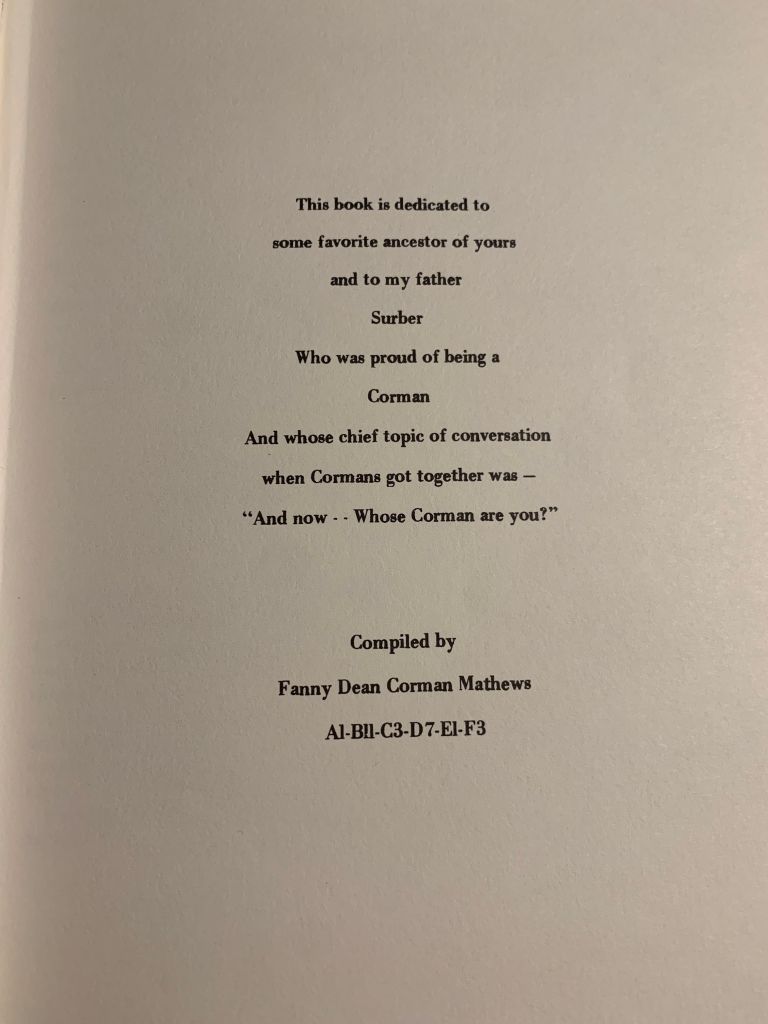
Forward from “Whose Corman Are You?”
“This book is dedicated to
some favorite ancestor of yours
and to my father
Surber
Who was proud of being a Corman
And whose chief topic of conversation
when Cormans got together was —
“And now…Whose Corman are you?”
Compiled by
Fanny Dean Corman Mathews
A3-B11-C3-D7-E1-F3
My grandmother was a voracious reader and I suspect she went to the library far more frequently in a week than to church. I grew up knowing of her book. And, it delighted little me to no end that my name and the names of family members appeared in the book. It was big in my little world and I was somebody in a way that had not been validated as such before. Fast forward to today, this publication has taken on a different significance. It is a road map. With fresh eyes, I read Fanny Dean’s call to action on the inside cover, I think of the 128 individuals that were my fifth-great grandparents and all their stories. It excites me to think of all the possibilities waiting to be discovered.
As if her own voice speaking these words to me –
“It is hoped that this information will make it easier for anyone who wishes to carry the work further.”







 POST CARD (side 1)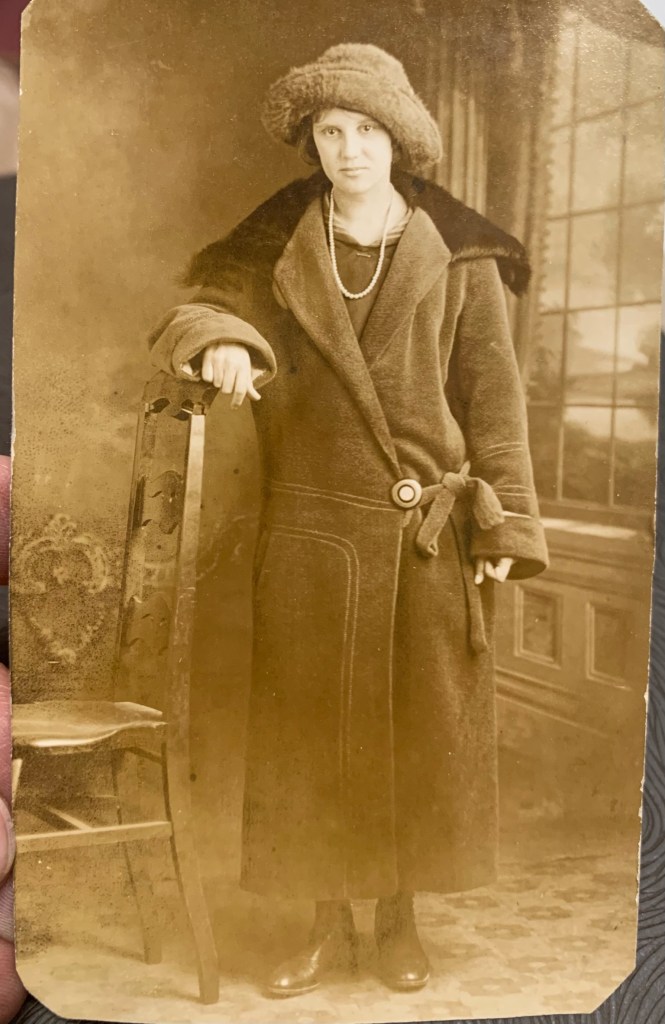




 that Kentucky girl