This deed is the legal origination of land that eventually served as my father’s family childhood homeplace.
James Douglass was an appointed deputy surveyor of Colonel William Preston, county surveyor, when Kentucky was known as Fincastle County of Virginia. In April 1774, Douglass joined John Floyd, Hancock Taylor (uncle to future US President Zachary Taylor), and Isaac Hite in heading to Kentucky. Other members of the surveyors group soon joined.
Although surveys had been conducted in the region a year or so prior, those claims were not considered legitimate because the men conducting the surveys were not deputized by Col. Preston.
In the detailed account, The Fincastle Surveyors in the Bluegrass, 1774 by Neal O. Hammon, around July 3, 1774, Douglass, having left the headwaters of the Elkhorn, “discovered a spring which he named Jessamine after his daughter, an only child.” This spring of Jessamine Creek served as the primary water supply for the my father’s homeplace.
He has shared memories of how integral was that spring to his youth. Finding arrowheads, swimming, how it would swell and on a few occasions shot up like a geyser, how he saved his older brother from drowning there, when the bridge was built…and more. I knew the creek spring as where the family gathered for my uncle’s pig roasts.
Kentucky Doomsday book record of 1,000 acre land grant at Jessamine Creek spring described as “a remarkable camping spot” which I had seen referenced on a landowners map by Clyde Bunch of the Jessamine County Historical Society.
Attempts to transcribe the handwriting and legal jargon of this time the late 1700s were a bit futile. When I am able to get clarity, I can revisit and update the references. I am building the timeline for how Douglass’ deed eventually came to be owned by Pleasant Cook, my 2nd great grandfather.
Words I can decipher – James Douglass, 1,000 acres, the District of Kentucky, 5 or 6 miles below Hickman creek, head of Jessamine Creek, a remarkable camping place.
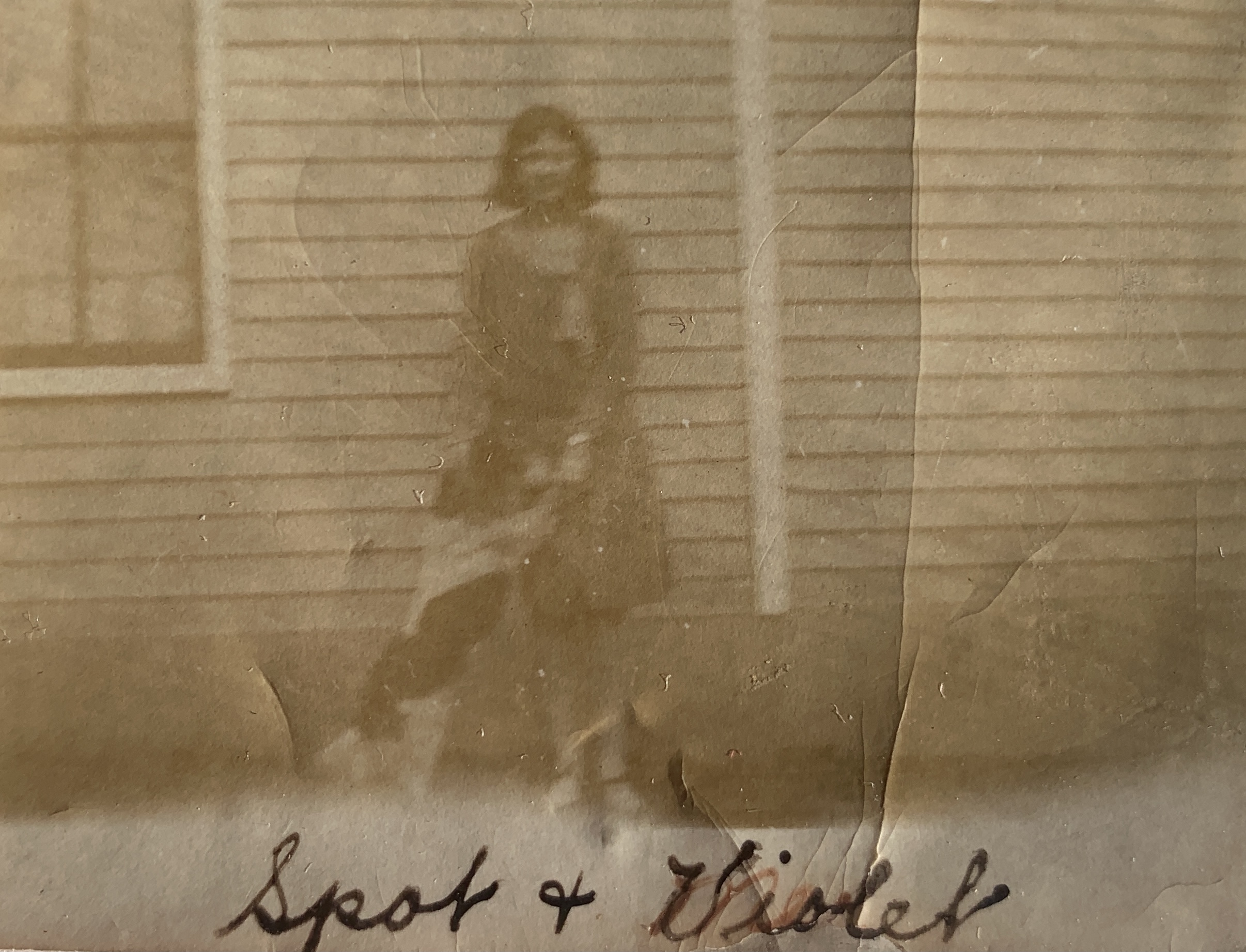
Spot, the Faynes’ farm dog, from my grandmother’s youth. Violet Fayne and her family lived in and around Little Hickman along Sugar Creek Pike in Jessamine County. She was the middle sibling of the five children and was born in June 1913. If she was still living at home when this photograph was taken, it would be circa 1924-1929.
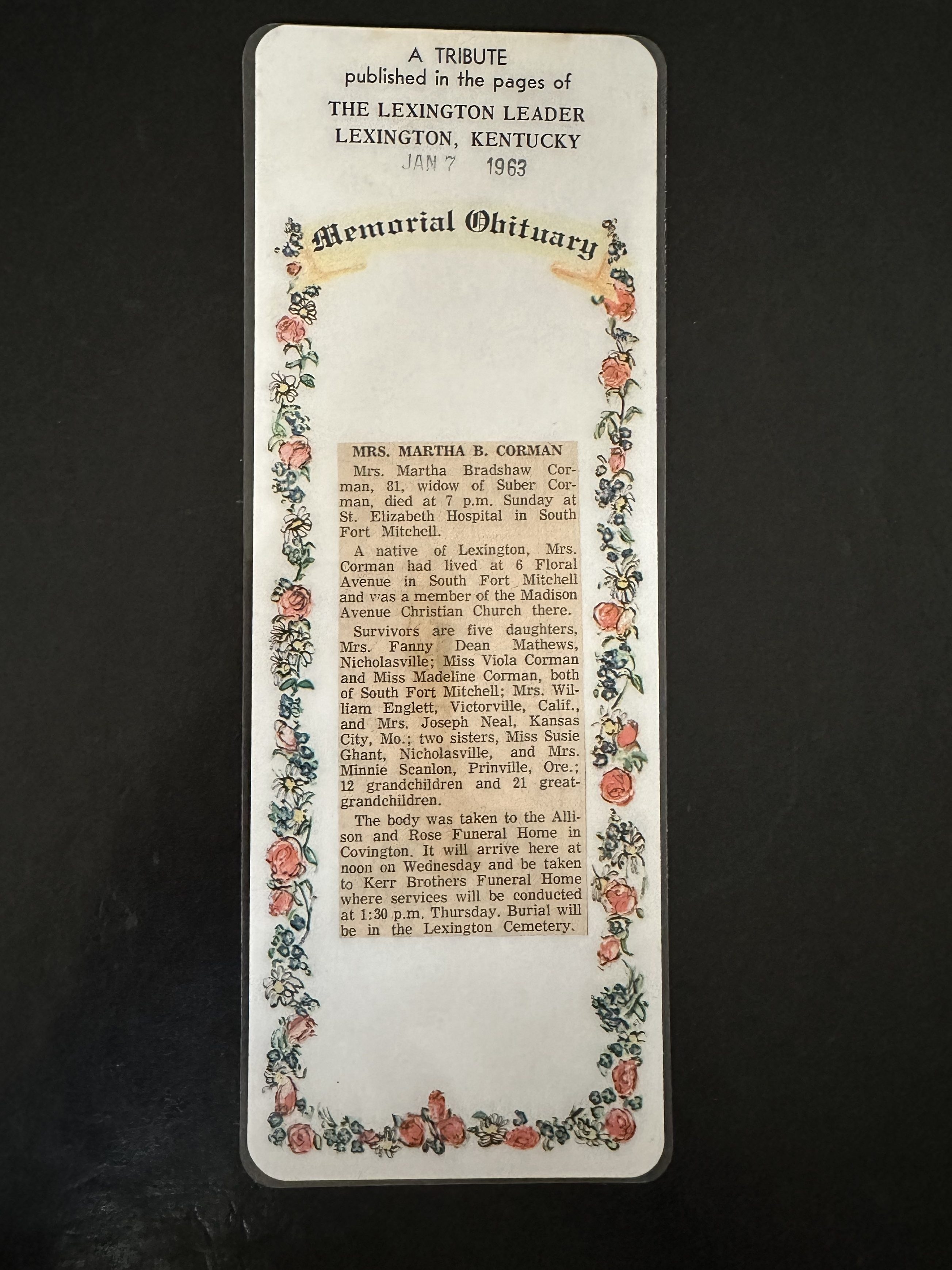
My great grandmother’s obituary produced as keepsakes by the local newspaper. It has been interesting to live as witness to the demise of the print journalism industry.
In Memoriam
HERALD-LEADER
Lexington, Ky. January 8 1963
Mrs. Martha B. Corman
Mrs. Martha Bradshaw Corman, 81, the widow of Suber* Corman, died at 7 p.m. Sunday at St. Elizabeth Hospital, South Fort Mitchell.
She was a native of Lexington. Mrs. Corman lived at 6 Floral Avenue in South Fort Mitchell and was a member of the Madison Avenue Christian Church there.
She is survived by five daughters, Mrs. Fanny Dean Mathews, Nicholasville; Miss Viola Corman and Miss Madeline Corman, both of South Fort Mitchell; Mrs. William Englett, Victorville, Calif., and Mrs. Joseph Neal, Kansas City, Mo; two sisters, Miss Susie Ghant, Nicholasville, and Mrs. Minnie Scanlon, Prineville, Ore; 12 grandchildren, and 21 great grandchildren.
The body was taken to the Allison and Rose Funeral Home in Covington.
It will arrive here at noon Wednesday and will be taken to Kerr Brothers Funeral Home where services will be held at 1:30 p.m. Thursday. Burial will be in the Lexington Cemetery.
One of two examples of obituary keepsakes laminated and serve as bookmarks.
A TRIBUTE
published in the pages of
THE LEXINGTON LEADER
LEXINGTON, KENTUCKY
JAN 7 1963
Memorial Obituary
Mrs. Martha B. Corman
Mrs. Martha Bradshaw Corman, 81, widow of Suber* Corman, died at 7 p.m. Sunday at St. Elizabeth Hospital in South Forth Mitchell.
A native of Lexington, Mrs. Corman had lived at 6 Floral Avenue in South Fort Mitchell and was a member of the Madison Avenue Christian Church there.
Survivors are five daughters, Mrs. Fanny Dean Mathews, Nicholasville; Miss Viola Corman and Miss Madeline Corman, both of South Fort Mitchell; Mrs. William Englett, Victorville, Calif., and Mrs. Joseph Neal, Kansas City, Mo., two sisters, Miss Susie Ghant, Nicholasville, and Mrs. Minnie Scanlon, Prinville, Ore.; 12 grandchildren and 21 great grandchildren.
The body was taken to the Allison and Rose Funeral Home in Covington. It will arrive here at noon on Wednesday and be taken to Kerr Brothers Funeral Home where services will be conducted at 1:30 p.m. Thursday. Burial will be in the Lexington Cemetery.
My grandfather, Pleas Mathews, died from osteomyelitis, a kind of staph infection of bone, reportedly contracted during WWI service while marching with US forces in Germany in worn-out boots and open sores on his feet. I wonder could there have been a parasite or exposure to chemicals? This was back before penicillin. Pleas was with the First Pioneer Infantry-Company I from June 1918 – July 1919, soldiers who built bridges, roads and maintained railroads just behind the front lines while maintaining combat readiness.
From family scrapbook
A well-written account of the First Pioneer Infantry in WWI can be found here in full text. And, I found a photograph of soldiers clearing a road in France in the same period my grandfather was serving there. The visual is powerful in alighting my imagination and the narrative follows Pleas’ journey in detail.
The family lore, if you will, consists of a reported medical study of Pleas’ collar bone regrowth, and the harsh realities in gradual progression of the overall physical toll from his illness or illnesses. Dad says Pleas had open sores over his body and his bones were routinely scraped down then packed with some substance leaving the sores exposed. He cringed as he recalled living with the smell of his father’s rotting bones and flesh. He recounted a story when Pleas bought some snake oil from a salesman in town that Dad said was nasty to taste or smell. They had no idea what was in it and he remembers how that bottle sat up on the shelf afterwards. Later, Pleas improved after receiving a trial of penicillin. His life was saved with the introduction of penicillin but the long-term effects of his illness were a plague for the remainder of his life.
From family archive collection
I’ve found few definitive details about his illness. One source is his WWII draft card I found on ancestry.com and in our family’s archival collection. Dated April 27, 1942, he was a light complexion, 47yo white man with brown eyes, brown and gray hair, weighing 130lbs at 5’7 1/2″ tall. Local (draft) Board No. 88 Jessamine KY registrar, Opal N. Finnell, notes as “Other obvious physical characteristics that will aid in identification” and her handwritten response, “Disabled soldier of last war Collar bone removed.” There are numerous itemized medical bills and receipts of payment during the period of 1946-1953. The pattern of treatments over time tell a grim story for his remaining years. Pleas died in 1955.
I cannot begin to imagine the life of my father in his youth and now regret not being more mindful of every detail he’s ever shared about those years on the ol’ homeplace. He grew up working tobacco on the family farm with his siblings, cousins, neighbors and, for a brief time, with German POWs. Hard working, hard living. A work ethic that epitomizes the definition of the term. Up early to work the farm, off to school, back home to finish chores. Do again the next day. I think of how I get “worn out” from some housecleaning or yard work and his daily life required both kinds of labor plus schooling. That book learning was a Mathews core value.
Pleas lost some use of his arm following the removal of his collar bone. This leaves many unanswered questions, including was this due to an injury from combat? Being the head of the household with limited dexterity, Pleas daily faced physical challenges of maintaining a farm, producing both cash crops and food for the family and farm animals. My dad was the son chosen to labor as literally serving at and as the hand of his father.
Pleas Mathews standing next to Fanny Dean in a family photo circa 1940, 21years after his military service. This image supports the narrative of his infirmary in which his collarbone had been removed following WWI.
Dad said Pleas would cite Bible verses from memory throughout their working hours. Knowing what little I know as a modern-day understanding of PTSD, clues like this make me wonder about his state of mind and whether he suffered the same. The nature of their family dynamics is infinitely intriguing to me through the lens of a soldier’s return home.
From the family archive collection – The Mathews – (left to right) John Shepherd (kneeling), John William Mathews, Pleas Mathews, Fanny Dean (standing), Kenneth Mathews (my father), Marjorie Mathews, Marita Mathews. Circa 1940.
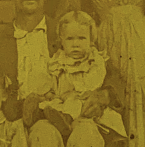
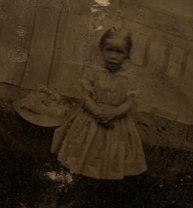
The only images I have found thus far of VIOLA MURPHY, my 1st cousin 2x removed, are in her early youth. She was the only one of her three siblings to live beyond 10 years. As it was, she died at 31yo from tuberculosis.
Viola was the fourth child born to Daniel J. Murphy, Jr., and Mary Bell “Mayme” Bradshaw, both of Mercer County, Kentucky.
Left-to-right: Susie Bradshaw (standing), Mary Bell “Mayme” Bradshaw Murphy (seated in chair), Maudy May Murphy (seated on porch), Daniel Murphy (seated in chair) holding ViolaMurphy in his lap, and Martha Jane Bradshaw (standing). Circa 1898-99.
Just two and a half years before the birth of Viola, mother Mayme had a nervous breakdown. She refused to acknowledge the death of her 15-month-old daughter, Florence. Three years earlier, she had lost her first child, Surber, in infancy, also.
Parents Mayme Bell and Daniel Murphy lost 3 children in ten years.
Family records indicate Maudy May was handicapped in some way. Viola Murphy was only 2yo when her 8yo sister, Maudy May Murphy, died. Based on these facts, the family portrait on the porch must have been very close to the time Maudy May died. It was not a thing to smile in photographs but could this image have captured any more poignantly the layers behind those faces?
Baby Viola Murphy seated on lap of father Daniel Murphy.Viola Murphy from a tin-type
My grandmother, Martha Jane, came to live with Mayme, her eldest sister’s family, to care for them all. The 13yo Martha must have had a special relationship with her very young niece, as she named her second daughter Viola.
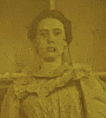
Adolescent Martha Jane Bradshaw, my great-grandmother.
And, in further layers of complexity, my grandmother’s manuscript recounts a falling out between Martha Jane and Daniel Murphy, her brother-in-law. Something happened when Martha Jane lived with the Murphys. It was a hurt that Martha Jane carried into adulthood.
The tragedy and sorrow of the Murphy family household – what a burden for a 13yo young woman to carry as her own caregiving yoke. What an introduction to mothering after losing her own mother when she was only 5yo.
When Viola Murphy died June 6, 1928, she was living in Danville, Boyle Co, KY. She had married Willie Duncan. There are records showing two children, Myrtle Chestnut and Annabelle. This is an area needing further research as I have since found refuting evidence.
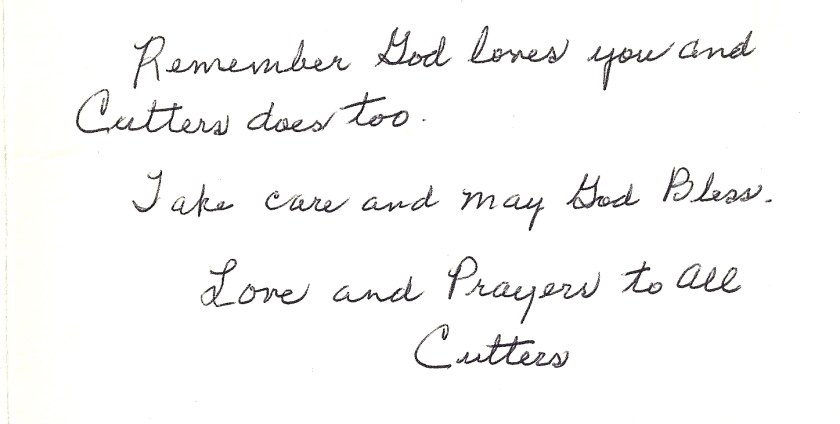
Violet McQuerry became Cutters in her grandmother years. She had a knack for keeping up with birthdays. Like me, cousins would receive a sweet, greeting card each year with a handwritten note in which she would wish happy birthday and provide a slice of life couple of paragraphs from her world. Friends coming to call, the weather and the like.
I remember many years she enclosed a check, never more than $5 or $10. At some point, I stopped cashing them because I liked having the check, itself. This was well before mobile deposits and the thought of forfeiting the money never outweighed wanting to keep her gift – just as it was. Invariably, she ended her notes with a signature. Not just her signed name, I mean. Her signature appears below:
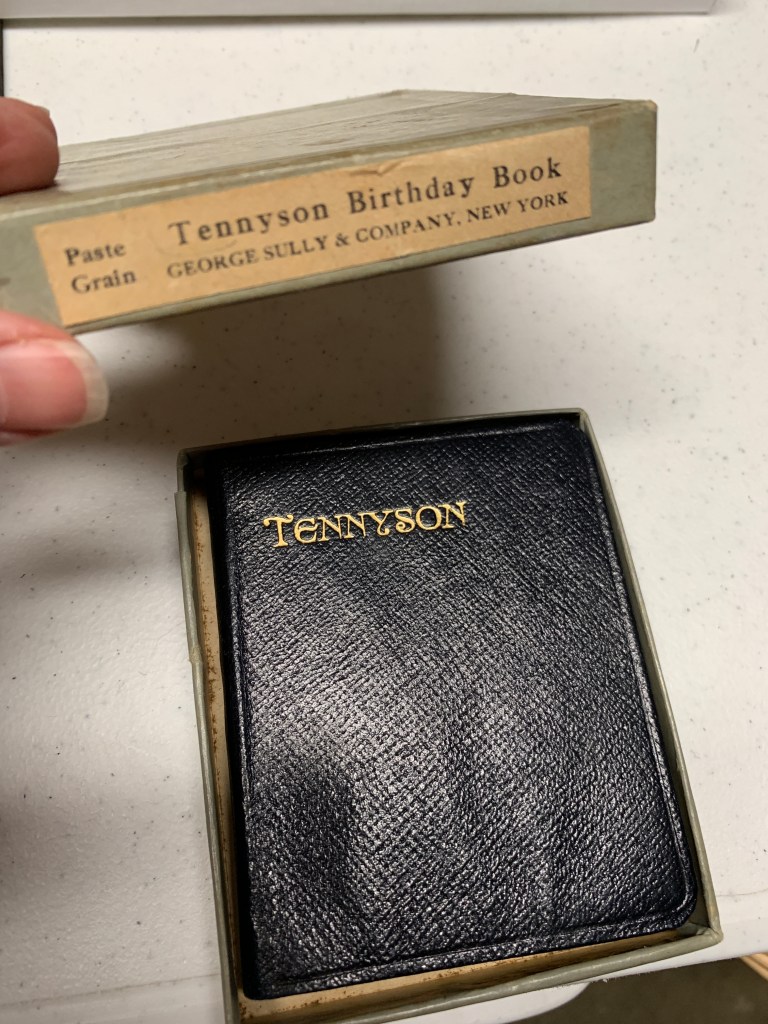
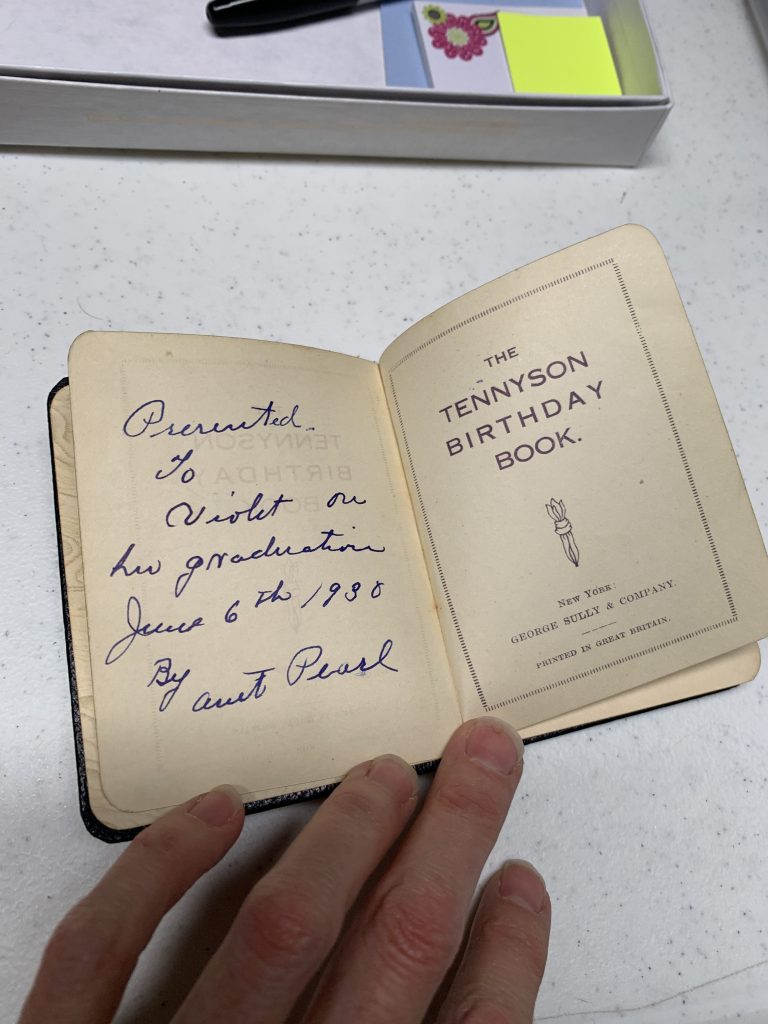
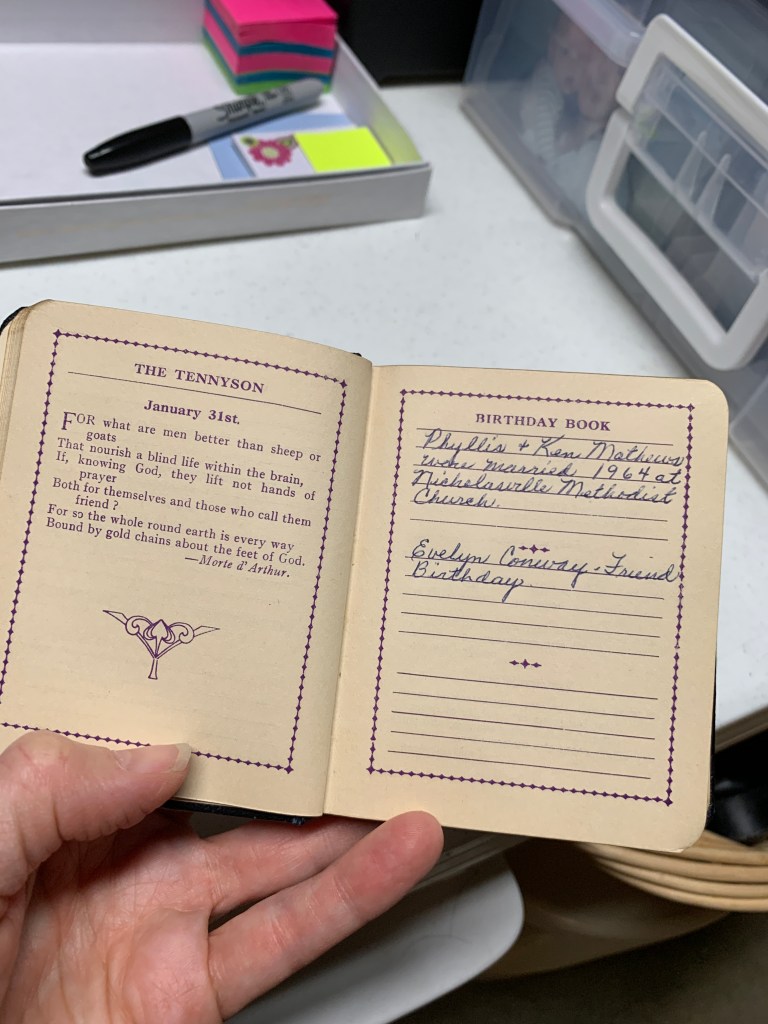
She gave me her first birthday book. A pocket-sized “Tennyson Birthday Book” made in England and sprinkled with quotes throughout the daily, lined sections for recording details. She received it from her maternal Aunt Pearl upon graduating high school in 1930. I believe this was the foundation of Cutters’ lifelong practice of recording and commemorating important family dates.
I found this book helpful in clarifying some answers to questions that were eluding me. And, numerous opportunities to read between the lines of love. Cutters’ love.
Another ancestor I never knew existed in the Mathews with one “t” lineage, thank you Ancestry.com, was named Dr. Joseph McDowell Mathews. His grandfather is my 3rd great grandfather.
This example really floors me for not knowing or being known among family. Additionally, there is not much to commemorate him and his significance appearing in areas of public domain where I think there should be. This is another reason my passion has a purpose. This man deserves wider recognition. I mean, was he the first to say “Turn your head and cough”? If so, I rest my case.
Joseph M. Mathews, MD
With the help of online archives for The Kentucky School of Medicine, a predecessor to the University of Louisville School of Medicine, I located several images of Dr. Joseph McDowell Mathews. He served on faculty at least seven of the graduating class years between 1887 and 1903, but I plan to dig deeper on this point for clarification. Next research visits must include UofL archives.
low-quality screenshot of cropped image online Dr. Joseph McDowell Mathews
1847 Born New Castle, Henry County, Kentucky
He was the fifth child born to Caleb Moffett Mathews & Frances Ann Sullinger Edwards-Beasley Mathews, in Henry County, KY, on May 29, 1847. Father Caleb Mathews was a prominent attorney and judge for the county in the early formation of New Castle. The children of the Caleb Moffett Mathews family were considered “illustrious” and were presumably well-educated, as their father had been. There are references to the Henry Academy and its formation.
You can read more about Caleb and his two Mathews brothers, Joseph & William. These were the only sons of John Mathews, the first Mathews ancestor to settle in Kentucky, and his wife Sarah McDowell Mathews. These three brothers were all younger than ten years old when their father John died. A guardianship arrangement was established with George Moffett in 1816.
If Ancestry.com connections are valid, the McDowells and Moffetts were Revolutionary War Patriots and offer rich layers of exploration along a separate rabbit hole.
Education to physician educator
After his youth spent in Henry County having attended New Castle Academy (a.k.a., Henry Academy?), Mathews attended the medical school in Louisville, KY and graduated at 20yo in 1867. There is more than one reference to him studying medicine in Europe (either London or Germany…or both). His career flourished over the next nine years. He served on faculty of Kentucky School of Medicine, as president of the state board of health, and as chairman of surgery for Medical College of Louisville.
1876
The first reference to Dr. Mathews’ residence and practice as listed in the Louisville city directory was in 1876. Then, the following year, he married Sarah “Sallie” Trumbo Berry of Versailles, Woodford County, KY, on May 29, 1877. They were married in Midway, Woodford County.
Sallie was a 29yo widow and the mother of William F. Berry, born 1867, who Dr. Mathews later adopted. The origin story of William F. was tragic for Sallie, too. Sallie may have had a tumultuous first marriage as indicated by a newspaper clipping reporting when her father, Adam Trumbo, murdered her first husband, William T. Berry, when son William was 5yo. There is more to that story, to be sure. Search in blog for Trumbo for the next installment on this.
Louisville practice
The Louisville City Directory shows Dr. Mathews’ lived and practiced in Jefferson County between 1876 and 1914. Dr. Mathews lived in Louisville as shown in the census records of 1880, 1890, 1900 & 1910.
Between 1876 and 1914, Dr. Mathews’ Louisville practice was located at: 747 Walnut Street, 647 Walnut Street, 289 5th Street, 580 4th Street, 10 Warren Bldg, 342 W. Walnut Street, Mathews & Asman, 411 Masonic Temple, 308 Masonic Temple, 316 West Chestnut Street and, finally, 308 Masonic Temple.
In the same timeframe, the home residences noted in city directories of Dr. Mathews were located: 19th Street, Broadway, Alexander’s Hotel, 518 W. Breckinridge, 923 4th Street, 500 Belgravia Ave, and Louisville Hotel.
By 30yo, Dr. Mathews began narrowing his practicing interests to colon and rectal diseases. What might have triggered such drive? When New York City did not provide for his pursuits, he then went to London to study at St. Marks Hospital. Determination. In 1879, Dr. J. M. Mathews became “the first US physician to limit practice to colon and rectal disease.”
1880
The 1880 US Census shows Joseph M. Mathews, doctor, 33yo, Sallie, 32yo, and William, 13yo, living at “house #186, South Side Jefferson Street” in Louisville, Jefferson, Kentucky, USA. With Dr. Mathews on faculty at Kentucky School of Medicine, Louisville, Jefferson County, KY.
1896
Dr. Mathews served as editor for the Mathews’ Medical Quarterly.
1898
Dr. Mathews elected President of the American Medical Association.
Joseph McDowell Mathews, M.D.
THE MEANING OF THE HONOR
Dr. Mathews is Now President of America’s Greatest Medical
Association and One of the Most Splendid
In the World.
Dr. Joseph M. Mathews of this city who was elected President of the American Medical Association at Denver Wednesday has in that election xxx on of the highest that be paid a physician as this is a national body and comprises every State and Territory in the Union. Dr. N. ??? of Chicago was the President last year, and Dr. ?name, Surgeon General of the army, is the retiring President. Dr. Mathews has had many honors conferred upon him in the past. He is ex-President of the Mississippi Valley Medical Association, President of the Kentucky State Medical Society, President of the State Board of Health of Kentucky, and has this year been First Vice President of the American Medical Association, the great body of which he has just been elected President. A few weeks ago a Pennsylvania university conferred upon him the degree of X.X.D.
The Courier-Journal, Louisville, Saturday Morning, June 11, 1898
1899
From Mathews to the Millennium – A Century of Achievement
A History of the American Society of Colon & Rectal Surgeons, 1899-1999
Written & Edited by J. Byron Gathright, Jr. M.D. and Richard S. Bragaw
1900
The 1900 Census shows their residence as 923 Fourth Avenue, Louisville, Jefferson County, KY. A search for this address turned up in a parking lot adjacent to Spalding University properties, downtown Louisville. I have yet to find images of the house. It is possible there were photos taken by municipal entities prior to the razing.
By this year, son William T. Berry was considered an invalid brought on by illness. He would die from pneumonia in March of the following year.
In 1900, there were at least two other Mathews with one “t” living in Louisville, Kentucky. As of now, I do not find evidence of a connection to these families.
One other juxtaposition of note that I plan to pursue in research: In the 1900 US census, the enumerator lists residents living at 921 Fourth Avenue, presumably next door to the 923 Mathews Family residence. Headed by 58yo Henrietta Long Miller, Samuel A. Miller’s widow of five years, along with their 28yo daughter Eleanor Everhart Miller Bingham, her husband of four years, Robert Worth Bingham, 29yo, and their child, Robert, 3yo.
Much has been written about the Millers, Longs, Binghams in their situations marked by tragedy and grief. Was Dr. Mathews a neighbor of the family that would become pivotal to the development of Louisville as a city? What if any interaction was there? Would any journals they kept hold clues to my own ancestors? Would their family photo archive show their home?
According to the Pewee Valley Historical Society, the Miller family home located at 921 Fourth Avenue was razed to make way for building The Puritan Apartments, which opened in 1917. It stands to reason the house located next door would also have been impacted by the sizeable land project of an apartment building.
1901
Burying babies
And, in further sadness, according to this obituary below, Sallie lived to bury her only son, William F. Berry. His obituary opens up several lines of inquiry, including athletics and baseball in Louisville, a career in Philly and end of life as an invalid.
WILLIAM F. BERRY DEAD
Formerly An Athlete, But Recently An Invalid
William F. Berry, thirty-two years of age, died of a complication of diseases at the home of Dr. J. M. Mathews, 923 Fourth avenue, at 3:xx o’clock yesterday morning. Mr. Berry, formerly one of the best-known baseball players and athletes in Louisville, was an invalid for three years. He first became ill in Philadelphia. After leaving Louisville, he went to the Pennsylvania metropolis and engaged in business. He suffered an attack of the grip, and pneumonia, which later developed, brought an ailment which wrecked his constitution. He was compelled to retire from business.
Mr. Berry was the son of Mrs. J. M. Mathews. The funeral will take place from the residence this afternoon at 3:3o o’clock. The Rev. Carter Helm Jones will conduct the services.
THE COURIER-JOURNAL, 6 MAR 1901 – PAGE 10
1902
Joseph McDowell Mathews, physician, surgeon, author, was born May 1, 1847, in New Castle, Ky. He is president of the Kentucky state board of Health. He is the author of Mathews on Disease, of the Rectum and Sigmoid Flexure.
Herringshow’s Encyclopedia of American Biography of the Nineteenth Century (1902)
The US Directory of Deceased American Physicians, 1804-1929, Dr. Mathews was an “Allopath” with practice specialties and places including in: Louisville, KY, May 5 1911, Los Angeles, CA, November 25, 1915, Seattle, WA, Jan 20, 1925. Licenses: KY, 1893. Professorship: Louisville and Hospital Medical College, Louisville surgery, JAMA Citation 91:1910
Sometime after 1901, Dr. & Mrs. Mathews changed their residence to Los Angeles, CA. Did Sallie need to change her scenery following the death of her son? Dr. Mathews’ practice sites included: Seattle, Los Angeles, Louisville. Was he in demand as the foremost practitioner on his area of focus?
1920
The 1920 Census Los Angeles Assembly District 64, Los Angeles, California; Page 13B; Enumeration District: 228. Joseph M. Mathews, 72yo, living on So Carondelet Street as Head of House, married to Sara E. Mathews, 68yo. Renting.
California to paradise, but Kentucky remains
1928
After an illustrious career and presumably a choice retirement, Dr. Mathews died from pneumonia at 80yo in Los Angeles, CA, on December 2, 1928. He and Sallie were living in the Shoreham Hotel, Carondelet Street in their eighteenth year as California residents. Would the Shoreham be as swanky back then? I suspect so. OG swanky.
Obituary, 1928
DR. JOSEPH MATHEWS DIES
LOS ANGELES – Dr. Joseph McDowell Mathews, 81, former president of the American Medical Association died here . Dr. Mathews came to Los Angeles 18 years ago from Kentucky, where he began his career after he was graduated from the University of Louisville. Born at New Castle, Ky., Dr. Mathews went to London in 1879 and on returning to Louisville became a pioneer in proctology and was the first presidnet of the American Proctologic Society.
Lexington Herald-Leader, December 3, 1928 (their typo, not mine)
She was 78yo. His wife, Sallie, died 18 days later and her funeral services were held at Little Church of the Flowers, Forest Lawn Memorial Park, Glendale, CA. Dating back to 1906, the Glendale location was the first Forest Lawn Memorial property. Of the network of parks, this original location today features the Forest Lawn Museum.
Obituary, 1928
MATHEWS, December 20, 1928, at the Shoreham Hotel, Mrs. Sallie E. Mathews, widow of the late Dr. Joseph M. Mathews.
Funeral services will be held Saturday, December 22, at 11 a.m. at the Little Church of the Flowers, Forest Lawn Cemetery. A. E. Maynes of the George A. Fitch, Inc., director, (Seattle and Louisville papers please copy.)
The Los Angeles Times, December 22, 1928, Page 16
“Dr. Mathews wrote a booklet on Proctology, a subject he originated and was the first Orthodox physician in the world to adopt proctology as a field of practice.”
Dr. & Mrs. J. M. Mathews were cremated and without memorialization, now side-by-side at Cave Hill Cemetery. A brief stop at the office confirms by map their location adjacent to the drive just up the hill from this administrative building. Their sites are without markers but aside the headstone for William F. Berry. They are there with the son but anonymous in the deep ground around. They left no children, also referred to as “without issue” which makes me wonder if they were close to their nieces and nephews?
Was that no-marker decision rooted in humility, anonymity or something else? No will of either among my records yet.
1938
According to the February 1991, every other year beginning in 1938, the American Proctology Society commemorates founder Dr. Joseph McDowell Mathews with The Joseph M. Mathews Oration.
What did the society publish? Where are those records? Was this a convention event?
Another doctor in the family
The Henry County Historical Society has been in transition recently but I plan some summer 2023 research road trips that will allow me to move closer in my understanding of the Mathews family in New Castle. And then, Danville.
Next, I will share about the connection to Dr. Ephraim McDowell, another cousin, 6x removed from me, who is famous as a pioneer surgeon for performing the first ovariotomy in Kentucky.
that.Kentucky.girl
A 6th-generation Kentuckian on a journey to find out – follow along
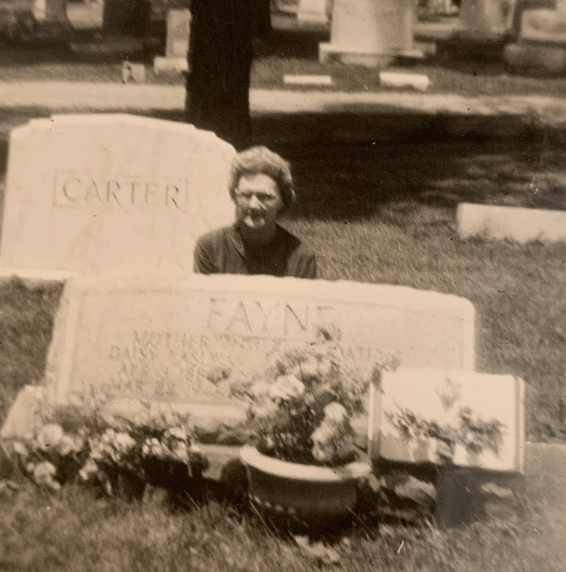
Many family members are interred in the Nicholasville cemetery, now known as Maple Grove Cemetery. I have been visiting Maple Grove since the 1970s on special occasions, funerals and otherwise. When I was very young, I could see the cemetery from the porch of Cutters & Granddaddy’s home on Richmond Ave. They lived in this house when they moved to town from Sugar Creek Pike. My grandmother (shown above) could see her own parents’ headstone from that porch. There is something sweet about that to me.
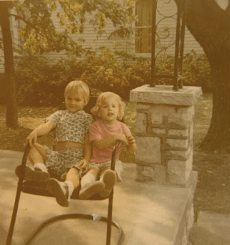
My cousin and I sitting on the porch together of Richmond Avenue home. If the photographer panned right, there you would see Maple Grove.
Maple Grove Cemetery was formed in May 1849 near downtown Nicholasville. The first person to be buried there is named Brown. He had a role in the formation of the cemetery, as well, prior to his death. The original entrance to the cemetery was from Richmond Avenue, known then as Union Mill Road. Very close to that entrance is where my paternal grandmother, a widow, and my maternal grandparents lived as neighbors for a time when my parents met.
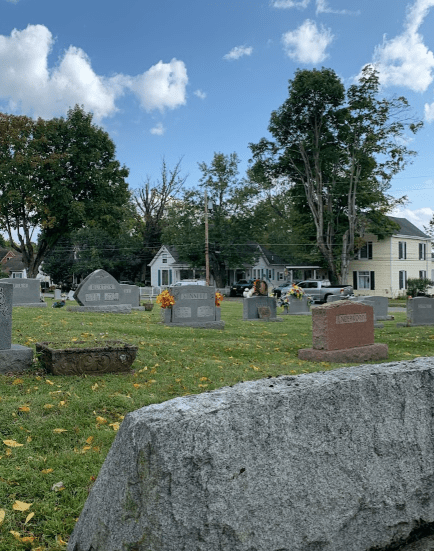
Present-day view from the Fayne headstone looking back at the homes on Richmond Avenue, Nicholasville, Jessamine Co, KY
I captured images as I walked around the 20+acre grounds on a recent visit to Nicholasville, KY. Most visits, we follow a memorized route from Main Street to Cutters’ & Granddaddy’s headstone. Near there, we can walk to a few other family sites. More recently, I found there are many more ancestors than I’ve ever known buried there, including Cooks, Cormans, Mathews, McQuerrys, and more.
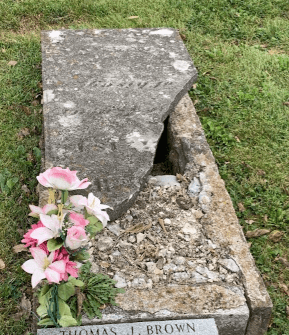
The condition of Brown’s grave fascinates me with its partially destroyed cover stone, the bright flowers and modern marker which was dedicated in 2007 by the Jessamine County Historical Society. I learned the style of stone that covers the entire grave is a full ledger marker. I wonder: were there words on that stone at some point?
Our regular family trips to Nicholasville ceased when Cutters passed in 2014 but I like to stop by Maple Grove whenever I am in the area. With the intention of honoring every single body that now forever rest at Maple Grove – including my ancestors.
Each step on this journey reveals excitement in discoveries but always with a bittersweet tinge for what is lost by never being recorded. The more I learn, the more I realize there is much I can never learn. That is inherent in the work of genealogy.
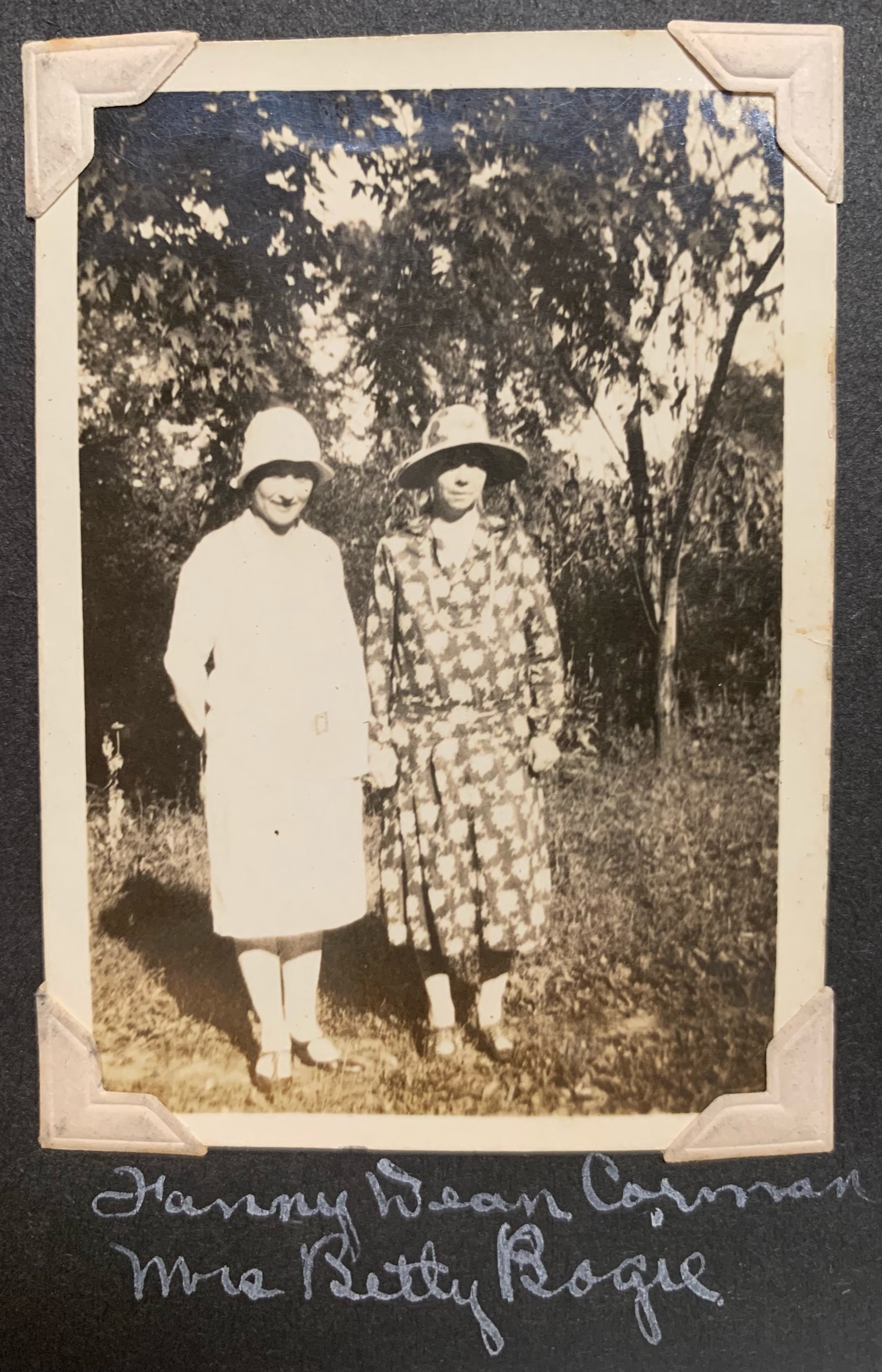
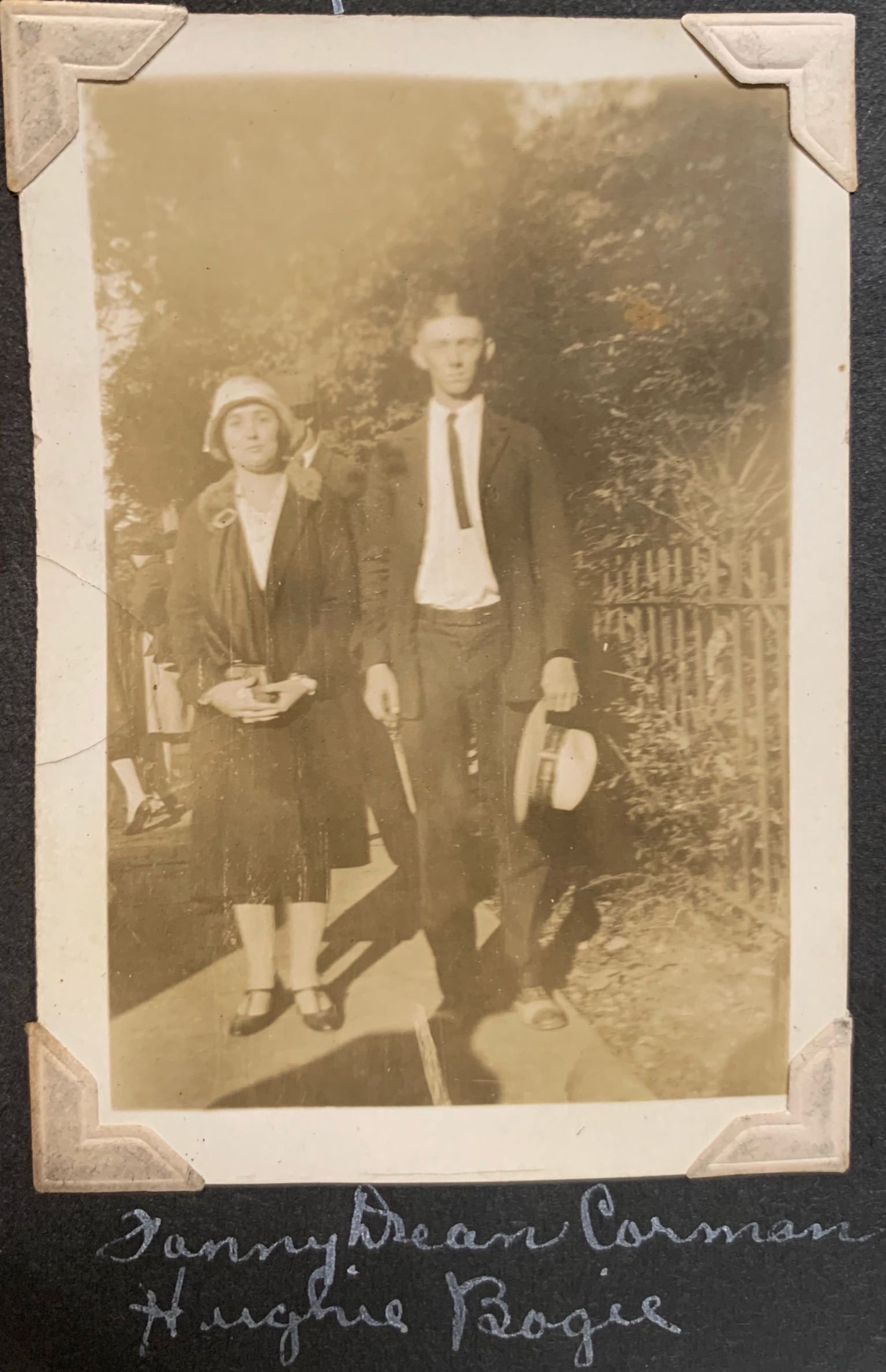
Here’s what I learned: These photos are all related and appear to be around the 1920s-1930s. Firstly, my grandmother Fanny Dean is in each one and she is approximately the same age in each. Also, three different members of the Bogie family are featured.
A quick check in ancestry.com & Google search located Betty Dean Bogie, mother of Rella, who lived in Nicholasville, KY the same time as my grandmother and who is buried in Maple Grove cemetery, as are many of my family members, including my grandmother.
My 28yo grandmother was a school teacher early in her career when in November 1930, she married a 36yo widower with a 5yo son. I do not know how they met or reconnected when she returned to Jessamine County from Missouri. Historically, rural one-room schoolhouses served concurrently varying ages of students from the adjacent communities. In those years teaching, Fanny Dean would board with families in a particular area where she taught. This period aligns with the timeline of her life as I understand it. Maybe she resided with the Bogie family during one of those stints. That is one theory.
Another is that Fanny “Dean” and Betty “Dean” may have been relations of some kind. Whether family or patrons, this family was significant to my grandmother. I did not find any references to Hughie in Fanny Dean’s writings but he is also the child of Betty according to some quick ancestry.com searching for connections.
Rella Bogie with Fanny Dean Corman (Jessamine County, KY)Fanny Dean Corman with Mrs. Betty Bogie (Jessamine County, KY)Fanny Dean Corman with Hughie Bogie (Jessamine County, KY)
that.Kentucky.girl
A 6th-generation Kentuckian on a journey to find out – follow along
Love of animals can be inherited, right? I did not have the experience of farm living as most of my extended family did. I did not get to know reliance on other creatures for living as on a farm. I speak from a place of recognition and honor of my own ignorance. I have enjoyed, though, many pets in my life.
My own first pet was a turtle. We got Toby, a Cock-a-Poo (cocker spaniel+poodle) for our family dog in the mid-1970s and numerous pets came and went thereafter. Often, my parents “hosted” – a somewhat reluctant state, if memory serves. An iconic black cat named Puddy Tat lived with me – and a few other kind souls – from new born kitten when I was in college until the birth of my second baby – a good long life of sixteen years. Then, I have a series of stories about the puppy tales from my years mothering my own young ones, but that is a different blog.
Looking at these old photos of family, some featuring the animals of the farm, I wonder about their natures – what manner of beasts. Of course they had personalities, and they had relationships with their humans. Dad has told us stories, like the one about his younger self (not more than 10yo) milking cows at 4am, running into a bull in the dark one morning, and the reaction they both had being startled. Some stories are poignant lessons of surviving on the farm, most are funny as to hear a Mathews tell it. Some are heartbreaking.
From the family photo album circa 1930
Take Ring, for example, featured in images from when Mr. and Mrs. John S. Mathews lived in the “big” house, as my Dad recalls first knowing it. Mr. & Mrs. Mathews – they were my Dad’s grandparents, who both died within a month of each other in 1940 when Dad was barely five. They lived to 76yo and 71yo, respectively. Ring served their farm and according to other photos in the family archive, there were possibly two other collie-type dogs well-loved on the farm after Ring.
I doubt Ring was an inside dog. I gather from my father that was NOT a thing back then and ESPECIALLY no where near any kitchen. So, likely Ring slept in the barn or some other cover when it was cold. Ring looks most like a border collie and herding IS a farm job. I imagine I would feel very affectionate for the dogs guarding the homeplace and alerting to visitors, dangers and otherwise. In my memory, there was a long drive from Harrodsburg Road back to the house and included more than one fence gate and crossing a bridge at the creek. In other words, some ground to cover as a runner, whether four or two feet.
Here’s my question: Why is Ring posed solo in a portrait? It suggests to me Ring wasn’t considered just an old farm dog to whomever took the photo. It looks like Ring is smart, eager to please, has something in the mouth and is wearing a collar with a tag. Maybe Ring knew a few tricks, too. “Sit” being a good bet.
Cut to modern days. Now we dress our pets for special occasions, the stores are filled with varying gourmet feed, toy and treat options. I do not leave my pup outside in the cold. He’s always been an inside dog and I have the traveling tumbleweeds of hair and dander to prove no matter how often I run the vacuum. He, too, is a smart dog and I have pictures and video on my phone as evidence. I am certain he would love to run himself out in farm living, as would I.
that.Kentucky.girl
A 6th-generation Kentuckian on a journey to find out – follow along












 that Kentucky girl