I access TV using a digital antenna because it is free on a relatively reliable signal. The upside is that KET offers a special variety of choices. BBC World News, Kentucky Edition and PBS NewHour is my preferred cocktail for evening media. Occasionally I stumble upon gold in my channel surfing and the series Headwaters by Appalshop is often the source.
This afternoon, I was able to catch some of “Justice in the Coal Fields” a 1995 documentary by Anne Lewis about the 1988 United Mine Workers (Virginia) strike against the Pittston Coal Company that explores a number of themes resonating for Kentucky, as well, including civil disobedience, right-to-work states, justice and the law. And, Appalachian history and culture.
Although dated in all aspects, the film’s interviews and images hit home for me. I do not know of any coal miners in our family, at least not yet in my research. It is more from the spirit and personalities of the people. The character and characters of the community, their sense of community – that is what I remember from my youth. I cannot yet articulate fully how but I am reminded of my family.
I am grateful there are resources featuring the history, both distant and recent, of the people of Appalachia and beyond. As I am working to create the threads of narrative about my ancestors, I appreciate how these stories are captured. Perhaps even one person will discover someday a missing piece of their own genealogical pursuits in what Appalshop has made available. And, you can stream and purchase episodes of the Headwaters series from KET Passport and from Appalshop.org.
Help with restoration of these treasures
Historic flooding in late July 2022 brought catastrophic damage to the resources held by Appalshop in Whitesburg, KY. Efforts are underway to recover as much as can be saved. Learn more and consider sending contributions to: Appalshop in Whitesburg, KY 41858
that.Kentucky.girl
A 6th-generation Kentuckian on a journey to find out – follow along
I am so lucky to have learned about the land office loot for researching geek outs.
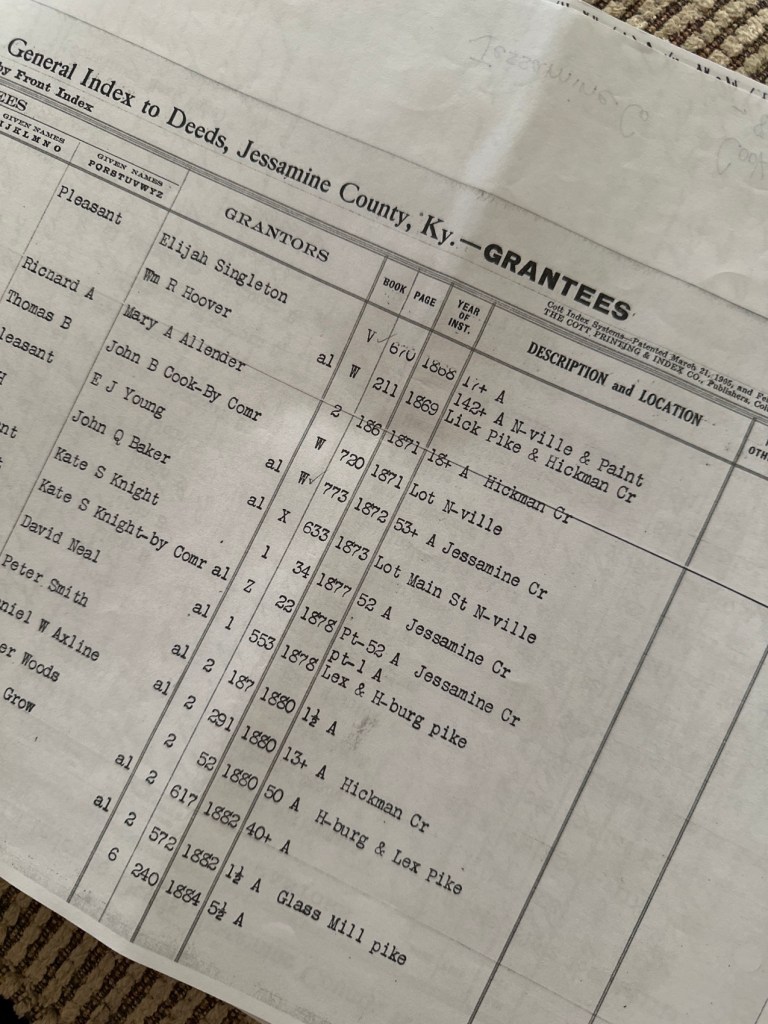
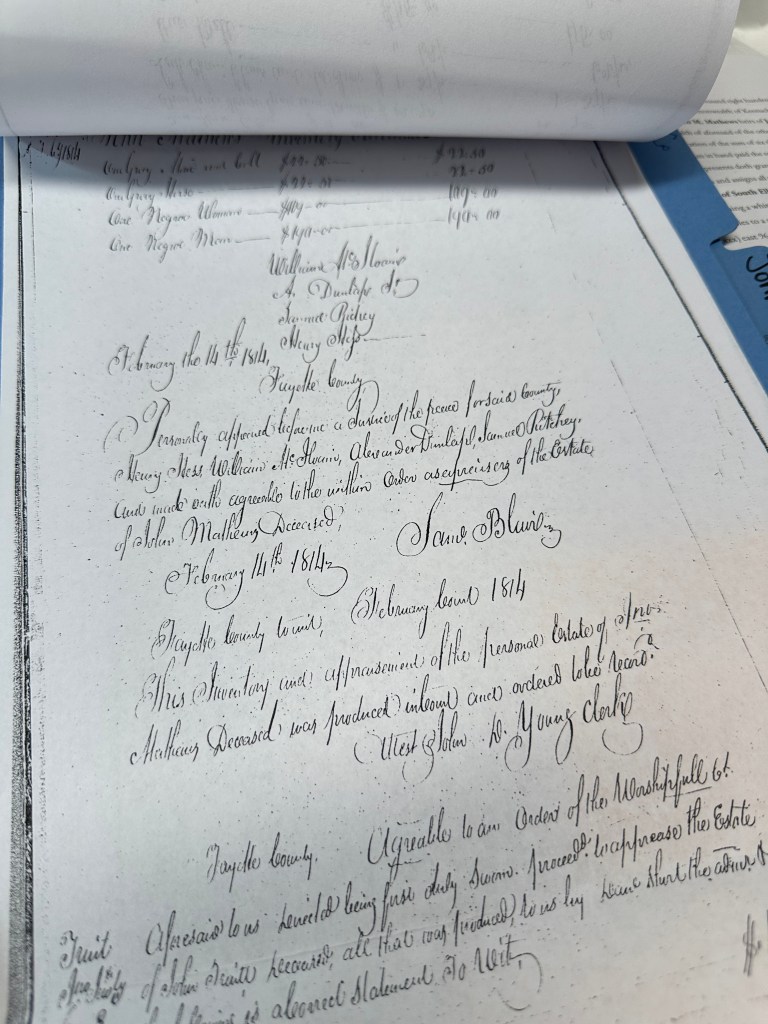
In the earliest of legal records, you will find a certain style of handwritten accounts when transactions became legally binding. Surprisingly few scribbled errors to which I give mad respect, particularly imagining a quill and ink well as the tools. Esoteric terms and colloquialisms in cursive on big pages can be overwhelming at first. Thankfully, at some point, there was a transition to typewritten records, as you see in the photo above, when later those earliest records were indexed.
Make a list using indexes
Here are some things I learned as I fumbled my way through my first visit to a county clerk land office. It happened to be Jessamine County County Clerk’s land records office located in the courthouse, downtown Nicholasville, KY. We arrived on a day when a wonderfully helpful fellow researcher offered up tips. She was in the office for title research and could tell I was without a clue. Soon, I got the basics and took off, as did Dad who wanted to walk around the town a bit. We were both happily engaged in our pursuits so it was a win, win.
First, I learned these indexes are listed alphabetically by surname groups. I started with my parents’ names and opened the Grantee records index first. From these indexes, I was able to note the names of the parties, the year recorded, a Volume and Page reference and a brief description. Usually, this was an acreage notation in the index, if a land record.
After jotting down my list of those references, next I turned to the bound records index of the Grantors – a different set of books. The two sets of lists served as my road map for moving forward in the research. I learned a great deal by trial and error.
Ledger volumes
In essence, you work backwards from the Indexes by compiling a listing of name/volume/page references. Next, to locate the full language of the record, you go pull out the respective volume. The deed records themselves were handwritten on tabloid-size paper and bound into large, heavy volumes. Records were captured chronologically within these oversize ledgers.
In each of the counties I have visited to research, the ledger volumes are stored on open shelving. Some storage space is limited and the older records are not as accessible or prominent. Because I could not possibly stay the length of time it would take to transcribe these resources, I needed to make copies.
Be prepared for a self-service situation in both reaching shelves and copying pages. The preservationist in me was especially careful in handling what was at times a delicate situation with pages showing wear and tear from the years.
My personal preference is to have actual size copies but it is more common to get reduced size pages. Take cash with you for any copies you make. At this time, capturing cellphone images is against Kentucky law so don’t try. This is precisely why I do not have an image to share of the impressive shelving of resources. You just need to go check it out yourself, in person.
One thing I find interesting is how the records have evolved. This county began with Book A~Book Z, then numeral 1 and forward. When you see these listings and references in research, it is safe to assume the oldest records are in volumes at the beginning of the alphabet. It may be helpful to find out what year the county was founded. The evolution of Kentucky’s current 120 counties from the original 3 counties can make this aspect of research a bit daunting. Stick with it, I say.
that.Kentucky.girl
A 6th-generation Kentuckian on a journey to find out – follow along
JOHN MATHEWS – This man has eluded me for several years now. Finally, I was able to connect the Mathews line back to him as my 3rd-great-grandfather. Records confirm mostly as his headstone reports his birth date as February 20, 1773, and death on December 18, 1813. I commonly find references to Augusta County, Virginia, his birthplace in my research. I am learning much about the development of land boundaries, the morphing of counties and the complexity of searching in multiple locations for the same thing. What was called Augusta County might soon be called Staunton but refers to the same spot.
The name John Mathews was common and was (is) often misspelled as Matthews, also a common surname at the time. (Yes, that extra “T” is a mistake, an assumption on your part, but I digress…). His father was William and his mother Mary. Also, common names. In fact, I have located two sets of William & Mary Wright Mat(t)hews parents of large families. John is reportedly the 9th of 11 children born to William and Mary Wright.
I find it curious that John was comparatively older for the time period when he married. I will continue to look for evidence of any first marriage or otherwise an explanation for his relative delay in starting a family. That being said, John Mathews (31yo) married Sarah “Sallie” McDowell (20yo) in 1804 and they had four children:
Son, Joseph McDowell Mathews, b. December 8, 1804 in Augusta, VA
Son, William Harvey Mathews, b. December 29, 1806 in Augusta, VA
Daughter, Margareet Mathews, b. October 29, 1808, died 1809 in Augusta, VA
Son, Caleb Moffett Mathews, b. October 27, 1810 in Staunton, Augusta, VA
John, his young wife Sarah and their three boys – 9yo Joseph, 7yo William and 3yo Caleb, settled in Fayette Co, KY in 1813. (I am fully prepared to discover that Fayette Co was formed from Augusta VA.) There was a William Mathews who died in Augusta, VA in 1811 who named his executor as his son, John Mathews.
In December of the year following their arrival to KY, John died at 41yo. Sarah, 30yo, was far away from her family, had three young boys and was a widow in winter, grieving at Christmastime. I am learning other family members settled in the area and she may not have been facing the dire circumstances on her own the entire time. The way these three children grew up appears to have effected them with a drive for pursuits. They each realized a level of professional success as an educator, a merchant and a judge. They were sent to school, a now historic school, known as Kentucky Academy, Marshall Academy, and other names, will be covered in more depth later.
Fayette County Records
June 2022: I had the best experience visiting the Fayette County Clerk‘s Office in downtown Lexington twice this year. The land records division is headed by a Kentucky native, Deputy Clerk Mr. Shea Brown, who I later saw featured in a KET broadcast about the Digital Access Project. The equipment they utilize yields quality images and they are extremely helpful so I am really happy they have this opportunity to provide virtual access for a wealth of records. But, as I can attest, the in-person experience with this office was wonderful and fruitful.
DEED 1793: John Mathews, Fayette County
The Fayette County 1793 deed signed by Levi Todd, grandfather of Mary Todd Lincoln.Other names referenced include: John Rogers, Jacob Troutman, Adam Troutman
ESTATEINVENTORY February 1814: John Mathews, deceased – This confounds me because his recorded death date is December 1814. So, was there more than one John Mathews in Fayette County?
DEED November 10, 1818: George Moffett for Mathews, Joseph, William H. & Caleb.
A deed of indenture was written in 1818 between George Moffett (again with the Moffett name and further research needed) and the three heirs of John Mathews for $6,570 along with 120 acres of land in Fayette Co on the waters of South Elkhorn. Another deed references being part of a “settlement” lying in Fayette Co on Davey’s Fork, a branch of Elkhorn. The General Index references David’s Fork.
My Dad, who trained as a surveyor while attending UK engineering school, provided his analysis of the land as described in the deed. To his calculations, the parcel exceeded the 100 acres noted in the deed. With so many references to ephemeral landmarks – black walnut, elm and buckeye, it might be virtually impossible to determine exactly. Or that is his assessment. He did sketch the shape, distance and degrees.
The culminating depiction through these three documents appears consistent. As best I can estimate, their home was near present-day Keeneland and the Kentucky Castle, perhaps somewhere along US-1967 (the year I was born, by the way). I fear that will be a much bigger undertaking that may end up inconclusive. It is on the list for later.
This parcel of land crossed over into Woodford Co and adjoined the land of Sarah (Mathews) Price, who had remarried in 1816 to Larkin Price. It appears Sarah had five children by Price, including Larkin Foster Price, a noted lawyer, state legislator and Judge in Texas who is buried in Alamo Masonic Cemetery, San Antonio, TX.
It is possible Sarah’s mother, Margaret Moffett, died in Woodford Co that same year and possibly the same month as the marriage. What are the circumstances for Margaret’s death? It is very easy to get your head turned around in trying to navigate the McDowell and Moffett families. More on that to come.
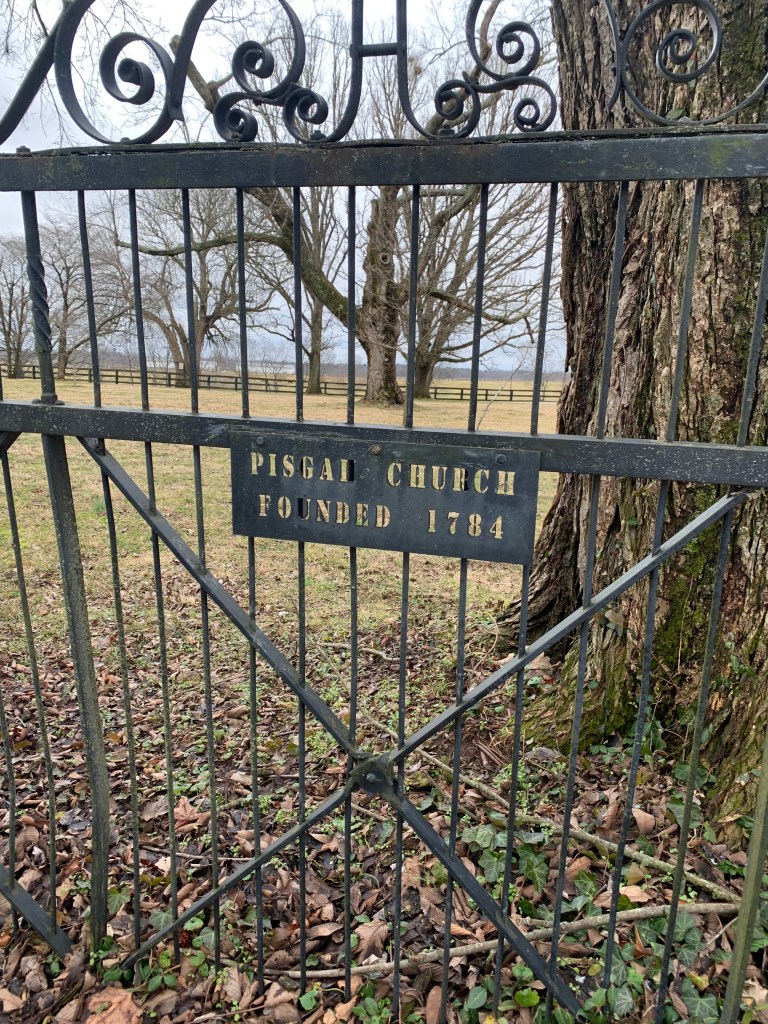
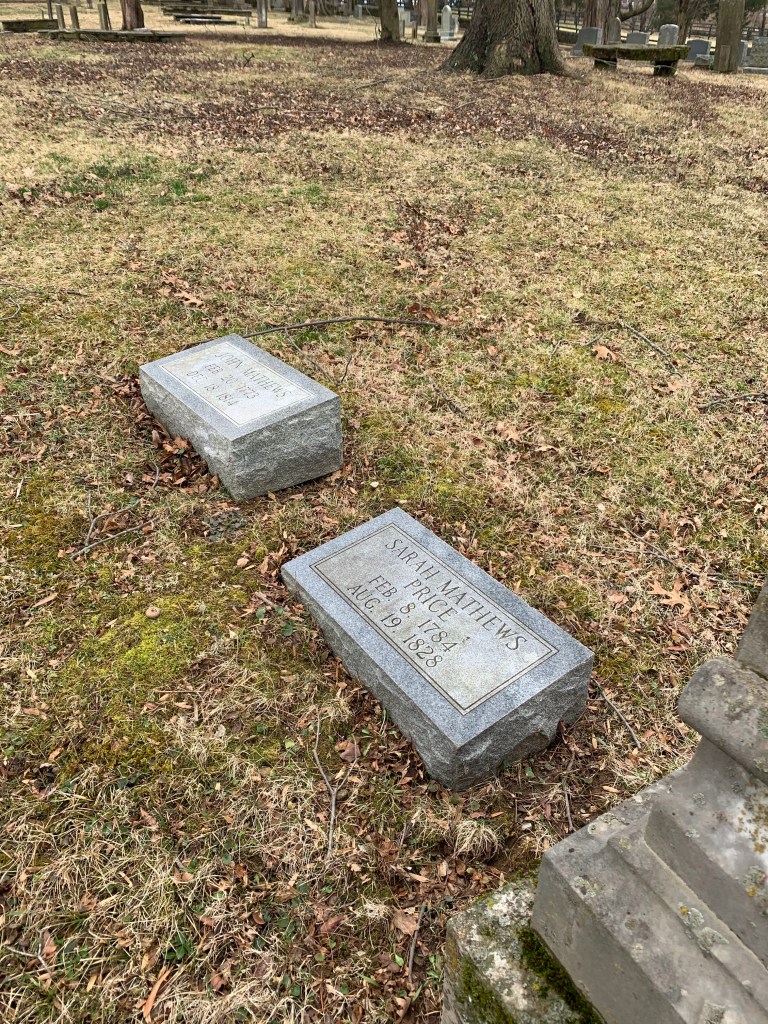
Sarah Mathews Price is buried in the Pisgah Presbyterian Church cemetery, Versailles, Woodford Co, KY, between John Mathews, her first husband, and Larkin Fahr Price, her second husband. She outlived them both, so she had the final say.
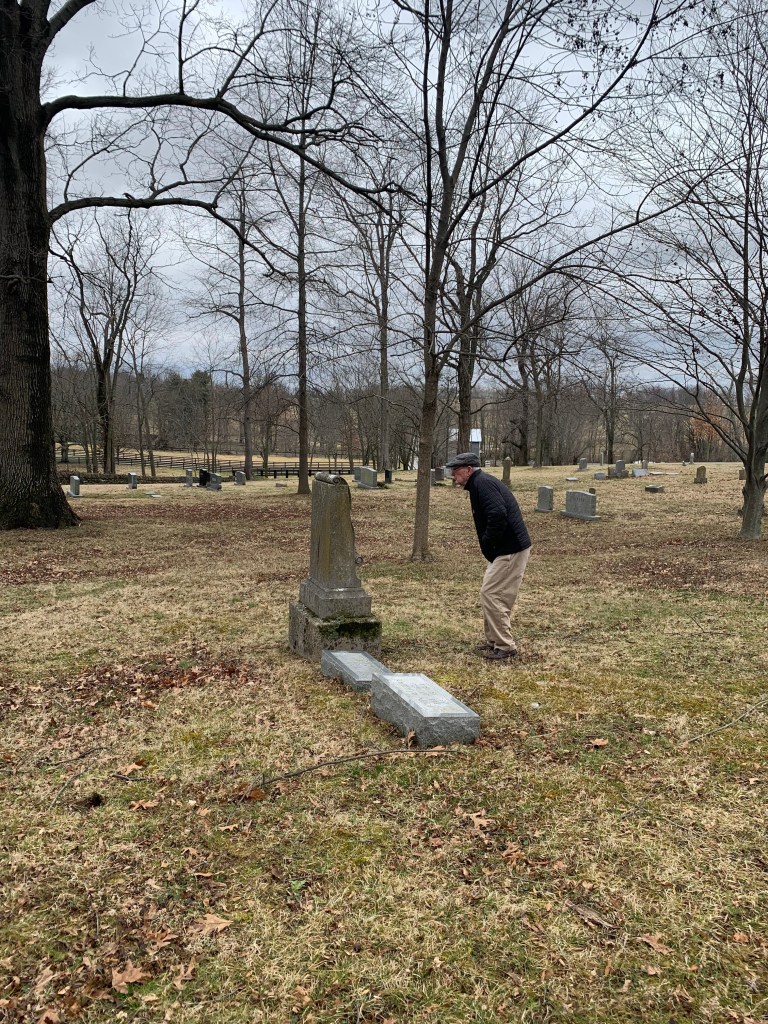
My Dad with me on a recent research trip who was surprised to find Happy Chandler’s headstone as we wandered. After looking around a good while in fairly cold temperatures, we found the graves of John Mathews and Sarah McDowell Mathews Price, his great-great-grandparents. I do not think my Dad had ever been to their graves before this day. The taller, much older headstone belongs to Larkin Price, Sarah’s second husband. Both John and Sarah’s headstones have been updated. My question: by whom and when?
This is where I have paused. I feel the need to have more proof before I move beyond this generation. If the details I’ve compiled from records are accurate, Sarah’s parents’ families – the McDowells and the Moffetts – were Patriots and Revolutionary War heroes. Seeing the “McDowell” and “Moffett” middle names of the children supports the theory that Sarah was, in fact, from this same prominent family. But, I continue to explore these connections for additional confirmation.
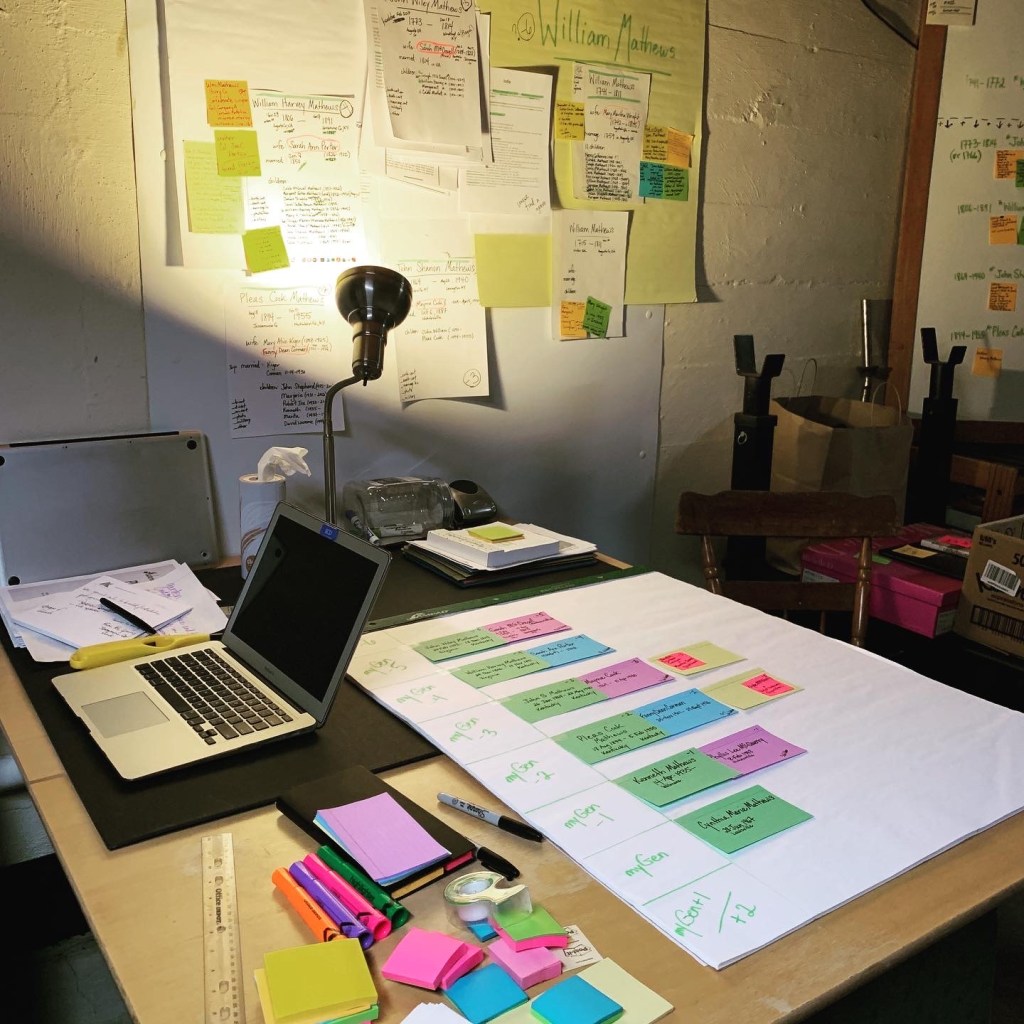
The scope of this current project (updated August 2022) is the result of 12 years active research and 3 years in earnest. Ancestry.com has been an invaluable tool both for discovery and organization. The scaffold is set. I am confident in the fourth- and fifth-generation connections and have acquired enough formal documentation to support the validity of research to all eight sets of great-great grandparents.
The next phase of research is to build the narratives to better understand the lives of these ancestors. And, to dig even deeper with confidence in reaching the far branches. Gratitude for the modern advances and tools.



![[ARTIFACT] 1984: The Jessamine Journal, Thursday, October 18, 1984](https://thatkentuckygirl.com/wp-content/uploads/2023/07/screen-shot-2023-07-24-at-6.11.07-pm.png?w=89)
 that Kentucky girl