Osteomyelitis echoes

My grandfather, Pleas Mathews, died from osteomyelitis, a kind of staph infection of bone, reportedly contracted during WWI service while marching with US forces in Germany in worn-out boots and open sores on his feet. I wonder could there have been a parasite or exposure to chemicals? This was back before penicillin. Pleas was with the First Pioneer Infantry-Company I from June 1918 – July 1919, soldiers who built bridges, roads and maintained railroads just behind the front lines while maintaining combat readiness.

From family scrapbook

A well-written account of the First Pioneer Infantry in WWI can be found here in full text. And, I found a photograph of soldiers clearing a road in France in the same period my grandfather was serving there. The visual is powerful in alighting my imagination and the narrative follows Pleas’ journey in detail.

The family lore, if you will, consists of a reported medical study of Pleas’ collar bone regrowth, and the harsh realities in gradual progression of the overall physical toll from his illness or illnesses. Dad says Pleas had open sores over his body and his bones were routinely scraped down then packed with some substance leaving the sores exposed. He cringed as he recalled living with the smell of his father’s rotting bones and flesh. He recounted a story when Pleas bought some snake oil from a salesman in town that Dad said was nasty to taste or smell. They had no idea what was in it and he remembers how that bottle sat up on the shelf afterwards. Later, Pleas improved after receiving a trial of penicillin. His life was saved with the introduction of penicillin but the long-term effects of his illness were a plague for the remainder of his life. 

From family archive collection

I’ve found few definitive details about his illness. One source is his WWII draft card I found on ancestry.com and in our family’s archival collection. Dated April 27, 1942, he was a light complexion, 47yo white man with brown eyes, brown and gray hair, weighing 130lbs at 5’7 1/2″ tall. Local (draft) Board No. 88 Jessamine KY registrar, Opal N. Finnell, notes as “Other obvious physical characteristics that will aid in identification” and her handwritten response, “Disabled soldier of last war Collar bone removed.” There are numerous itemized medical bills and receipts of payment during the period of 1946-1953. The pattern of treatments over time tell a grim story for his remaining years. Pleas died in 1955.

I cannot begin to imagine the life of my father in his youth and now regret not being more mindful of every detail he’s ever shared about those years on the ol’ homeplace. He grew up working tobacco on the family farm with his siblings, cousins, neighbors and, for a brief time, with German POWs.  Hard working, hard living.  A work ethic that epitomizes the definition of the term.  Up early to work the farm, off to school, back home to finish chores. Do again the next day.  I think of how I get “worn out” from some housecleaning or yard work and his daily life required both kinds of labor plus schooling. That book learning was a Mathews core value.

Pleas lost some use of his arm following the removal of his collar bone. This leaves many unanswered questions, including was this due to an injury from combat? Being the head of the household with limited dexterity, Pleas daily faced physical challenges of maintaining a farm, producing both cash crops and food for the family and farm animals. My dad was the son chosen to labor as literally serving at and as the hand of his father.
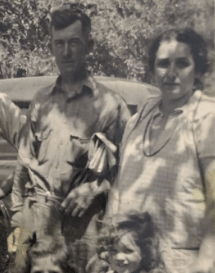
Pleas Mathews standing next to Fanny Dean in a family photo circa 1940, 21years after his military service. This image supports the narrative of his infirmary in which his collarbone had been removed following WWI.

Dad said Pleas would cite Bible verses from memory throughout their working hours. Knowing what little I know as a modern-day understanding of PTSD, clues like this make me wonder about his state of mind and whether he suffered the same. The nature of their family dynamics is infinitely intriguing to me through the lens of a soldier’s return home.
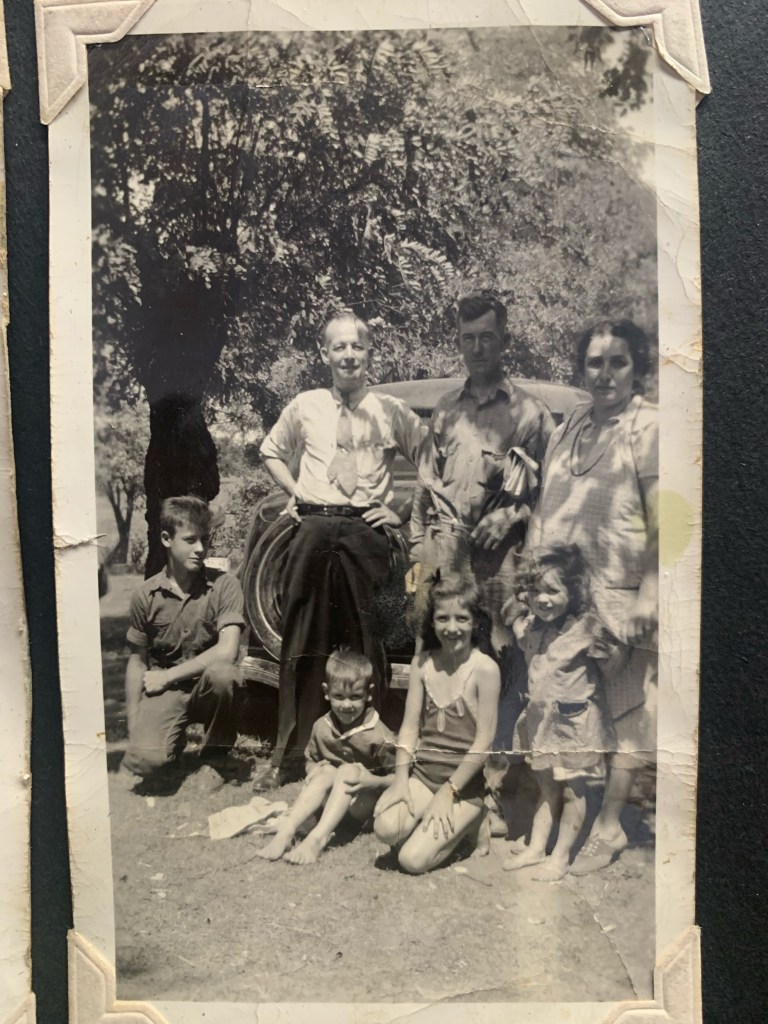
From the family archive collection – The Mathews – (left to right) John Shepherd (kneeling), John William Mathews, Pleas Mathews, Fanny Dean (standing), Kenneth Mathews (my father), Marjorie Mathews, Marita Mathews. Circa 1940.

[MILITARY] Easley and Corman in War of 1812

Two ancestors I’ve discovered received pensions for service during the War of 1812 – Pleasant Easley and George A. Corman, Sr. Both served in the Fifth Kentucky Regiment under Lt. Col. William Lewis.

Pleasant Easley served as a private in Captain James C. Price’s Company. Known as the “Jessamine Blues” this unit of Jessamine County militia were so called by their remarkable uniforms. They experienced losses at the Battle of River Raisin. I definitely have this on my next level research topics.

Private Easley served August 15-October 1812. Six months after his discharge, Pleasant married Patience Dean Holeman. I am still working on the birth and death dates for this family. Some of these findings do not yet make sense despite being based on research, and therefore may be incorrect. For now, I am going with Pleasant and Patience as likely my 4th-great grandparents.

Then, we have my 3rd-great grandparents George A. Corman, Sr. (1793-1866) and Abigail Hicks (1796-1880). Of their information, I am much more certain.

Pennsylvania-born, Jessamine Co Kentucky volunteer George Corman (or Cornman) served as a 19yo private in Captain Hamilton’s Co of Kentucky Militia, August 15, 1812-February 15, 1813. Corman was recorded as a Prisoner-of-War (POW) on January 22, 1813. A reference to Palladium on March 24, 1813 needs follow-up. Six months after discharge, George married Abigail in Fayette Co, KY, on August 5, 1813. George died and was buried with others in family, Corman Cemetery, Bethel Pike, Nicholasville, KY.

Both Kentucky militia soldiers, Pleasant and George volunteered. Both married six months after military service. Both settled in Jessamine Co.

Resource: Jessamine Historical Quarterly, Vol.2, No. 1, January 2003, published by Jessamine County Historical & Genealogical Society (www.jesshistorical.com)


← Back

Thank you for your response. ✨

Warning
Warning
Please rate our website(required)

Warning
Warning
Warning.

Prescience was it, Pleasant?

Assembling the “ol’ homeplace”

My paternal 2nd great-grandfather was named Pleasant Cook. Not a name I think I’ve ever heard before until researching. But, pleasant. Is it possible to live up to it, though?

He was born at home in 1832 at the Cook Family Home, Harrodsburg Road on the border of Woodford and Jessamine Counties. His mother, Nancy Easley, died when he was 8yo and his father remarried to Pauline Bryant in 1841.

inscription on back: “farm with Pleas Cook in front of house” circa 1910-1917

Pleasant worked for 21 years as a carpenter following an apprenticeship to Woodford County carpenter Barry Holloway that began in 1847 when he was 16yo. In 1850, he was employed by Holman R. Crow as a carpenter along with Aaron Crow, George Crow, William Trisler and Neal Wilson.

Two years later, when he was 21, he went out on his own professionally and married Mary Chowning in October, 1852. Over the next 17 years, they had four children: John, Melvin, James, Charles and Mayme (my great grandmother). They farmed 230 acres at this homeplace he assembled over time in the same area as his in-laws.

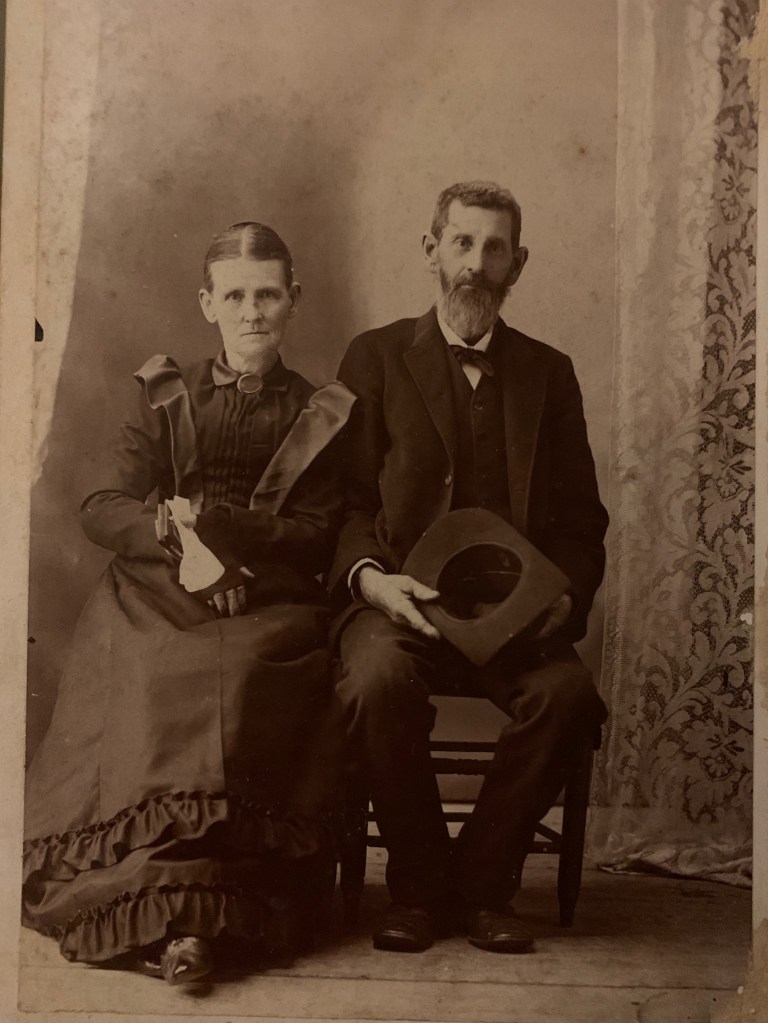
My great-great grandparents, Mary Ann Chowning and Pleasant Cook. The image, therefore, appears to be a middle-aged period based. Best guess: circa 1880-1890.
If you ask me, his hands suit his vocation. And, it may have been something for mother to hold a handkerchief, book or something – can’t distinguish.

Pleasant outlived Mary by 8 years after she died in 1909 at 75yo. His wife’s obituary includes a reference to the Cook family as “one of the oldest families of the county.” Pleasant lived to be 86yo and died in August 1917. Grandson Pleas had just registered for the US draft in June 1917.

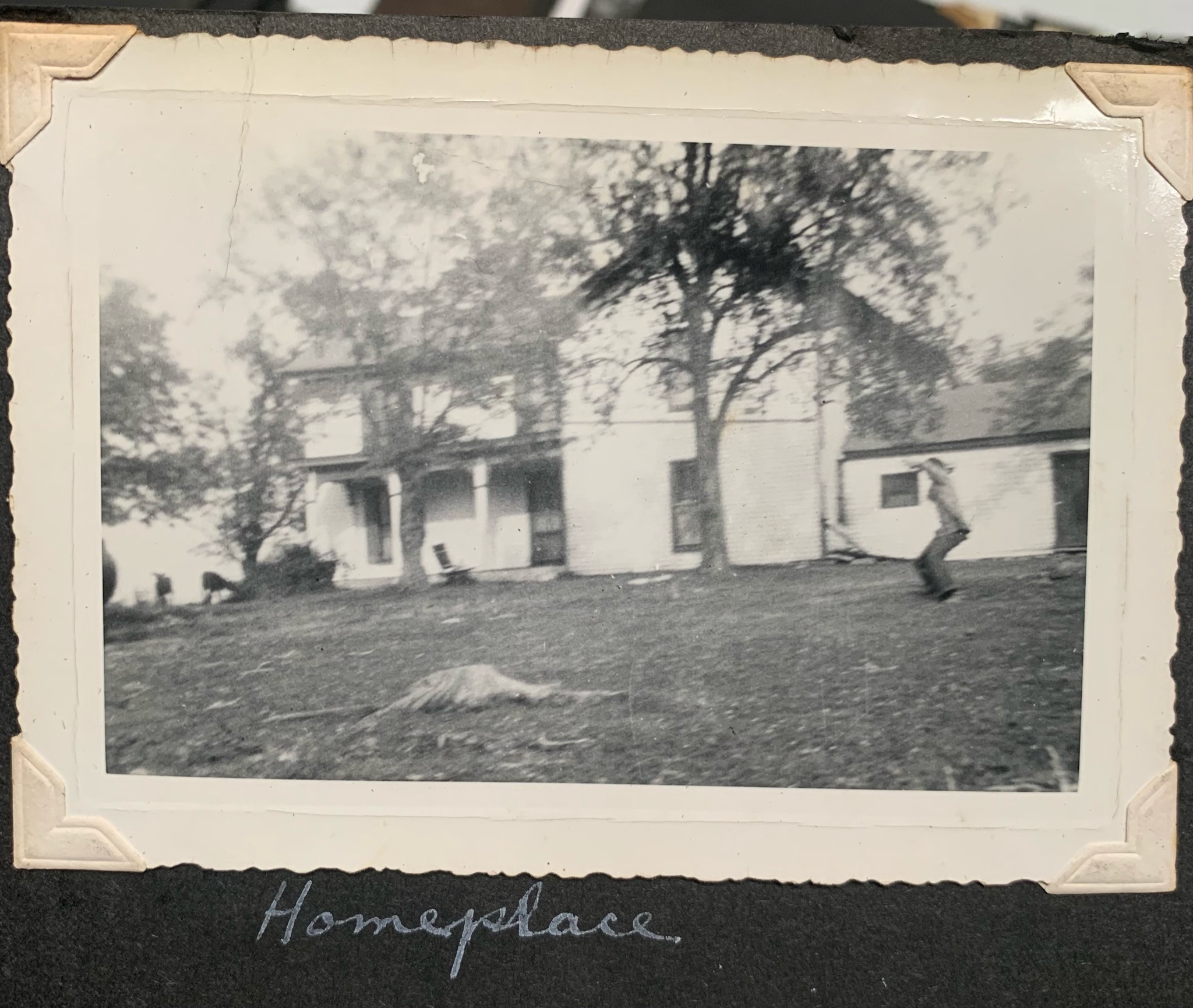
The “ol’ homeplace” on Jessamine Creek in Jessamine County, Kentucky
at the time of my grandparents raising their children, including my father circa late 1940s

With confidence in research validations, I know Pleasant Cook and Mary Chowning to be my great-great grandparents. From Pleasant, I am working my way further along his tree including his father named Thomas Cook, mother Nancy Easley (surname also found in my maternal grandmother’s tree) and possibly three siblings or more. From the family artifacts collection, there is a handwritten listing of Chowning family and their respective birth, death and marriage dates which will come in handy when I get to that stage of research. The Chownings, along with the Singletons, were early settlers of the area and presumably purchased from surveyor and settler James Douglass. *Research topic for later

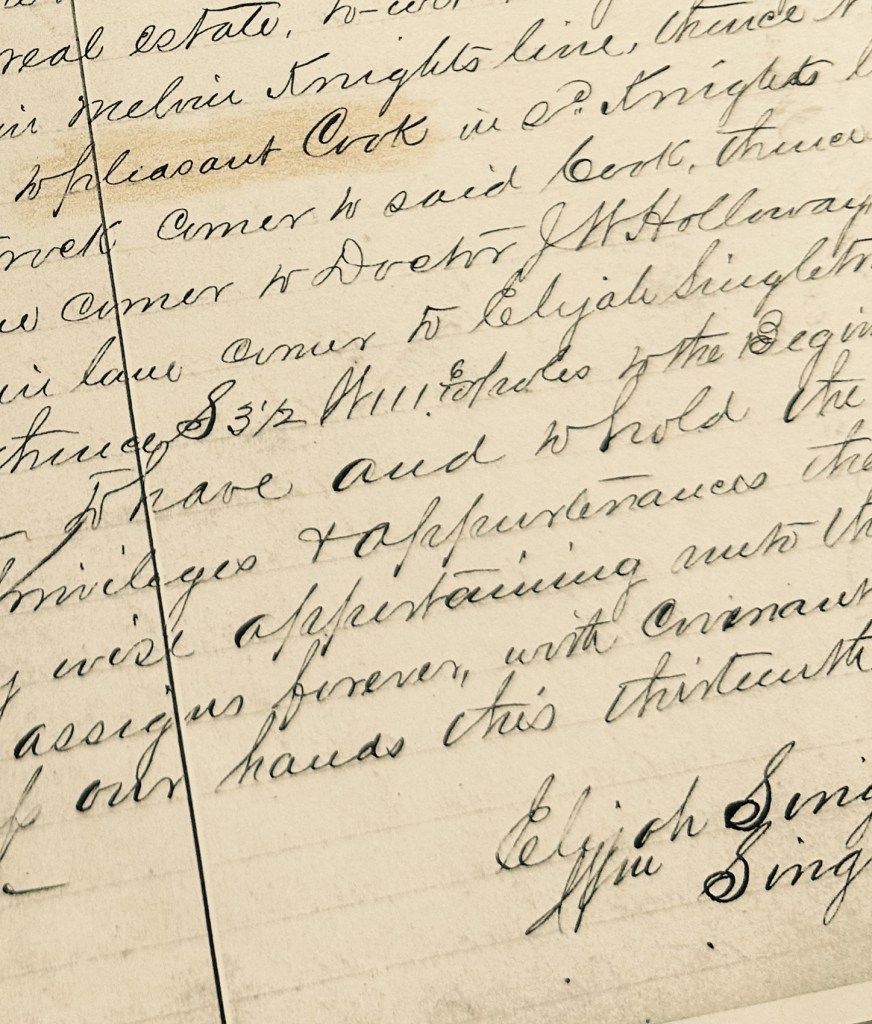
Cropped image of 1868 deed

According to Jessamine County land records, Pleasant Cook, at 37 yo, was first recorded in 1868 as a grantee of 10 acres for $1,000 by William Singleton. From that date, there are six entries in which Pleasant was a grantee. By tallying the descriptions in those deed records, he acquired more than 222 acres in the 34 years between 1868-1902.

He worked with his hands, creating things of utility and beauty both in the fields and in the workshop. I have been fortunate to have been gifted several pieces that belonged to “the Cooks” as Dad says he was told. Perhaps Pleasant made one of them himself . . .?

I wonder: Did Pleasant have his eye on this particular land for his assemblage into a farm for his family and subsequent generations? Was it the realization of his goals and dreams?