My paternal 2nd great-grandfather was named Pleasant Cook. Not a name I think I’ve ever heard before until researching. But, pleasant. Is it possible to live up to it, though?
He was born at home in 1832 at the Cook Family Home, Harrodsburg Road on the border of Woodford and Jessamine Counties. His mother, Nancy Easley, died when he was 8yo and his father remarried to Pauline Bryant in 1841.
inscription on back: “farm with Pleas Cook in front of house” circa 1910-1917
Pleasant worked for 21 years as a carpenter following an apprenticeship to Woodford County carpenter Barry Holloway that began in 1847 when he was 16yo. In 1850, he was employed by Holman R. Crow as a carpenter along with Aaron Crow, George Crow, William Trisler and Neal Wilson.
Two years later, when he was 21, he went out on his own professionally and married Mary Chowning in October, 1852. Over the next 17 years, they had four children: John, Melvin, James, Charles and Mayme (my great grandmother). They farmed 230 acres at this homeplace he assembled over time in the same area as his in-laws.
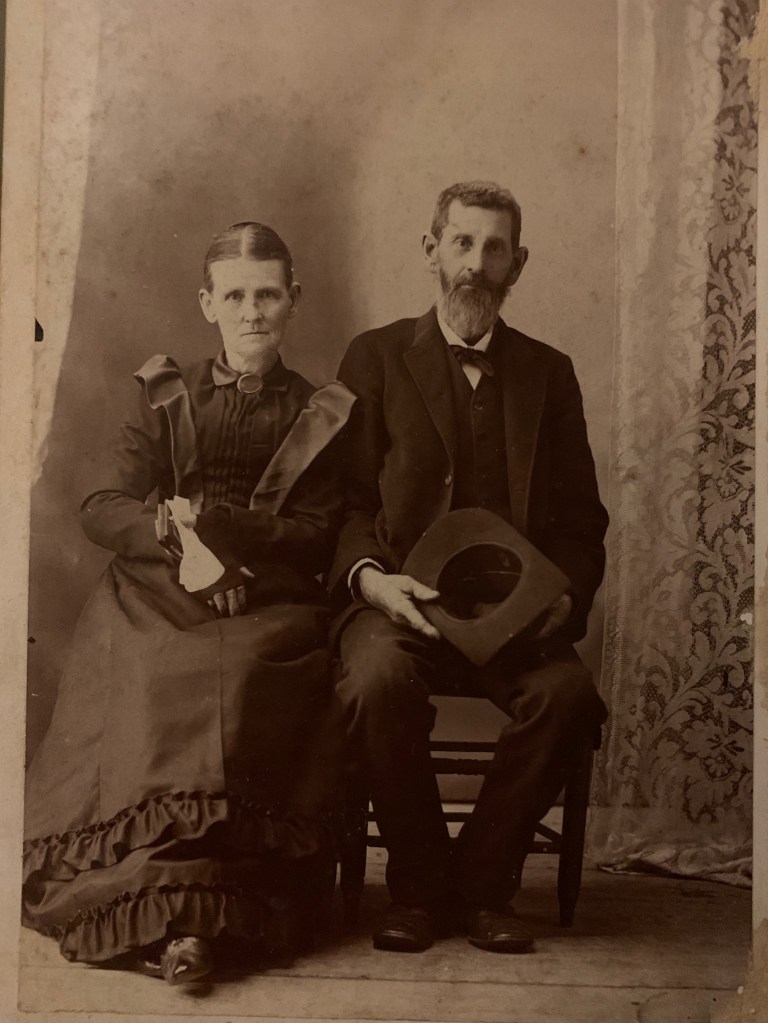
My great-great grandparents, Mary Ann Chowning and Pleasant Cook. The image, therefore, appears to be a middle-aged period based. Best guess: circa 1880-1890. If you ask me, his hands suit his vocation. And, it may have been something for mother to hold a handkerchief, book or something – can’t distinguish.
Pleasant outlived Mary by 8 years after she died in 1909 at 75yo. His wife’s obituary includes a reference to the Cook family as “one of the oldest families of the county.” Pleasant lived to be 86yo and died in August 1917. Grandson Pleas had just registered for the US draft in June 1917.
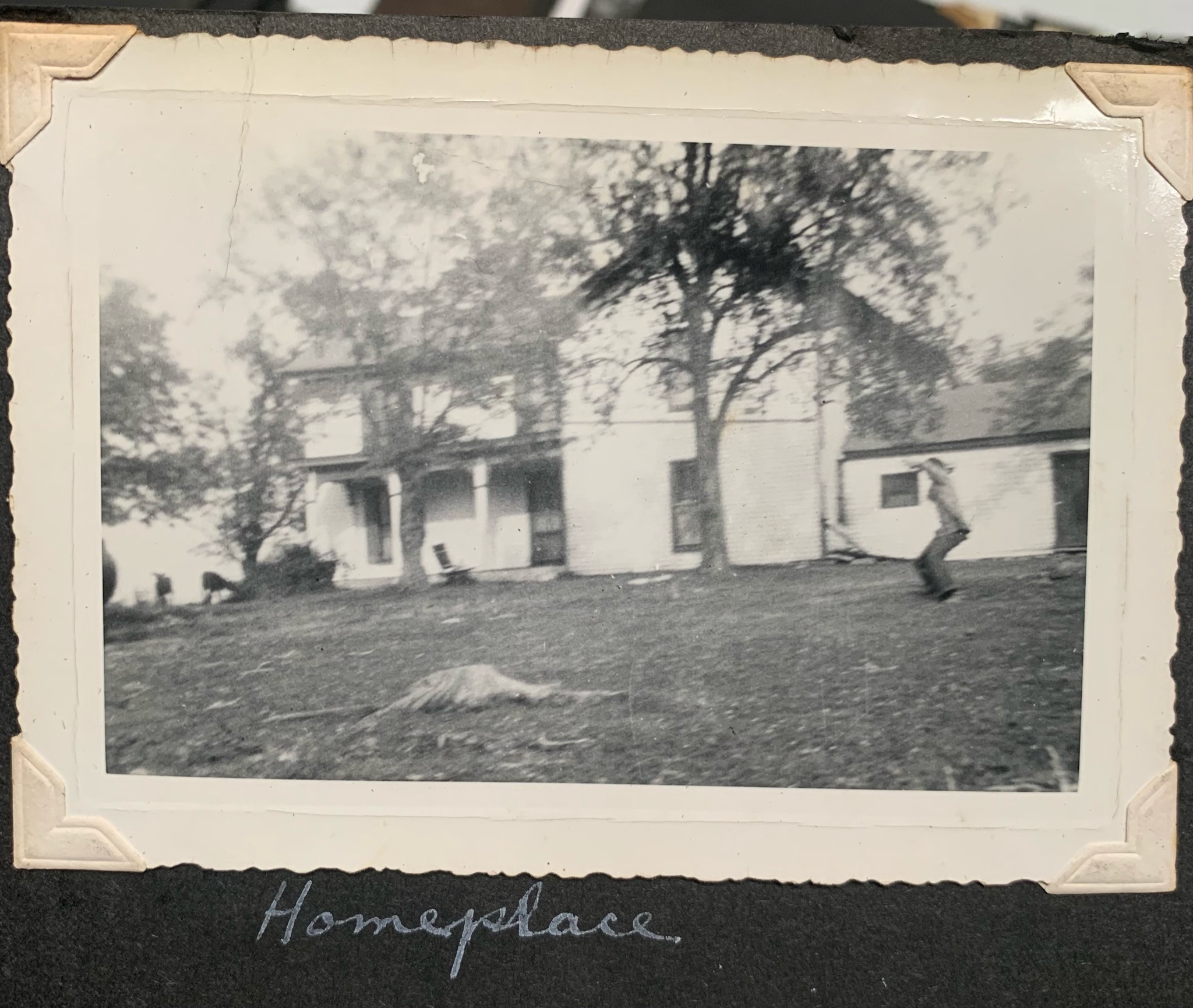
The “ol’ homeplace” on Jessamine Creek in Jessamine County, Kentucky at the time of my grandparents raising their children, including my fathercirca late 1940s
With confidence in research validations, I know Pleasant Cook and Mary Chowning to be my great-great grandparents. From Pleasant, I am working my way further along his tree including his father named Thomas Cook, mother Nancy Easley (surname also found in my maternal grandmother’s tree) and possibly three siblings or more. From the family artifacts collection, there is a handwritten listing of Chowning family and their respective birth, death and marriage dates which will come in handy when I get to that stage of research. The Chownings, along with the Singletons, were early settlers of the area and presumably purchased from surveyor and settler James Douglass. *Research topic for later
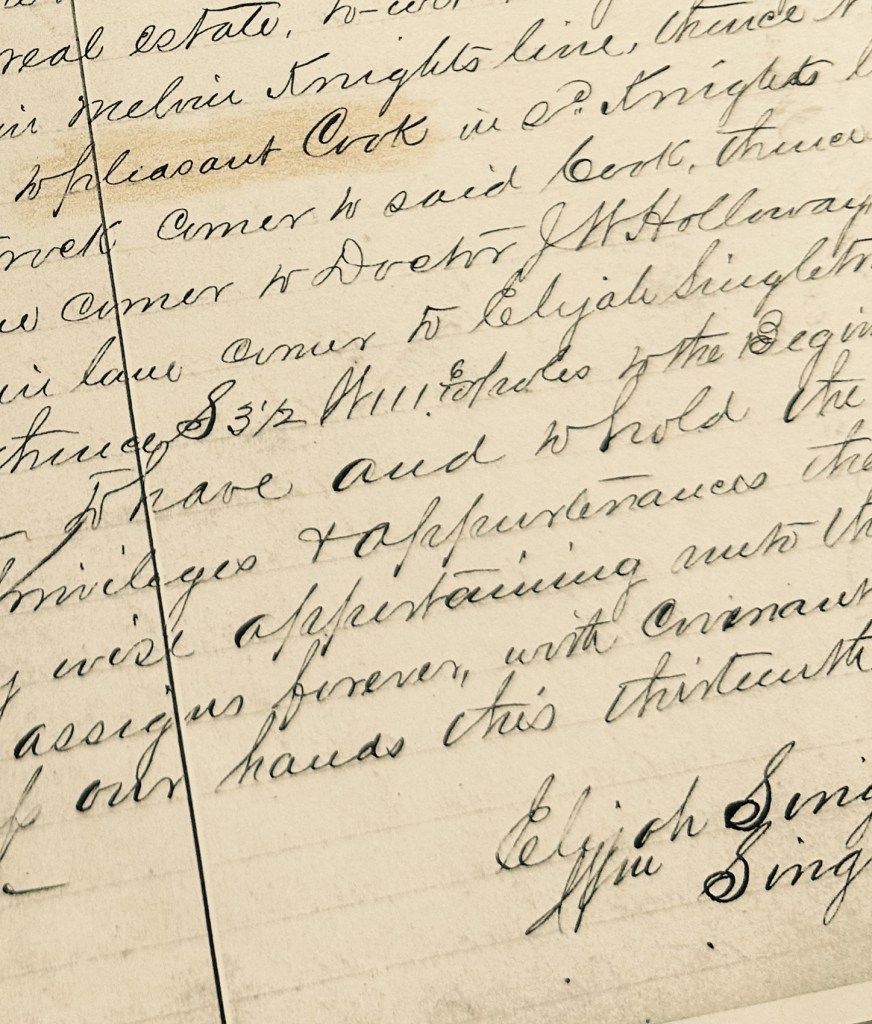
Cropped image of 1868 deed
According to Jessamine County land records, Pleasant Cook, at 37 yo, was first recorded in 1868 as a grantee of 10 acres for $1,000 by William Singleton. From that date, there are six entries in which Pleasant was a grantee. By tallying the descriptions in those deed records, he acquired more than 222 acres in the 34 years between 1868-1902.
He worked with his hands, creating things of utility and beauty both in the fields and in the workshop. I have been fortunate to have been gifted several pieces that belonged to “the Cooks” as Dad says he was told. Perhaps Pleasant made one of them himself . . .?
I wonder: Did Pleasant have his eye on this particular land for his assemblage into a farm for his family and subsequent generations? Was it the realization of his goals and dreams?
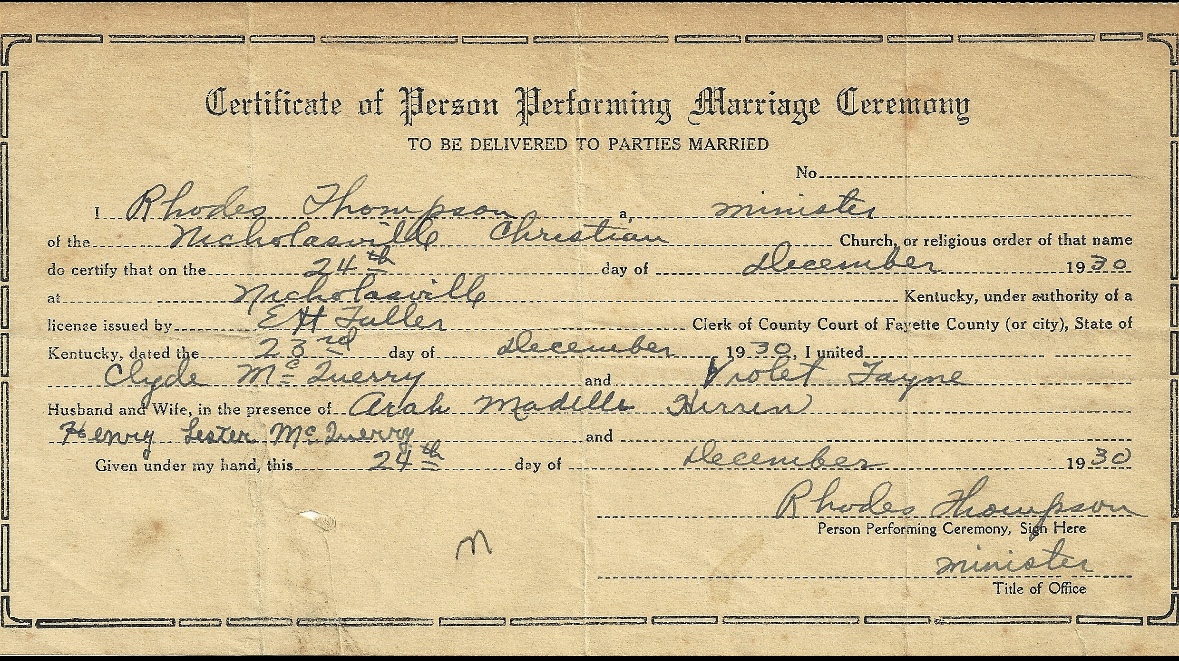
Clyde McQuerry (22 years old) married Violet Fayne (17 years old) on December 24, 1930 in Jessamine County, KY.
A Christmas Eve wedding
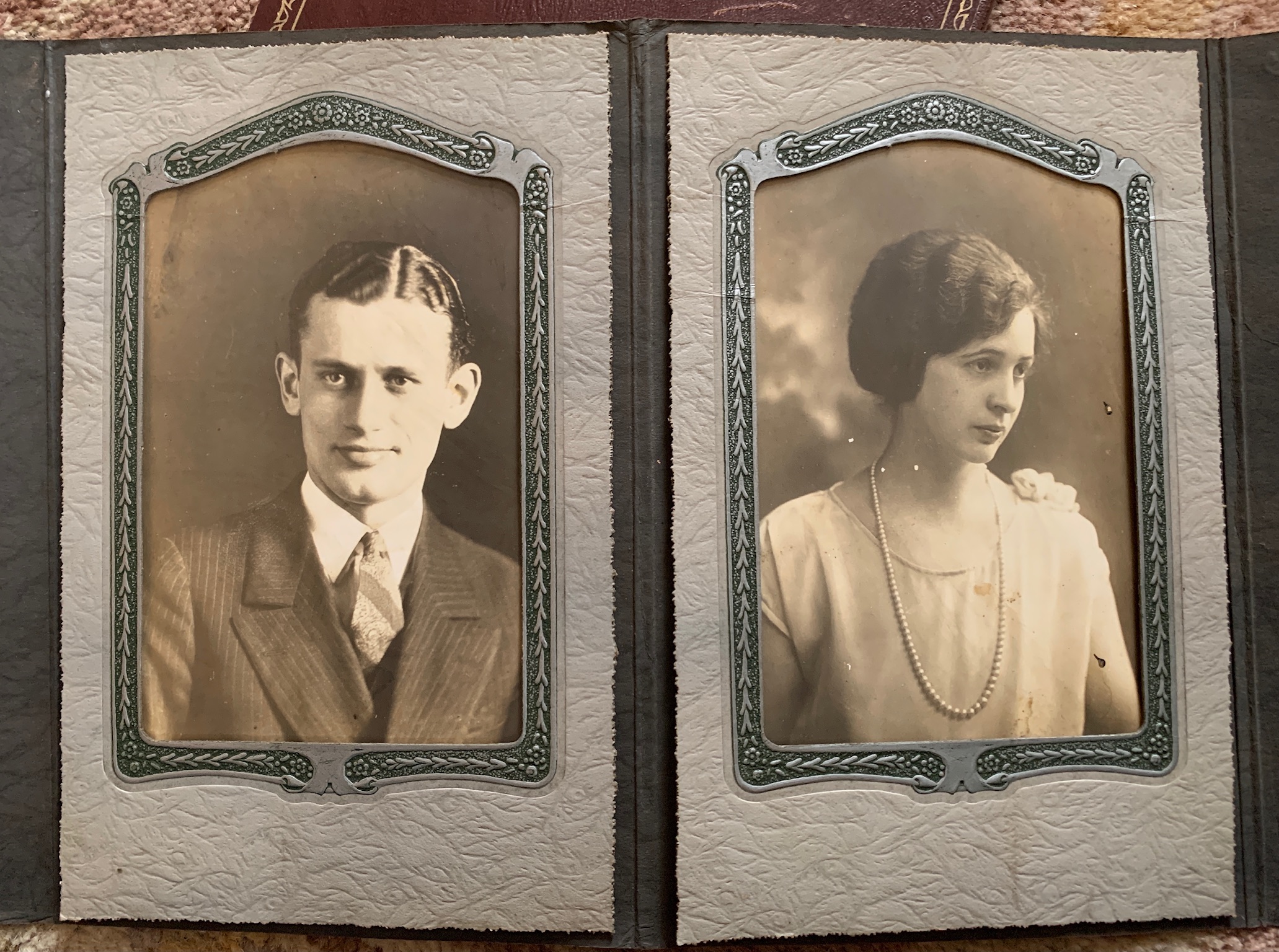
A courtin’ scene – Clyde Herbert McQuerry and Violet Sunbeam Fayne, my maternal grandparents circa 1928-30, Sugar Creek Pike, Little Hickman, Jessamine County, Kentucky
The phrase “don’t make ’em like they used to” comes to mind. I look at these young faces and see the beginning of a love story that spanned nearly a century. Look at their arms, hands. Entwined and naturally fitted together. A metaphor for their lives. Even after Clyde died from cancer in 1977, Cutters kept their connection a daily practice. She wrote to him in her diaries, everyday for 35 years until she could no longer see well enough to write. She reached 100 years before that happened.
Both families were members of Wesley Chapel on Sugar Creek Pike, Cutters was born next door to their church, which is where they met, although they did attend different schools. The McQuerrys lived on a large, likely multi-generational farm south on the banks of the Kentucky River. Up the hill from there on Sugar Creek Pike was (and is) Wesley Chapel and neighboring Fayne family. Her utter goodness must have shot through him like a lightning bolt. Or, what if it was a slow burn, like they played together as kids? Both born and raised in a rural church community, it is within the realm of possibility. (I will ask Daddy Mac & ‘Tuh.)
She carried a quiet wholeness and holiness, fingers ever in motion creating something for sharing like legendary bread and crocheted afghans. Cutters, as I knew Violet much later in her life, had this look at times of a far away thought. Her pause was nearly always just to the point you felt the need to pick up a dropped thread. You’d even inhale to speak, then suddenly, she released, nailing the reply. She reflected before speaking her wisdom and I suppose it was by the lessons along the way. She knew EXACTLY what was going on but she had to reflect and, in doing so, to compel you the same. In her presence you’d welcome the pause. She also delivered zingers with impeccable timing. Very clever. It was fun to giggle with Cutters.
The Cutters I knew also carried a sadness reminiscent of long-suffering as in The Bible. She carried it selflessly, though. She could experience joy and you can be sure if you were in her presence the light of that joy was always bright and it shone on you. Always, even in pain and brokenness, she spread light. And, she knew brokenness.
The proximity of Wesley Chapel to the house where Cutters (Violet Sunbeam Fayne McQuerry) was born on Sugar Creek Pike, Jessamine County, KY. Photo: C. Mathews taken on a Ya-Ya’s trip in 2020, 107 years after.
But, in this moment, Clyde, my grandfather at 22 years-old, and Violet, my grandmother at 17 years-old, were in love and embarking together on the future. Christmas Eve. It was a Wednesday. It was 1930. Was it magical? How I hope there may have been a photo I might discover. When did Clyde know she was an angel walking among us? Did he whisper to her “I want to marry you on Christmas?”
The McQuerry-Fayne marriage ceremony was conducted at the parsonage of Rhodes Thompson, minister of the Nicholasville Christian church. [NOTE: I would like to locate this minister’s home address in future research.] You might wonder why the wedding ceremony did not take place at their own church, nor with their own minister. I wonder about that, also. Maybe these “crazy kids” had a reason.
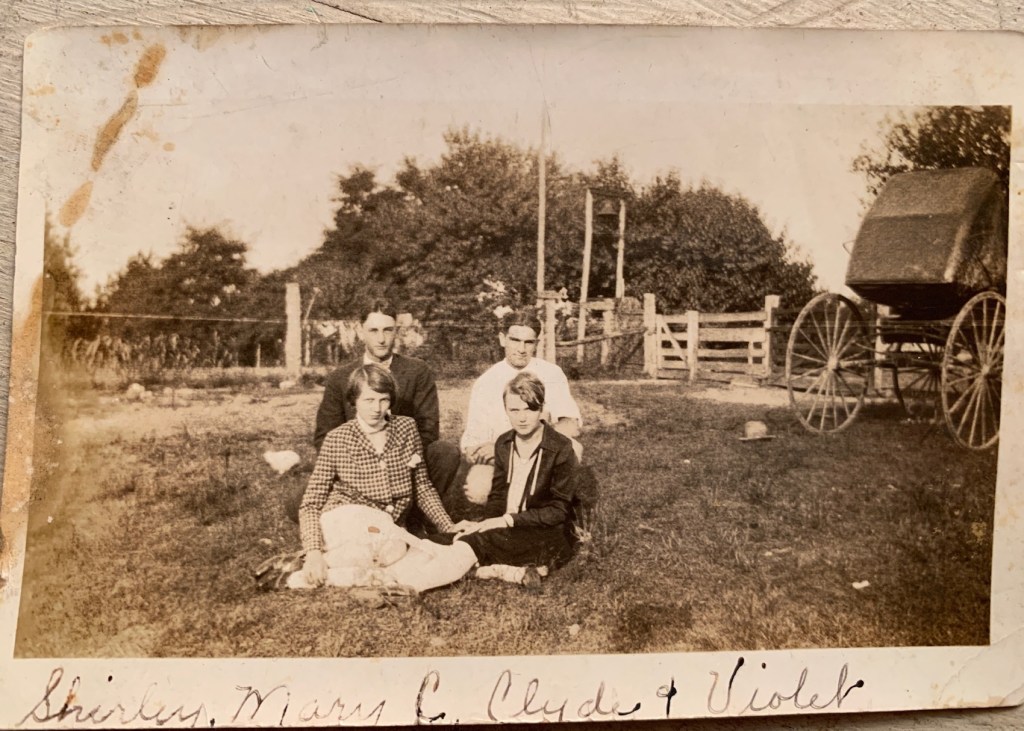
Shirley (unk), Mary C (unk), Clyde & Violet date unrecorded, circa 1928
She had graduated from high school in the summer. She was a teenager, they were young’ns. So, you graduate high school and you plan to be married at Christmas? Don’t you wonder what the “kids” talked about then? Their connection to the outside world was through radio, newspapers, telegrams and word of mouth. The Wall Street Crash had occurred in October 1929 and now, one year later, people were IN the Great Depression. Also, prohibition was in effect, but I don’t think either of them drank alcohol ever.
In the photograph of four friends, you can see what looks like a buckboard in the corner, a fence and a large wooden gate. It reminds me of watching Little House on the Prairie growing up. Cutters liked to watch the TV show, also. I have a litany of “LHotP” stories. That Pa, though. More for another time.
Certificate of Person Performing Marriage Ceremony
TO BE DELIVERED TO PARTIES MARRIED
I, Rhodes Thompson, minister of the Nicholasville Christian Church or religious order of that name do certify that on the 24th day of December 1930 at Nicholasville Kentucky, under authority of a license issued by E. H. Fuller, Clerk of County Court of Fayette County (or city), State of Kentucky, dated the 23rd day of December 1930, I united Clyde McQuerry and Violet Fayne Husband and Wife in the presence of Arab Madilla Herrin(sp?), Henry Lester McQuerry Given under my hand this 24th day of December 1930.
Person Performing Ceremony, Sign Here – Rhodes Thompson
Title of Office – minister
Witnessed by two people: A. M. H. (need help deciphering what is both hard to read and completely unfamiliar) and Henry Lester McQuerry. Should I expect to see a vouchsafe for the bride (because I do)? Where is the implication for her parents’ permission in this process? Or, was that not a thing? Their minister and her family are not represented on the certificate. I mean, where were HER people? Where was Big Mother and Ol’Daddy?
Celebrating Christmas for me was never complete until going with family to “Cutters’ Christmas.” I would venture to guess any of the cousins would say the same. The annual tradition remained a deeply special occasion for decades and maybe that was how Violet chose to honor their special day and her love Clyde each year.
Merry Christmas Eve and Happy Anniversary to you, Clyde and Violet. May you be entwined around each other celebrating for eternity.
Rev. Ira Malcolm Corman, BORN 26-Feb-1904, Wilmore, KY, DIED 30-Jul-1930 Vesta Jane McCord, BORN 22-Nov-1902, Bartholomew, IN, DIED 5-Apr-1995 my granduncle and grandaunt
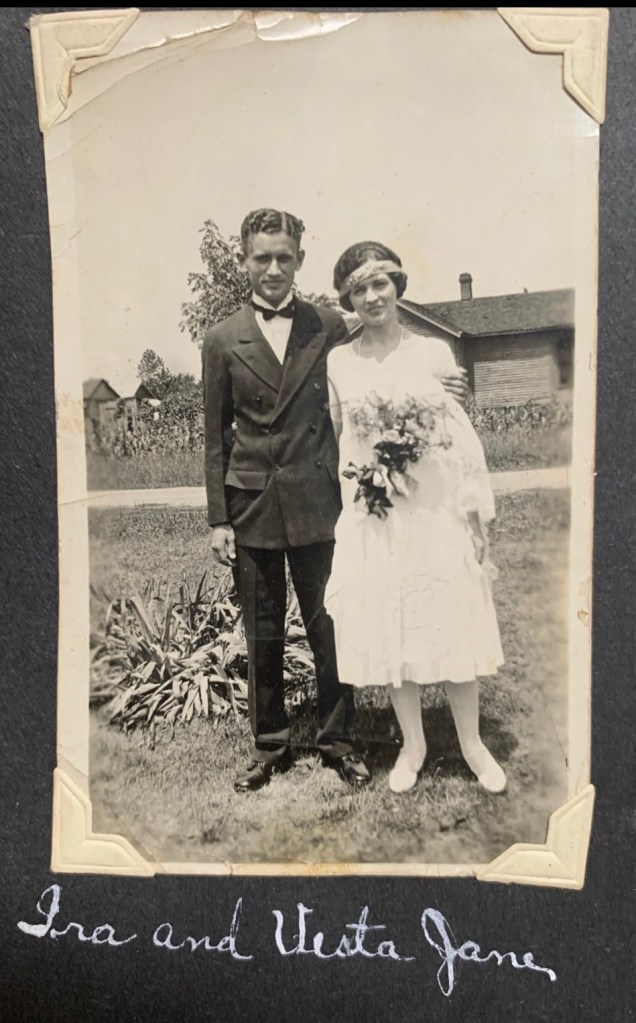
Ira (22yo) married Vesta Jane (23yo) on Wednesday, July 28, 1926, in her hometown in Bartholomew County, IN. He attended seminary at Manhattan Bible College (present-day Manhattan Christian College) which opened in 1927 as Christian Workers University in Kansas. How did they meet? Still working on that detail.
Wedding Day, July 28, 1926 “Ira and Vesta Jane”
They were married only four years when Ira died July 30, 1930, of typhoid fever while living and preaching in Erlanger, KY. Typhoid fever rates had declined since the advent of drinking water purification efforts and is caused most commonly by exposure to Salmonella bacteria (see Johns Hopkins references) At the time, there was less than a 20% chance (20 in 100K) incidence of typhoid fever, according to The CDC, so somewhat rare. They had no children. They had only just celebrated their 4-year wedding anniversary two days before his death. Maybe he was already sick and they could not celebrate.
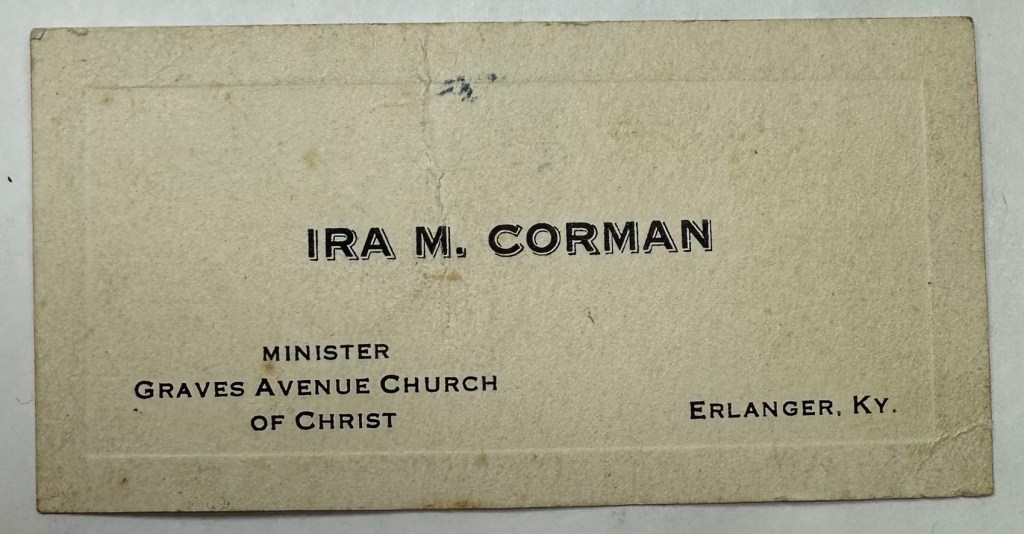
Brother’s calling card
As recorded in the 1950 US Census just released this year, Vesta J. Corman was a 47 year old widow, “lodger” who “teaches grade school” living in Fort Thomas, Campbell Co, KY. The handwritten letters of the census taker appears to be on “Alex Pine” with “River View” street on one side and “So. Fort Thomas Ave” on the other side. I will map this eventually.
Although Vesta Jane remarried following Ira’s untimely death, they are buried together in Section 50, Garland Brook Cemetery, Columbus, Barthlolomew County, Indiana.
Interestingly, Vesta Jane’s second husband Howard Long was the widower of Ira’s eldest step-sibling, Minnie Pearl Corman Long. Minnie Pearl, a nurse, died at 58 years old on Dec. 28, 1948, due to a stroke.
In the 1940 Census, Howard Long, his wife Minnie, their adopted son Alan and Howard’s mother Elizabeth (Vandiver) Long lived at 220 Forest Park Road in Lexington, Fayette Co, KY. Eight years later, Minnie died.
The 1950 Census places Howard Stanley Long still living at Forest Park Road. He is 56 years old, widowed and working for the water company in the occupations of “Reading and Repairing Water lines” with an income of $3,730. Living in the residence are 14 year old son Alan B. Long, 87 year old mother Elizabeth P. Long, and Stella J. Hamilton, the 60 year old nurse who’s occupation is listed as “Nursing and companion.” Presumably, this was for the senior Mrs. Long.
Sometime between 1950 and Howard’s death in 1959, Vesta and Howard married. Vesta Jane lived another 36 years as a widow again and joined the cadre of Corman women who lived to their ripe old ages caring for others and for each other. They were my role models, these women in community.
It’s That Kentucky Girl
that.Kentucky.girl
A 6th-generation Kentuckian on a journey to find out – follow along
JOHN MATHEWS – This man has eluded me for several years now. Finally, I was able to connect the Mathews line back to him as my 3rd-great-grandfather. Records confirm mostly as his headstone reports his birth date as February 20, 1773, and death on December 18, 1813. I commonly find references to Augusta County, Virginia, his birthplace in my research. I am learning much about the development of land boundaries, the morphing of counties and the complexity of searching in multiple locations for the same thing. What was called Augusta County might soon be called Staunton but refers to the same spot.
The name John Mathews was common and was (is) often misspelled as Matthews, also a common surname at the time. (Yes, that extra “T” is a mistake, an assumption on your part, but I digress…). His father was William and his mother Mary. Also, common names. In fact, I have located two sets of William & Mary Wright Mat(t)hews parents of large families. John is reportedly the 9th of 11 children born to William and Mary Wright.
I find it curious that John was comparatively older for the time period when he married. I will continue to look for evidence of any first marriage or otherwise an explanation for his relative delay in starting a family. That being said, John Mathews (31yo) married Sarah “Sallie” McDowell (20yo) in 1804 and they had four children:
Son, Joseph McDowell Mathews, b. December 8, 1804 in Augusta, VA
Son, William Harvey Mathews, b. December 29, 1806 in Augusta, VA
Daughter, Margareet Mathews, b. October 29, 1808, died 1809 in Augusta, VA
Son, Caleb Moffett Mathews, b. October 27, 1810 in Staunton, Augusta, VA
John, his young wife Sarah and their three boys – 9yo Joseph, 7yo William and 3yo Caleb, settled in Fayette Co, KY in 1813. (I am fully prepared to discover that Fayette Co was formed from Augusta VA.) There was a William Mathews who died in Augusta, VA in 1811 who named his executor as his son, John Mathews.
In December of the year following their arrival to KY, John died at 41yo. Sarah, 30yo, was far away from her family, had three young boys and was a widow in winter, grieving at Christmastime. I am learning other family members settled in the area and she may not have been facing the dire circumstances on her own the entire time. The way these three children grew up appears to have effected them with a drive for pursuits. They each realized a level of professional success as an educator, a merchant and a judge. They were sent to school, a now historic school, known as Kentucky Academy, Marshall Academy, and other names, will be covered in more depth later.
Fayette County Records
June 2022: I had the best experience visiting the Fayette County Clerk‘s Office in downtown Lexington twice this year. The land records division is headed by a Kentucky native, Deputy Clerk Mr. Shea Brown, who I later saw featured in a KET broadcast about the Digital Access Project. The equipment they utilize yields quality images and they are extremely helpful so I am really happy they have this opportunity to provide virtual access for a wealth of records. But, as I can attest, the in-person experience with this office was wonderful and fruitful.
DEED 1793: John Mathews, Fayette County
The Fayette County 1793 deed signed by Levi Todd, grandfather of Mary Todd Lincoln.Other names referenced include: John Rogers, Jacob Troutman, Adam Troutman
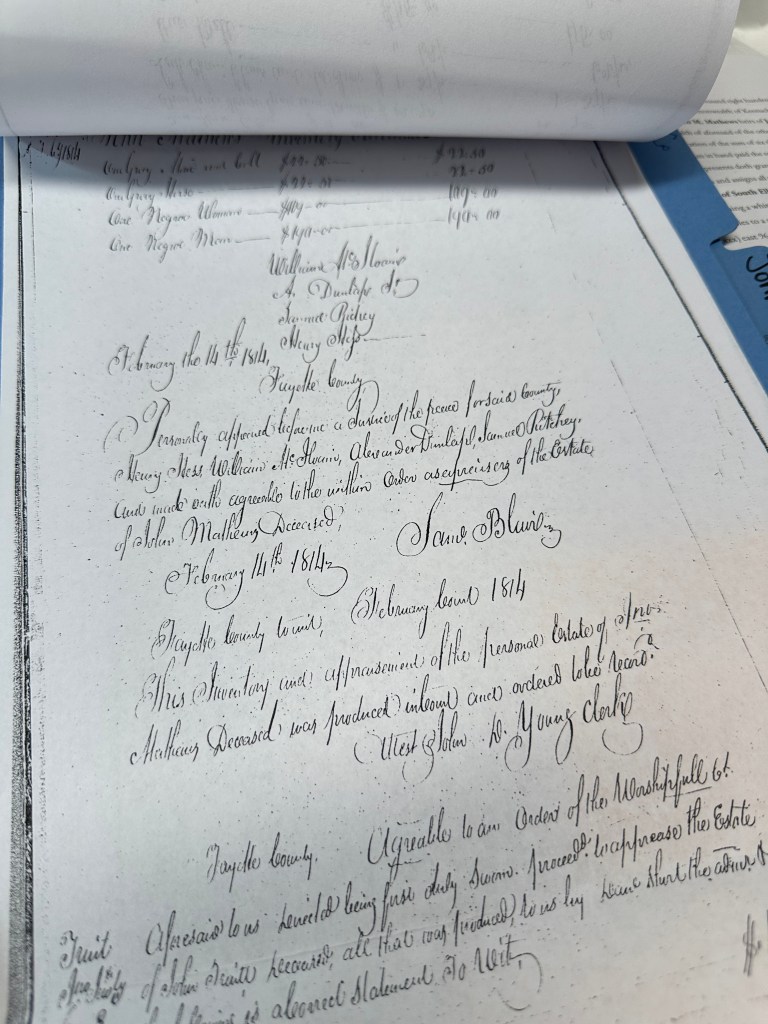
ESTATEINVENTORY February 1814: John Mathews, deceased – This confounds me because his recorded death date is December 1814. So, was there more than one John Mathews in Fayette County?
DEED November 10, 1818: George Moffett for Mathews, Joseph, William H. & Caleb.
A deed of indenture was written in 1818 between George Moffett (again with the Moffett name and further research needed) and the three heirs of John Mathews for $6,570 along with 120 acres of land in Fayette Co on the waters of South Elkhorn. Another deed references being part of a “settlement” lying in Fayette Co on Davey’s Fork, a branch of Elkhorn. The General Index references David’s Fork.
My Dad, who trained as a surveyor while attending UK engineering school, provided his analysis of the land as described in the deed. To his calculations, the parcel exceeded the 100 acres noted in the deed. With so many references to ephemeral landmarks – black walnut, elm and buckeye, it might be virtually impossible to determine exactly. Or that is his assessment. He did sketch the shape, distance and degrees.
The culminating depiction through these three documents appears consistent. As best I can estimate, their home was near present-day Keeneland and the Kentucky Castle, perhaps somewhere along US-1967 (the year I was born, by the way). I fear that will be a much bigger undertaking that may end up inconclusive. It is on the list for later.
This parcel of land crossed over into Woodford Co and adjoined the land of Sarah (Mathews) Price, who had remarried in 1816 to Larkin Price. It appears Sarah had five children by Price, including Larkin Foster Price, a noted lawyer, state legislator and Judge in Texas who is buried in Alamo Masonic Cemetery, San Antonio, TX.
It is possible Sarah’s mother, Margaret Moffett, died in Woodford Co that same year and possibly the same month as the marriage. What are the circumstances for Margaret’s death? It is very easy to get your head turned around in trying to navigate the McDowell and Moffett families. More on that to come.
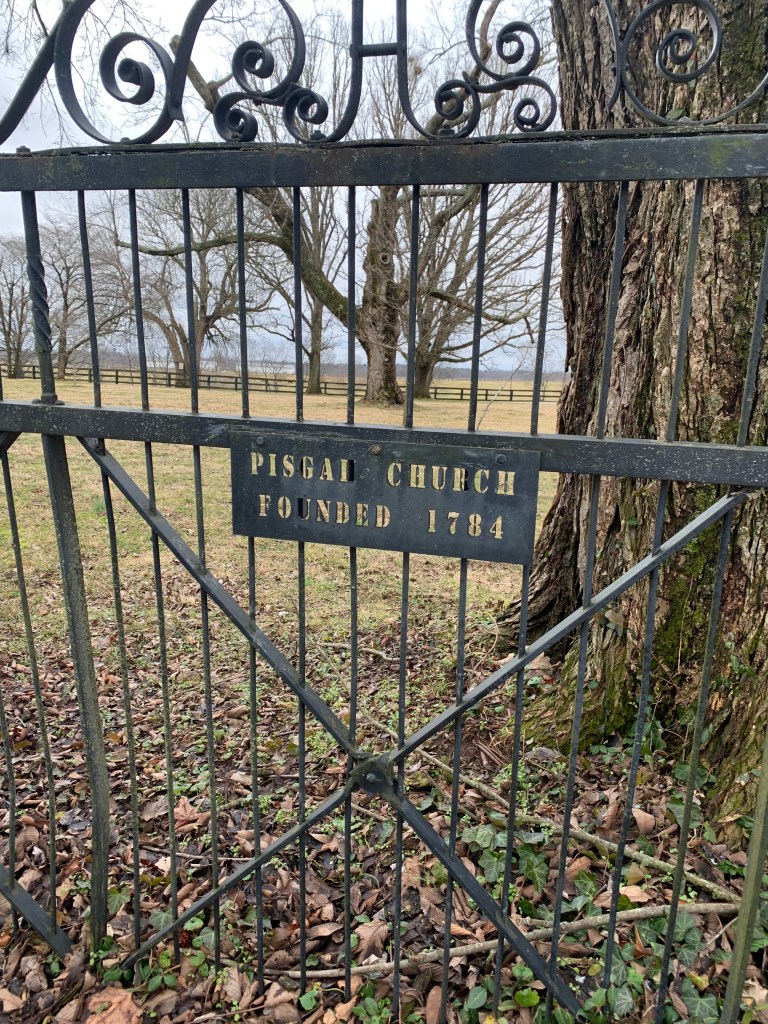
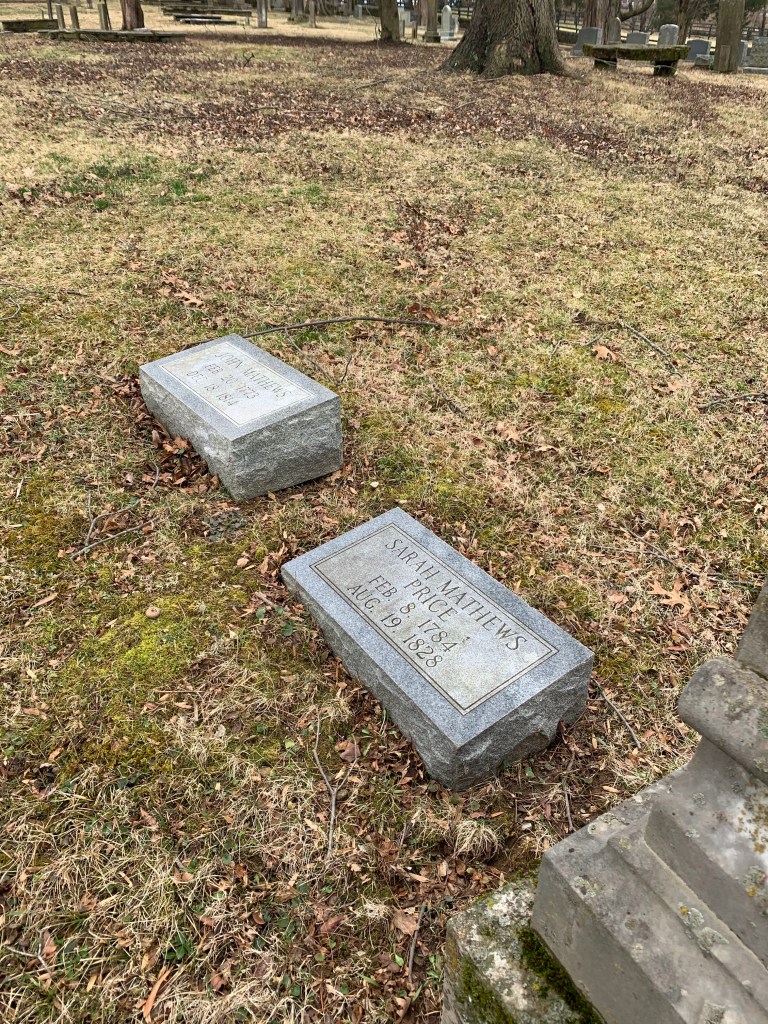
Sarah Mathews Price is buried in the Pisgah Presbyterian Church cemetery, Versailles, Woodford Co, KY, between John Mathews, her first husband, and Larkin Fahr Price, her second husband. She outlived them both, so she had the final say.
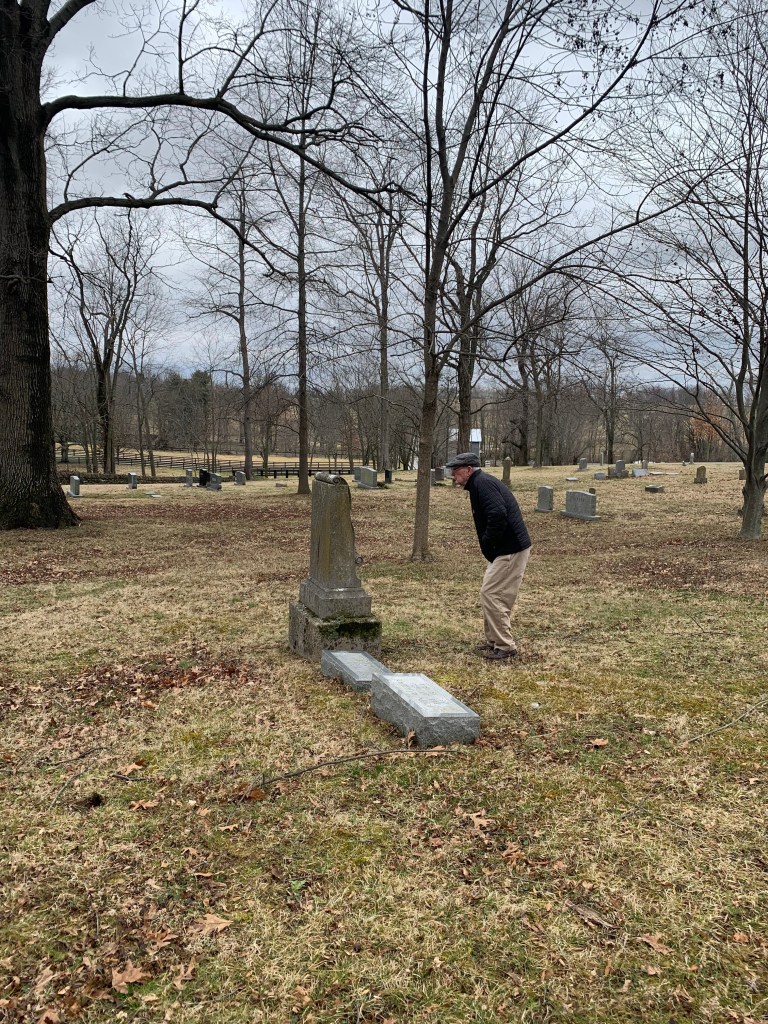
My Dad with me on a recent research trip who was surprised to find Happy Chandler’s headstone as we wandered. After looking around a good while in fairly cold temperatures, we found the graves of John Mathews and Sarah McDowell Mathews Price, his great-great-grandparents. I do not think my Dad had ever been to their graves before this day. The taller, much older headstone belongs to Larkin Price, Sarah’s second husband. Both John and Sarah’s headstones have been updated. My question: by whom and when?
This is where I have paused. I feel the need to have more proof before I move beyond this generation. If the details I’ve compiled from records are accurate, Sarah’s parents’ families – the McDowells and the Moffetts – were Patriots and Revolutionary War heroes. Seeing the “McDowell” and “Moffett” middle names of the children supports the theory that Sarah was, in fact, from this same prominent family. But, I continue to explore these connections for additional confirmation.
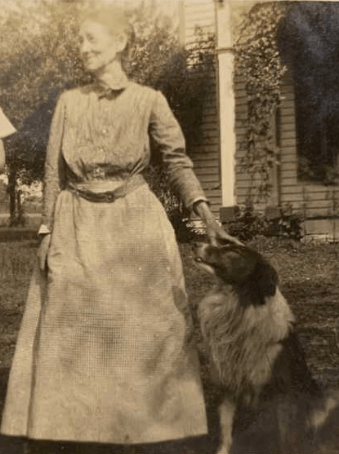
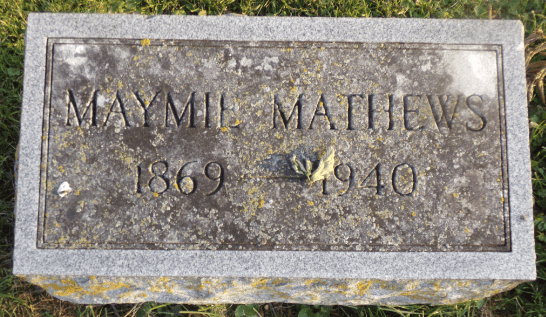
Mayme Cook Mathews, my great-grandmother born 1869 and died 1940 in Jessamine Co
Mrs. John S. Mathews – Mayme Cook
MATHEWS
Mrs. John S. Mathews, 71, died at her home on Brown street here Monday after a two-day illness. She is survived by her husband and two sons, Pleas C. and John Mathews, both of Nicholasville.
Deceased was the daughter of the late Mr. and Mrs. Pleas Cook one of Jessamine county’s oldest families. She was a kind Christian woman and was loved by a large host of friends and acquaintances.
Funeral services will be held at 10 o’clock Wednesday morning at the Baptist church, the Rev. J. A. Stallings officiating. Interment in Maple Grove cemetery here.
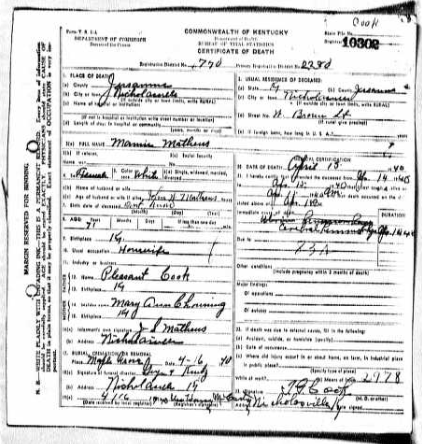
Mamie Mathews’ death certificate is missing details and has her name misspelled. Was the authorizer hurried? The cause of death is noted as “cerebral hemorrhage” which could be due to an injury or a stroke. The Lexington obituary cites paralysis, which again leads me to believe she had a stroke.
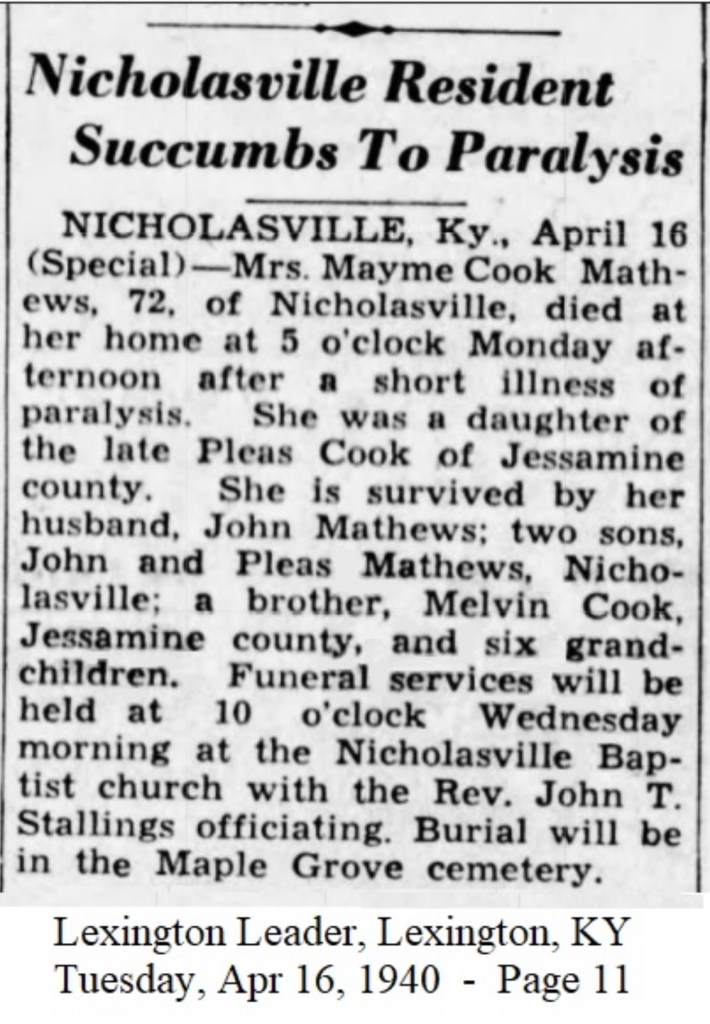
Nicholasville Resident Succumbs to Paralysis
Nicholasville, Ky., April 16 (Special) – Mrs. Mayme Cook Mathews, 72, of Nicholasville, died at her home at 5 o’clock Monday afternoon after a short illness of paralysis. She was a daughter of the late Pleas Cook of Jessamine county. She is survived by her husband, John Mathews; two sons, John and Pleas Mathews, Nicholasville; a brother, Melvin Cook, Jessamine county, and six grandchildren. Funeral services will be held at 10 o’clock Wednesday morning at the Nicholasville Baptist church with the Rev. John T. Stallings officiating. Burial will be in the Maple Grove cemetery.
The Lexington Leader, Lexington, KY, Tuesday, April 16, 1940 – Page 11
Maple Grove Cemetery, Nicholasville, Jessamine County, KY image borrowed from Find A Grave
FOR FURTHER RESEARCH: Why is her address listed as Brown Street? Brown Street is in town and runs off Main Street near where the new library was opened. I thought John & Mayme Cook Mathews lived on the farm until John died, ironically about a month after Mayme died.
You can have V-8 performance – and gas economy, too!
An 85 h.p. Ford gave 24.92 miles per gallon in the annual official Gilmore-Yosemite road test, open to all cars. This was best mileage of all standard-equipped cars in this class!
You can have easy-handling – with big-car room and ride!
Everyone knows how easy it is to drive a Ford. But no one would know, til he gets in side, how big this Ford is in leg-room, seat-room, knee-room . . . nor what a thrillingly soft, steady, big-car ride it gives!
You can have low cost upkeep – and enjoy real fine-car features!
You shift gears on a Ford with the easy-acting type finger-tip shift used on costly cars. You get a semi-centrifugal clutch giving lower pedal pressure at shifting speeds, also typical of costly cars . . . to say nothing of the biggest hydraulic brakes ever used on a low-cost car. Your Ford Dealer’s ready and willing to trade . . . See him now!
You can have a FORD V-8 – and that’s what you’ll want when you try it!
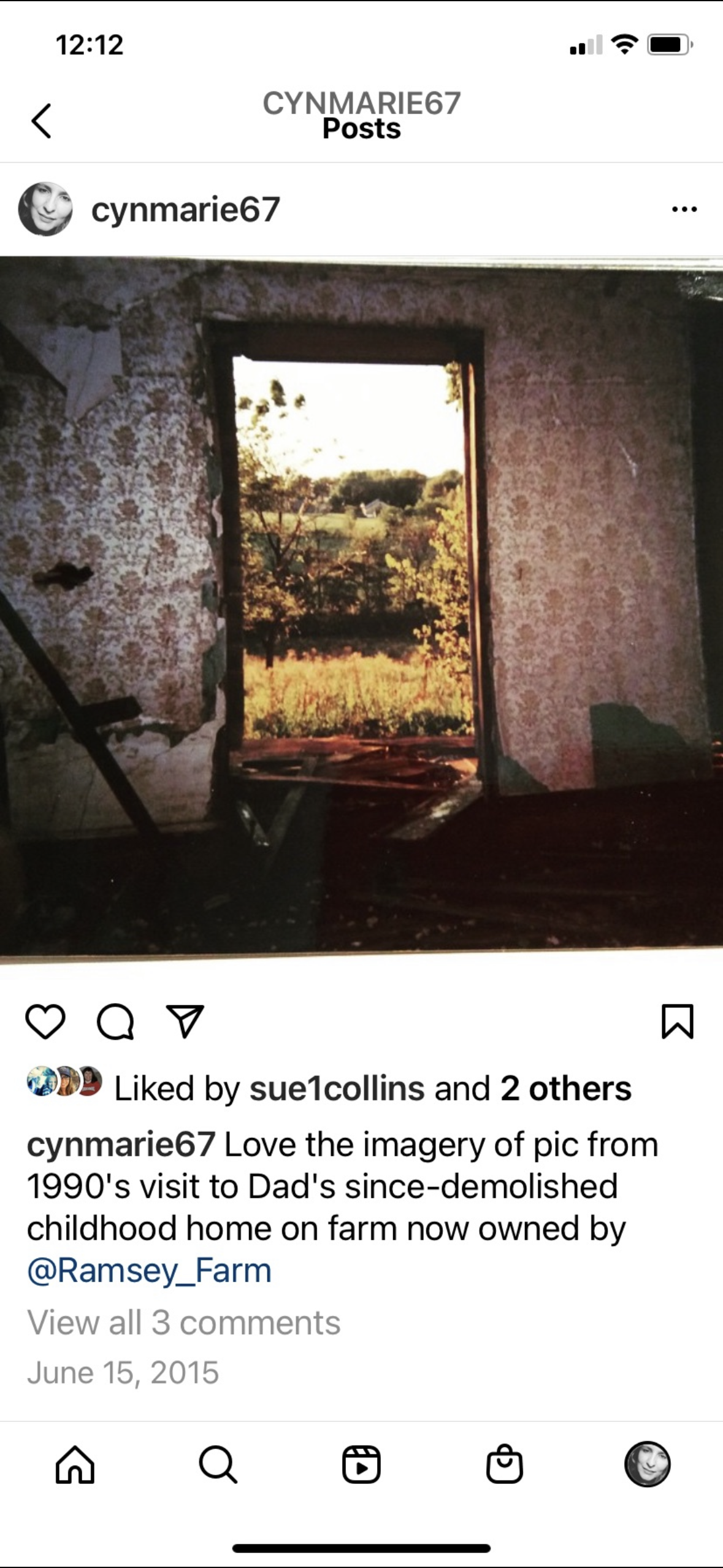
I made a visit to the home place of four family generations just up the hill from Jessamine Creek spring sometime in the 1990s.
The camera I carried with me was disposable and, truthfully, might never have been processed to the light of day. (I believe I still have undeveloped Kodak 35mm rolls from my youth somewhere in my boxed packrat tendencies. The canister with lid tale-tale (but not always of the contents, iykyk.))
Fortunately, I took those pictures that day – long before the genealogy bug bit down or the common use of cellphones, for that matter. And, not long before the building was razed. It had fallen into disrepair and sadly is no more.
My memory of visits to the home I called “Uncle Johnny’s” began when a very young child. The more prevalent in memory are those visits with Cutters, my mother Phyllis’ mother. I may have visited Grandmother Mathews more often than I have memories but they followed my grandmother’s move into town when she sold the property to eldest child, her step-son John Shepherd Mathews. Johnny’s wife Nannie Katherine died way too young in September, 1974. He and their four daughters stayed on the farm. Cousin Susan is a sweet wealth of stories from her life on the farm.
This picture is the view at the back, and I believe an east-southeast-facing side of the house just above the kitchen. I THINK and my Dad will hopefully correct me when he reads this if not. A second-story bedroom above is where my cousin Angie and I had spent hours jumping out of a closet loft onto a bed.
At the time of this photo, the floor was strewn with remnants of the lives that had made this home along with leaves and other debris blown in from the outside through the missing window pane. Perhaps you can imagine pausing amongst the random relics, and glancing out an opening between peeling wallpaper and broken beams and witness the irony in its framing the exterior beauty of Kentucky blooming and a farmhouse in the distance.
If you came across Abandoned Kentucky (@Abandoned.ky), this would have been a perfect feature, had timing been different.
For several years in the late 1990s, two of my great-aunts – Aunt Vi and Aunt Hazel – resided at Royal Manor nursing home. It was designed as two long hallways like a letter “U” connected by central gathering, community spaces.
Down one corridor, my maternal grandmother’s elder sister had a room with a roommate, if I remember correctly. Hazel’s mind was strong and clear, her spirit mostly unsettled and her physical constraints dictated reliance on other people, whether in kindness and compassion or not. She knew what was up and was definitely not okay with it all.
Conversely, my paternal grandmother’s younger sister had a room to herself on the opposite Royal Manor corridor. She remained a sweet, pleasant spirit but drifted in and out of lucidity. We had deep conversations about far-distant memories. She could not tell me what or whether she had eaten that day. She did get manicures, apparently.
Here we are seated together on her bed. You can see the hospital nature of the bedframe along with the accent of “homelike” touches in a handmade afghan. Another contrast.
She was child-like as she worked to remove the gift wrap while emanating that giddy, expectant energy.
I remember one visit we sat side by side in rockers on the front porch and admired the sunset together. She talked of her home and that when she returned there someday soon, I should come visit. She would offer me things that she wanted to gift to me. She did not know that her home was packed away in a storage unit nearby and she would never be “going home” again.
Every so often, her body would shudder all over and she’d let out a moan, close her eyes for a moment. I do not know what her diagnosis was. Her pain was fleeting and repetitive, but I am not certain she remembered one to the next, really.
Viola died February 2000 and Hazel died in December 2000 that same year when I was living in New Jersey.
You might say educating is in my blood and these women were paramount in my own formation. Educators, living their Christian service and love instilled by the Shaker-educated youth of Martha Jane Bradshaw Corman, mother, and three of her daughters – Madeline, Viola & Fanny Dean. Two of the sisters taught school at the elementary and middle grades in northern Kentucky while the other, my grandmother, taught in one-room school houses throughout the Bluegrass region of Kentucky, specifically Jessamine County, with names like Sweet Home and Oak Hill.
Fully enjoying summers traveling, they invited the grandchildren-age generation of cousins on their annual summer trips across all these United States. The ORIGINAL aunt camp (*credit: S. C. Mathews – I see you Pebby). And, the original Ya-Ya’s, as we say in our family.
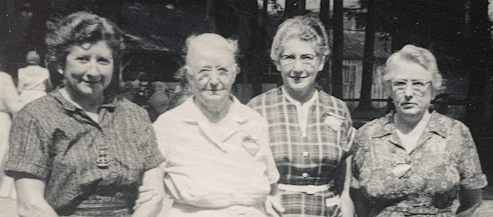
Photo: (left to right) Iva Madeline Corman, Martha Jane Bradshaw Corman, Viola Josephine Corman, and Fanny Dean Corman Mathews, my grandmother.
I remember visiting Frankenmuth, Michigan, as well as author and artist Gwen Frostic’s studio/visitor center in Benzonia. I have a beautiful collection of her work gifted to me, purchased by me and bequeathed to me through the estates’ transitions. It is on that trip with Aunt Vi & Aunt Madeline that I began with Christmas tree ornaments collecting as mementos from my travels.
It feels as though caring is woven in my DNA and was nurtured along by simply spending time with my great-aunts. My grandmother passed when I was in 4th grade living in Pittsburgh, PA, and my memories with her are fuzzy. When I look around my home, I pause to appreciate the things from my family, much of which ties back to them. Any artifact’s value perhaps felt priceless only to me, ultimately. It is the STORIES I crave and these hand-me-downs bring the memories and my soul to rejoice. I want to protect and preserve.
Maybe my heart’s call as service to others honors my ancestors, lives out in legacy. I can confirm I am a lifelong learner – and, most often the hard way. But, if it comes from the heart, is it ever wrong? Let me tell you, if you keep with these ancestry storylines I’m putting down – along the way, your heart will ache. Fair warning.
But, let’s first take a moment to reflect with some levity. Where my educators AT?!
Check out this excerpt from my WKU folk studies professor William Lynwood Montell’s 2011 publication, Tales from Kentucky One-Room School Teachers:
In 1872, the Kentucky State Legislature formally mandated its nine “Rules for Teachers”:
Teachers each day will fill lamps, trim the wicks and clean chimneys.
Each morning teacher will bring a bucket of water and a scuttle of coal for the day’s session.
Make your pens carefully. You may whittle nibs to the individual taste of the pupils.
Men teachers may take one evening each week for courting purposes, or two evenings a week if they attend church regularly.
After ten hours in school, the teachers may spend the remaining time reading the Bible or any other good books.
Women teachers who marry or engage in unseemly conduct will be dismissed.
Every teacher should lay aside from each pay a goodly sum of his earnings for his benefit during his declining years so that he will not become a burden on society.
Any teacher who smokes, uses liquor in any form, frequents pool or public halls, or gets shaved in a barber shop will give good cause to suspect his worth, intention, integrity and honesty.
The teacher who performs his labor faithfully and without fault for five years will be given an increase of twenty-five cents per week for his pay, providing the Board of Education approves.
Okay, with so much to unpack here, is it even possible? Take a moment. Read it again. Read it aloud to someone. I wonder how much of this was still codified when my grandmother was a one-room school house teacher almost 50 years later.
born February 26, 1904, Wilmore, KY, died July 30, 1930, Kenton Co, KY. Buried Garland Brook Cemetery, Columbus, Bartholomew Co, IN, Sec. 50.
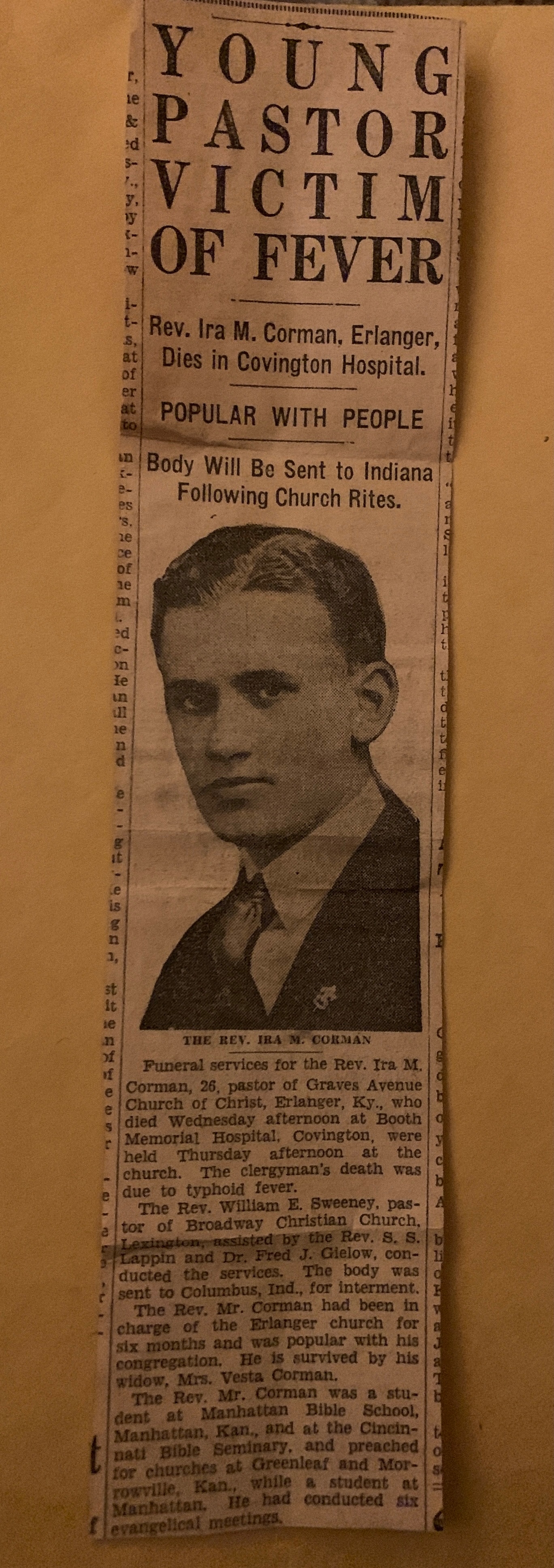
OBITUARY: YOUNG PASTOR VICTIM OF FEVER
Rev. Ira M. Corman, Erlanger, Dies in Covington Hospital
POPULAR WITH PEOPLE
Body Will Be Sent to Indiana Following Church Rites.
The Rev. Ira M. Corman
Funeral services for the Rev. Ira M. Corman, 26, pastor of Graves Avenue Church of Christ, Erlanger, Ky., who died Wednesday afternoon at Booth Memorial Hospital, Covington, were held Thursday afternoon at the church. The clergyman’s death was due to typhoid fever.
The Rev. William E. Sweeney, pastor of Broadway Christian Church, Lexington, assisted by the Rev. S. S. Lappin and Dr. Fred J. Gielow, conducted the services. The body was sent to Columbus, Ind., for interment.
The Rev. Mr. Corman had been in charge of the Erlanger church for six months and was popular with his congregation. He is survived by his widow, Mrs. Vesta Corman.
The Rev. Mr. Corman was a student at Manhattan, Kan., and at the Cincinnati Bible Seminary, and preached for churches at Greenleaf and Morrowville, Kan., while a student at Manhattan. He had conducted six evangelical meetings.
Family library artifact, unknown publication name
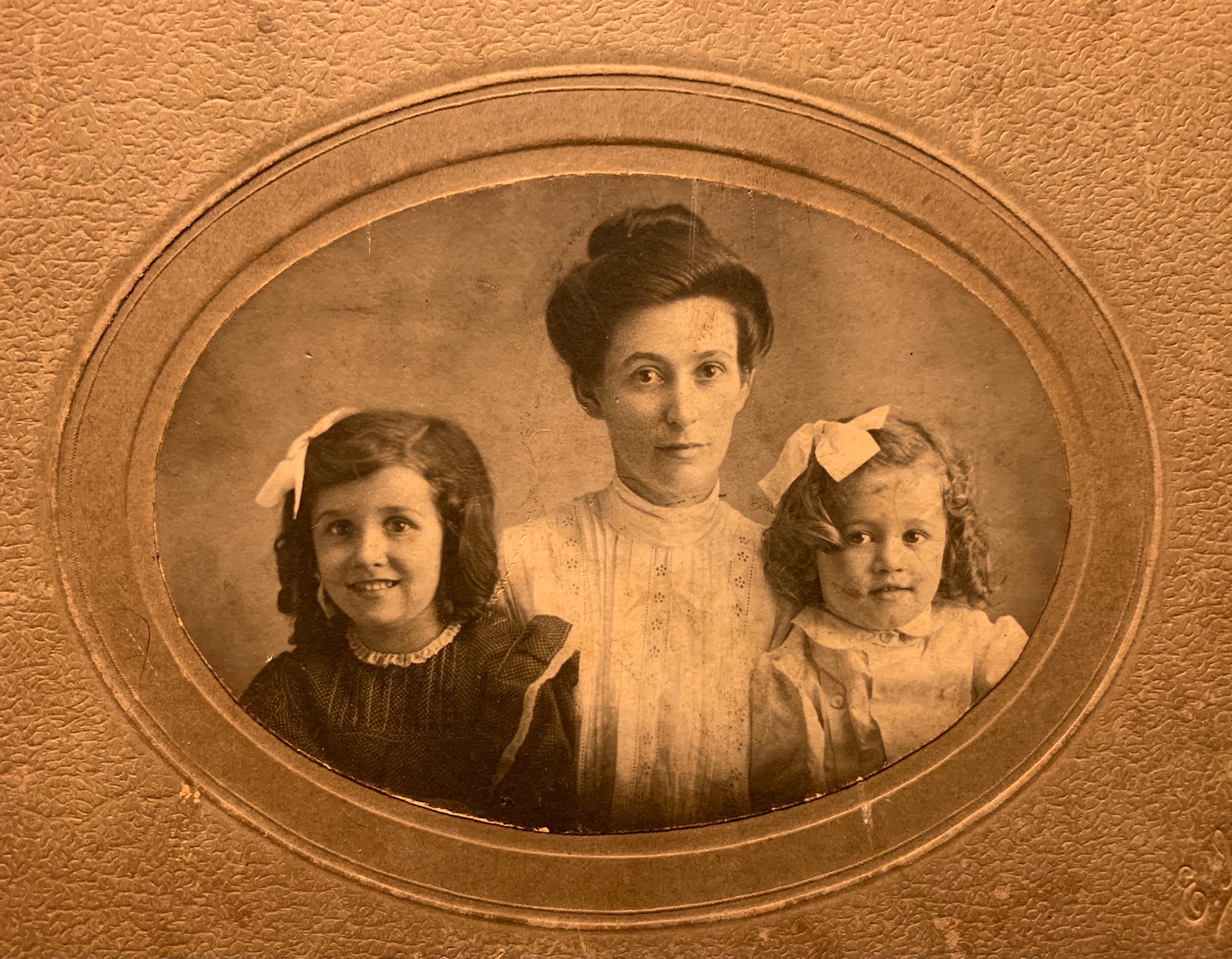
Fanny Dean Corman, Martha Jane Bradshaw Corman, Ira Malcolm Corman






![[ARTIFACT] 1984: The Jessamine Journal, Thursday, October 18, 1984](https://thatkentuckygirl.com/wp-content/uploads/2023/07/screen-shot-2023-07-24-at-6.11.07-pm.png?w=89)




 that Kentucky girl