BRICK WALL: John Mathews – VA to KY in 1813, died 1814 (Fayette Co)

JOHN MATHEWS – This man has eluded me for several years now. Finally, I was able to connect the Mathews line back to him as my 3rd-great-grandfather. Records confirm mostly as his headstone reports his birth date as February 20, 1773, and death on December 18, 1813. I commonly find references to Augusta County, Virginia, his birthplace in my research. I am learning much about the development of land boundaries, the morphing of counties and the complexity of searching in multiple locations for the same thing. What was called Augusta County might soon be called Staunton but refers to the same spot.

The name John Mathews was common and was (is) often misspelled as Matthews, also a common surname at the time. (Yes, that extra “T” is a mistake, an assumption on your part, but I digress…). His father was William and his mother Mary. Also, common names. In fact, I have located two sets of William & Mary Wright Mat(t)hews parents of large families. John is reportedly the 9th of 11 children born to William and Mary Wright.

I find it curious that John was comparatively older for the time period when he married. I will continue to look for evidence of any first marriage or otherwise an explanation for his relative delay in starting a family. That being said, John Mathews (31yo) married Sarah “Sallie” McDowell (20yo) in 1804 and they had four children:

  • Son, Joseph McDowell Mathews, b. December 8, 1804 in Augusta, VA
  • Son, William Harvey Mathews, b. December 29, 1806 in Augusta, VA
  • Daughter, Margareet Mathews, b. October 29, 1808, died 1809 in Augusta, VA
  • Son, Caleb Moffett Mathews, b. October 27, 1810 in Staunton, Augusta, VA

John, his young wife Sarah and their three boys – 9yo Joseph, 7yo William and 3yo Caleb, settled in Fayette Co, KY in 1813. (I am fully prepared to discover that Fayette Co was formed from Augusta VA.) There was a William Mathews who died in Augusta, VA in 1811 who named his executor as his son, John Mathews.

In December of the year following their arrival to KY, John died at 41yo. Sarah, 30yo, was far away from her family, had three young boys and was a widow in winter, grieving at Christmastime. I am learning other family members settled in the area and she may not have been facing the dire circumstances on her own the entire time. The way these three children grew up appears to have effected them with a drive for pursuits. They each realized a level of professional success as an educator, a merchant and a judge. They were sent to school, a now historic school, known as Kentucky Academy, Marshall Academy, and other names, will be covered in more depth later.

Fayette County Records

June 2022: I had the best experience visiting the Fayette County Clerk‘s Office in downtown Lexington twice this year. The land records division is headed by a Kentucky native, Deputy Clerk Mr. Shea Brown, who I later saw featured in a KET broadcast about the Digital Access Project. The equipment they utilize yields quality images and they are extremely helpful so I am really happy they have this opportunity to provide virtual access for a wealth of records. But, as I can attest, the in-person experience with this office was wonderful and fruitful.

DEED 1793: John Mathews, Fayette County

The Fayette County 1793 deed signed by Levi Todd, grandfather of Mary Todd Lincoln. Other names referenced include: John Rogers, Jacob Troutman, Adam Troutman

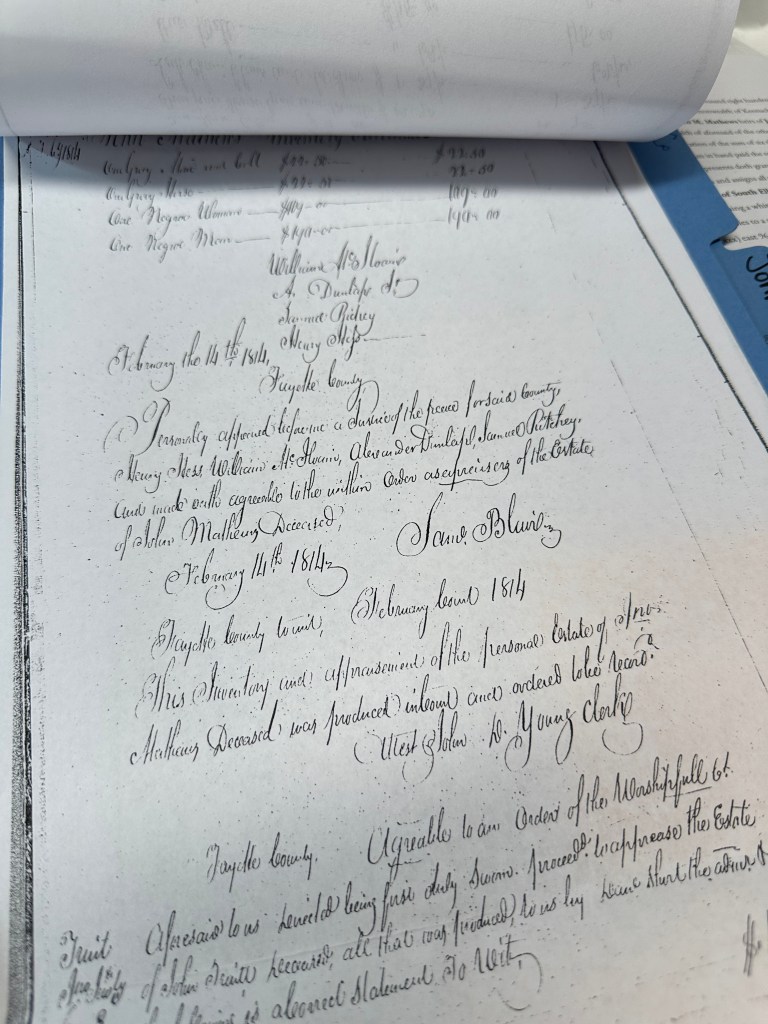
ESTATE INVENTORY February 1814: John Mathews, deceased – This confounds me because his recorded death date is December 1814. So, was there more than one John Mathews in Fayette County?
DEED November 10, 1818: George Moffett for Mathews, Joseph, William H. & Caleb.

A deed of indenture was written in 1818 between George Moffett (again with the Moffett name and further research needed) and the three heirs of John Mathews for $6,570 along with 120 acres of land in Fayette Co on the waters of South Elkhorn. Another deed references being part of a “settlement” lying in Fayette Co on Davey’s Fork, a branch of Elkhorn. The General Index references David’s Fork.

My Dad, who trained as a surveyor while attending UK engineering school, provided his analysis of the land as described in the deed. To his calculations, the parcel exceeded the 100 acres noted in the deed. With so many references to ephemeral landmarks – black walnut, elm and buckeye, it might be virtually impossible to determine exactly. Or that is his assessment. He did sketch the shape, distance and degrees.

The culminating depiction through these three documents appears consistent. As best I can estimate, their home was near present-day Keeneland and the Kentucky Castle, perhaps somewhere along US-1967 (the year I was born, by the way). I fear that will be a much bigger undertaking that may end up inconclusive. It is on the list for later.

This parcel of land crossed over into Woodford Co and adjoined the land of Sarah (Mathews) Price, who had remarried in 1816 to Larkin Price. It appears Sarah had five children by Price, including Larkin Foster Price, a noted lawyer, state legislator and Judge in Texas who is buried in Alamo Masonic Cemetery, San Antonio, TX.

It is possible Sarah’s mother, Margaret Moffett, died in Woodford Co that same year and possibly the same month as the marriage. What are the circumstances for Margaret’s death? It is very easy to get your head turned around in trying to navigate the McDowell and Moffett families. More on that to come.

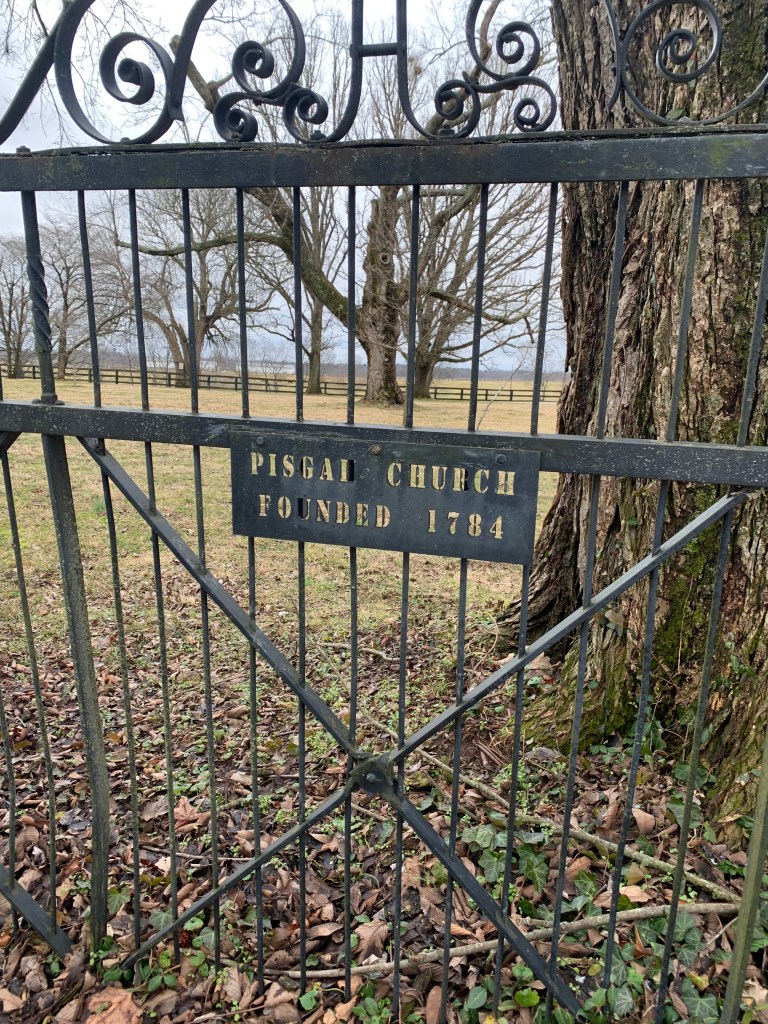
Sarah Mathews Price is buried in the Pisgah Presbyterian Church cemetery, Versailles, Woodford Co, KY, between John Mathews, her first husband, and Larkin Fahr Price, her second husband. She outlived them both, so she had the final say.
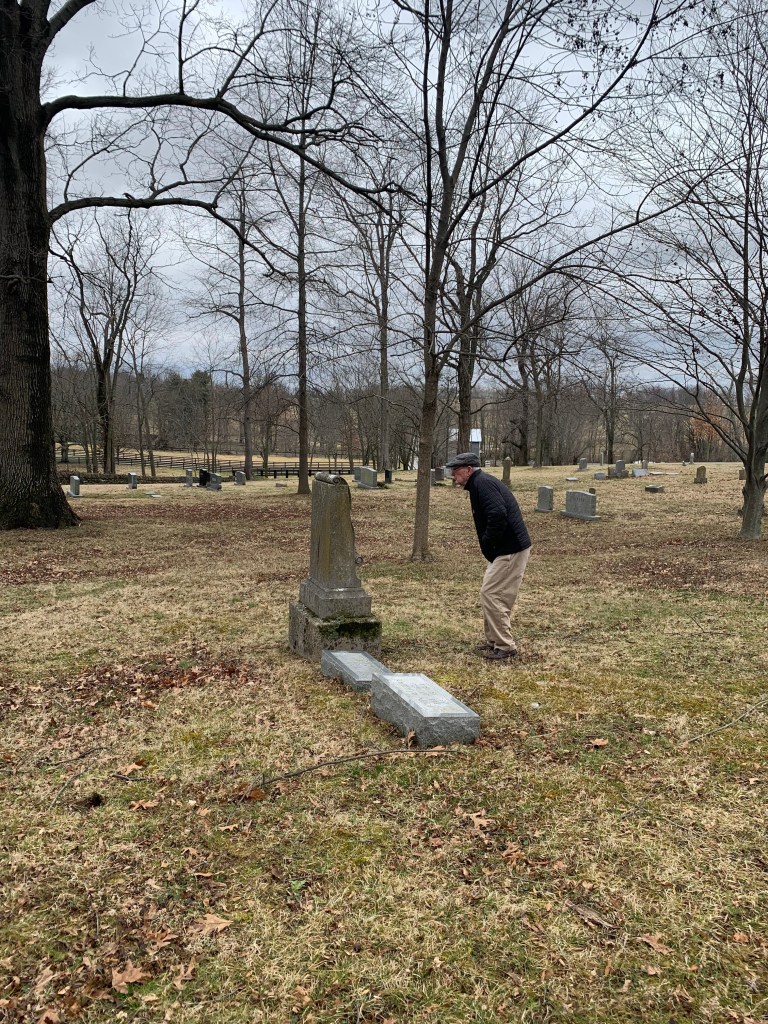
My Dad with me on a recent research trip who was surprised to find Happy Chandler’s headstone as we wandered. After looking around a good while in fairly cold temperatures, we found the graves of John Mathews and Sarah McDowell Mathews Price, his great-great-grandparents. I do not think my Dad had ever been to their graves before this day. The taller, much older headstone belongs to Larkin Price, Sarah’s second husband. Both John and Sarah’s headstones have been updated. My question: by whom and when?

This is where I have paused. I feel the need to have more proof before I move beyond this generation. If the details I’ve compiled from records are accurate, Sarah’s parents’ families – the McDowells and the Moffetts – were Patriots and Revolutionary War heroes. Seeing the “McDowell” and “Moffett” middle names of the children supports the theory that Sarah was, in fact, from this same prominent family. But, I continue to explore these connections for additional confirmation.
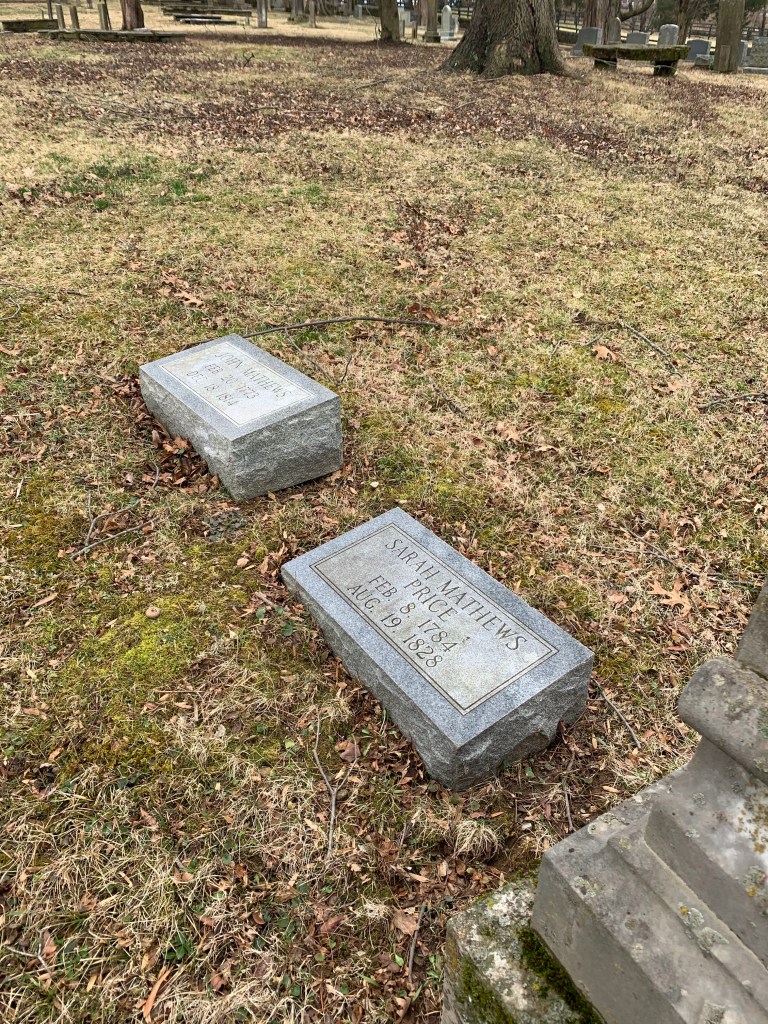

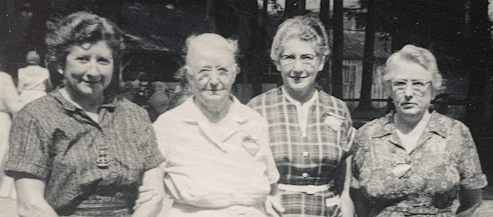
PHOTO: The Corman Carers

You might say educating is in my blood and these women were paramount in my own formation. Educators, living their Christian service and love instilled by the Shaker-educated youth of Martha Jane Bradshaw Corman, mother, and three of her daughters – Madeline, Viola & Fanny Dean. Two of the sisters taught school at the elementary and middle grades in northern Kentucky while the other, my grandmother, taught in one-room school houses throughout the Bluegrass region of Kentucky, specifically Jessamine County, with names like Sweet Home and Oak Hill.

Fully enjoying summers traveling, they invited the grandchildren-age generation of cousins on their annual summer trips across all these United States. The ORIGINAL aunt camp (*credit: S. C. Mathews – I see you Pebby). And, the original Ya-Ya’s, as we say in our family.

Photo: (left to right) Iva Madeline Corman, Martha Jane Bradshaw Corman, Viola Josephine Corman, and Fanny Dean Corman Mathews, my grandmother.

I remember visiting Frankenmuth, Michigan, as well as author and artist Gwen Frostic’s studio/visitor center in Benzonia. I have a beautiful collection of her work gifted to me, purchased by me and bequeathed to me through the estates’ transitions. It is on that trip with Aunt Vi & Aunt Madeline that I began with Christmas tree ornaments collecting as mementos from my travels.

It feels as though caring is woven in my DNA and was nurtured along by simply spending time with my great-aunts. My grandmother passed when I was in 4th grade living in Pittsburgh, PA, and my memories with her are fuzzy. When I look around my home, I pause to appreciate the things from my family, much of which ties back to them. Any artifact’s value perhaps felt priceless only to me, ultimately. It is the STORIES I crave and these hand-me-downs bring the memories and my soul to rejoice. I want to protect and preserve.

Maybe my heart’s call as service to others honors my ancestors, lives out in legacy. I can confirm I am a lifelong learner – and, most often the hard way. But, if it comes from the heart, is it ever wrong? Let me tell you, if you keep with these ancestry storylines I’m putting down – along the way, your heart will ache. Fair warning.


But, let’s first take a moment to reflect with some levity. Where my educators AT?!

Check out this excerpt from my WKU folk studies professor William Lynwood Montell’s 2011 publication, Tales from Kentucky One-Room School Teachers:

In 1872, the Kentucky State Legislature formally mandated its nine “Rules for Teachers”:

  1. Teachers each day will fill lamps, trim the wicks and clean chimneys.
  2. Each morning teacher will bring a bucket of water and a scuttle of coal for the day’s session.
  3. Make your pens carefully. You may whittle nibs to the individual taste of the pupils.
  4. Men teachers may take one evening each week for courting purposes, or two evenings a week if they attend church regularly.
  5. After ten hours in school, the teachers may spend the remaining time reading the Bible or any other good books.
  6. Women teachers who marry or engage in unseemly conduct will be dismissed.
  7. Every teacher should lay aside from each pay a goodly sum of his earnings for his benefit during his declining years so that he will not become a burden on society.
  8. Any teacher who smokes, uses liquor in any form, frequents pool or public halls, or gets shaved in a barber shop will give good cause to suspect his worth, intention, integrity and honesty.
  9. The teacher who performs his labor faithfully and without fault for five years will be given an increase of twenty-five cents per week for his pay, providing the Board of Education approves.

Okay, with so much to unpack here, is it even possible? Take a moment. Read it again. Read it aloud to someone. I wonder how much of this was still codified when my grandmother was a one-room school house teacher almost 50 years later.

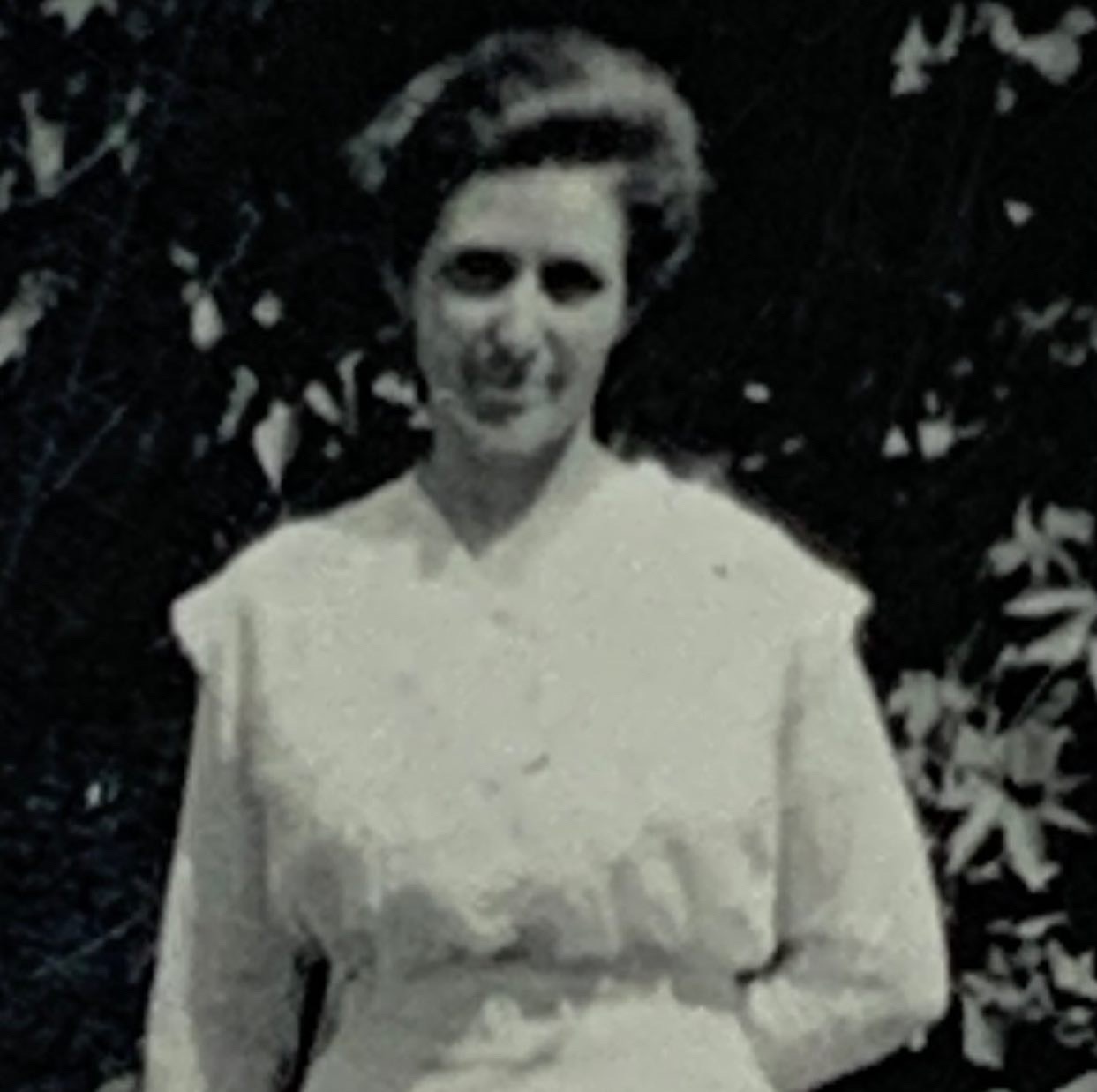
Martha Jane Bradshaw (1881-1963), born Mercer Co, KY.

paternal great-grandmother

Oh, my Martha Jane. Her story will break your ever-loving heart. She lost her mom when she was five years old. She and her sister were raised by Shakers at Pleasant Hill, KY. Plucked suddenly from that idyllic, utopian children’s life to then carrying the weight of consummate caregiving for a family in crisis.

She was brought to apply all the learning of Shakers care full-time for the family of her eldest sister, Mary Bell Bradshaw Murphy. Martha was thirteen years younger than her sister, who needed help even before her mental breakdown.

Martha Jane broke off a romance after she was scorned by the mother of the man she loved. Martha Jane then married Surber Corman, a young widower with two small children after the recent tragic loss of their mother.

Martha Jane endured burying babies and children from more than one angle. She endured harsh conditions. And, her own tragic end is hard to conceive with the cause of death noted as “2nd & 3rd degree burns over 60% of her body,” according to the KY death certificate.

Traumas and taking on the yoke of someone’s tragedy lives in my DNA. I don’t need 23&Me to tell me that, even if they could. I can think of repeat experiences that fit that depiction.

More on Martha Jane Bradshaw in S1:E 23-E24-E25, coming later.

S1:E1 ~ “And now…Whose Corman are you?”

In the mid 1970s, retired school teacher Fanny Dean (Corman) Mathews self-published a compilation of genealogy research she had conducted over many years. The nearly 200-page publication was the product of building on a fellow kinsman’s tree published in 1916 Carlisle PA by Charles Cornman.

When I think of how she conducted her research in contrast to the modern relative ease for finding resources on the Internet, I am all the more inspired by her work and the tenacity that must have been required. She wrote letters – no such thing as email then. [Child, can you EVEN imagine it?] Her focus appears to have been recording the demographic details – births, marriages, siblings, deaths, locations, etc. As it was, she was working with knowledge of two of her own 32 great-grandparents, if not more.

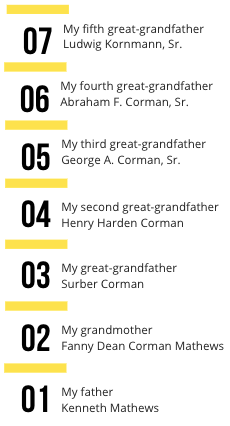
The Corman surname is widely known throughout central Kentucky and has evolved from the original spelling – Kornmann. The pioneer ancestor of this paternal family tree branch was born in 1713 near Munich, Germany. At 24 years old, he emigrated to America – sailing from Rotterdam and landing in Philadelphia in 1737. Ludwig Kornmann, Sr. and his wife were early settlers and eventually, they made a home in Lancaster, PA. Their seventh child served under Gen. Washington in the notorious winter of Valley Forge.

Their eleventh child and my direct ancestor, son Abraham Cornman, Sr., arrived in Jessamine Co, Kentucky and had thirteen children of his own – five of whom are mapped in the two Kornmann-family tree publications. Numerous resources in Jessamine Co KY archival material indicate these Corman siblings lived in the same vicinity on Jessamine Creek three miles southwest of Nicholasville.

As Abraham of The Bible and the stars of the sky, the Abraham Corman family prospered and multiplied. An enclave of German Protestants representing other surnames of my family tree included Earthenhousers, Easleys, Funks, Grows, Rhorers, Rices, and Yosts. These “United Brethren” as they were known were members of the Morovian Church. The original Morovian Church, located on present-day Short Shun Pike, was also the site of a school.

Abraham Sr.’s third child, son George A. Corman, Sr., served as a private for Kentucky’s volunteer Militia in the War of 1812 and fought along with his younger brother, John, in the Battle of River Raisin. John Corman, just fifteen years old, has been cited as firing the first shot at this conflict.

Unlike the families before him, my paternal great-grandfather, Surber, was an only child. This will continue to be a question that I seek to answer in my research. Surber inspired my grandmother Fanny Dean – along with her siblings – to serve as active members of the numerous Corman Family branches quite literally spread out across the United States. The annual Corman family reunion was a significantly attended occasion bringing travelers from near and far. I feel a kind of melancholy that we do not still gather.

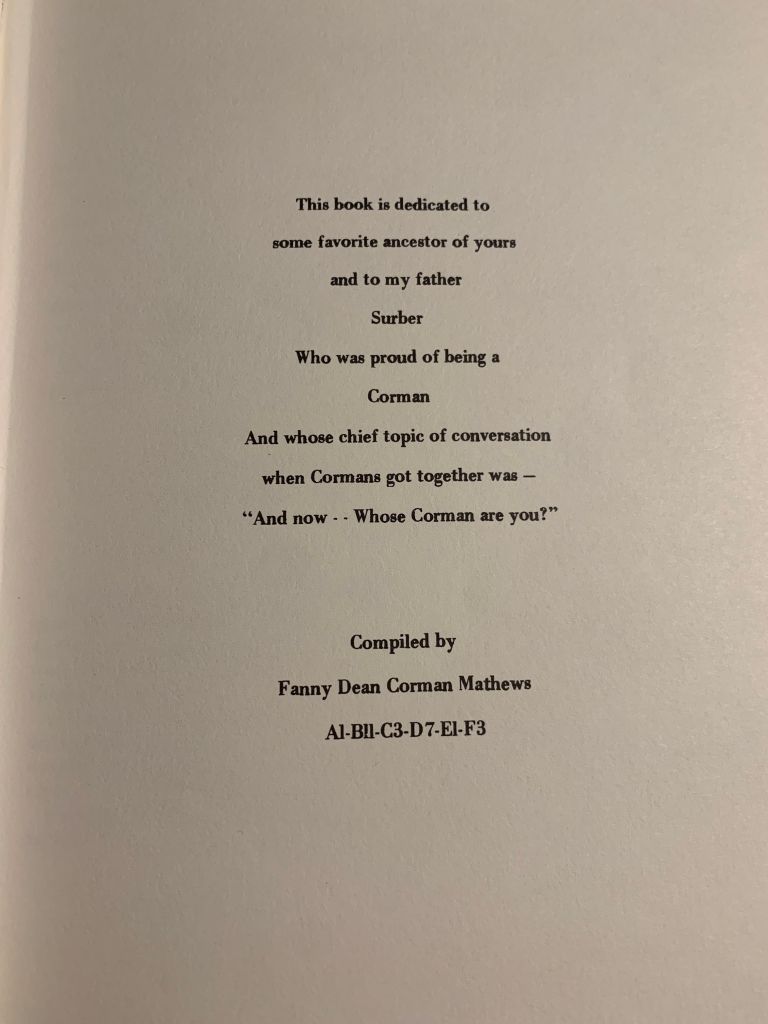
Forward from “Whose Corman Are You?”

“This book is dedicated to

some favorite ancestor of yours

and to my father

Surber

Who was proud of being a Corman

And whose chief topic of conversation

when Cormans got together was —

“And now…Whose Corman are you?”

Compiled by

Fanny Dean Corman Mathews

A3-B11-C3-D7-E1-F3

My grandmother was a voracious reader and I suspect she went to the library far more frequently in a week than to church. I grew up knowing of her book. And, it delighted little me to no end that my name and the names of family members appeared in the book. It was big in my little world and I was somebody in a way that had not been validated as such before. Fast forward to today, this publication has taken on a different significance. It is a road map. With fresh eyes, I read Fanny Dean’s call to action on the inside cover, I think of the 128 individuals that were my fifth-great grandparents and all their stories. It excites me to think of all the possibilities waiting to be discovered.

As if her own voice speaking these words to me –  

“It is hoped that this information will make it easier for anyone who wishes to carry the work further.”

I hear you calling, Fanny Dean.

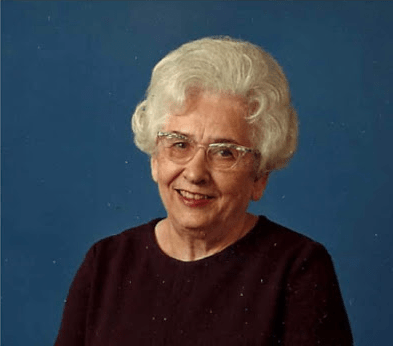
Fanny Dean Corman Mathews (circa early 1970s)

Why do you shake?

I’m from the shaking Quakers

If not by The Blood

yet formative all the same

pneumonia took Momma

when only forty four

her body rests everlasting

on the Old Kitty Bradshaw place

well-known in Mercer County

Martha, thirteen days from turning five

and little Susie, only two

seventh & eighth of Fannie’s babies, after all

What can the men of the house do

Please raise these young’uns,

entrusting them to your care

as I tend to your Pleasant gardens

asking not to be forced into your ways

I ask that they be loved

their primary formation spent in Centre utopia

lessons deeply, profoundly echoing through generations.

Resonating over 130 years,

So dance on you dervish

whirling to the glory of all

before, after, below and above

proof for what we carry in our DNA.

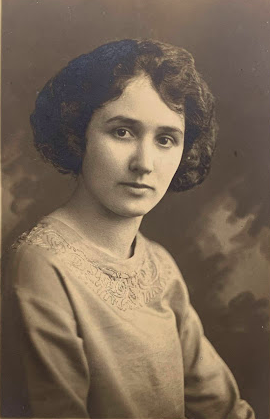
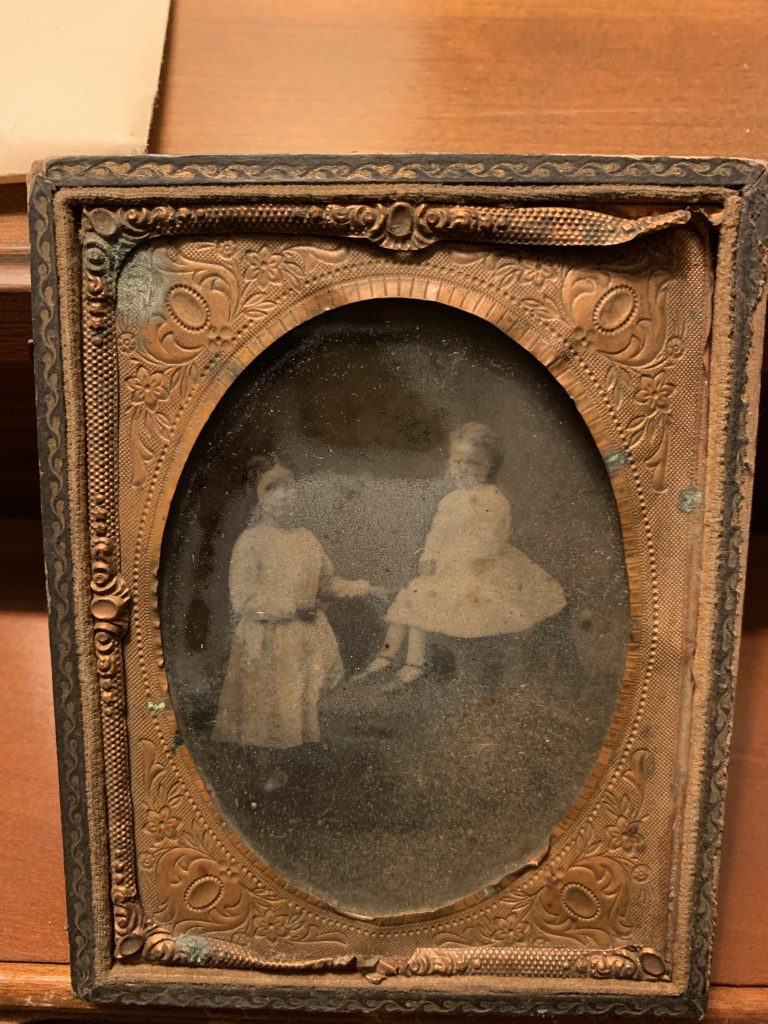
Sisters Martha Jane Bradshaw and Susie “Mattie” Bradshaw, estimated soon after the 1886 death of their mother, Frances Jane Murphy Bradshaw (framed in copper with all elements fused together such that the image cannot be separated from the packaging that is potentially more than 130 years old)